Pituitary pars intermedia dysfunction (PPID) is one of the most common endocrine disorders equine practitioners encounter, but not every case follows the same playbook. In this episode of Daily Vet Life, Phoebe Smith, DVM, DACVIM, walked listeners through an unusual case that challenged conventional thinking about PPID, insulin dysregulation, and long-term management.
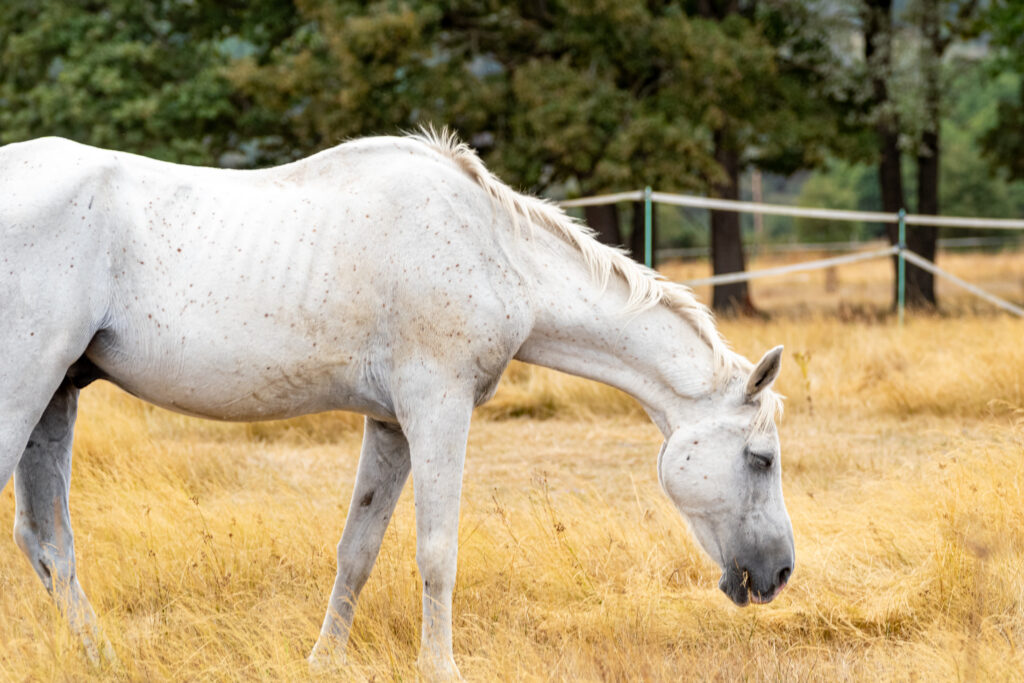
The horse initially came to Smith as a referral case. He had already been diagnosed with PPID, was receiving an FDA-approved pergolide product, and had a decade-long history of recurrent laminitis. However, the horse presented with a puzzling combination of findings: He was thin, maintained on an appropriately low nonstructural carbohydrate (NSC) diet, had a normal ACTH concentration, yet continued to have persistently elevated insulin levels.
The question top of Smith’s mind was: “Why do I have this skinny horse on an appropriate diet with his insulin that I can’t get to budge?”
The horse wasn’t severely painful but had a history of getting foot-sore about three weeks into each shoeing cycle. “That was a tip-off that there was something cyclical happening,” she noted.
So, Smith recommended measuring triglycerides to determine whether the horse’s body was functioning as though it were in a negative energy balance, mobilizing fat to feed itself despite eating an appropriate diet throughout the day. The results confirmed moderately elevated triglycerides, supporting her theory.
With dietary management already optimized and exercise limited by chronic laminitis, Smith elected to use the sodium-glucose cotransporter-2 (SGLT2) inhibitor ertugliflozin. Within five days, the horse’s insulin levels dropped and his comfort improved.
The improvement, however, wasn’t permanent. After about three months, the horse became slightly sore again, and a recheck showed insulin concentrations had increased despite continued therapy. Smith experimented with dosage adjustments before discovering that this individual horse responded best to intermittent “on-off” administration of the medication, allowing insulin sensitivity to return while carefully monitoring triglyceride concentrations.
“It’s a very individual thing,” said Smith. “His body responded to the SGLT2 inhibitor clearly needing time off in order to become sensitive to it again. That’s a little bit different from most cases that I work with.”
She said this case also reinforced another important point: Not all insulin-dysregulated horses are overweight.
“The non-obese insulin dysregulation is one really curious piece,” she noted. “We usually think those horses are fat, and most of them are. A small number of insulin dysregulation cases are skinny.”
Ultimately, Smith increased the horse’s pergolide dosage based on his persistent clinical signs despite normal ACTH values, which helped improve his hair coat and other manifestations of PPID. He continues to do well on the current management plan.
For practitioners facing similarly perplexing endocrine cases, Smith encourages collaboration with internists and frequent reassessment.
“Work with the owner to understand that in order to help this (atypical) horse, I’m going to need to do repeat bloodwork to figure this out,” she said.
As veterinarians increasingly monitor insulin concentrations and more tests become validated, Smith believes these “atypical” presentations might prove more common than previously recognized.
Listen to the full episode to hear Smith share more clinical insights and practical strategies for diagnosing and managing complex PPID and insulin dysregulation cases.
About Dr. Phoebe Smith
Phoebe Smith, DVM, DACVIM, owns Riviera Equine Internal Medicine and Consulting in Santa Ynez, California. Upon receiving her veterinary degree from Auburn University in 1997, Dr. Smith completed an internship at Alamo Pintado Equine Medical Center in Los Olivos. Following two years in private practice, she completed an internal medicine residency at the University of California, Davis, while concurrently working as a relief veterinarian with Loomis Basin Large Animal Clinic. After achieving board certification with the American College of Veterinary Internal Medicine in 2003, Dr. Smith rejoined Alamo Pintado as an internal medicine specialist. In 2007, she joined the faculty at The Ohio State University as an assistant professor of equine internal medicine until establishing her current practice in 2010.
Related Reading
- Updates on Equine Endocrinological Disorders: PPID and EMS
- Updates on SGLT2 Inhibitors for Horses
- How Endocrine Disorders Impact Equine Athletes
Stay in the know! Sign up for EquiManagement’s FREE weekly newsletters to get the latest equine research, disease alerts, and vet practice updates delivered straight to your inbox.