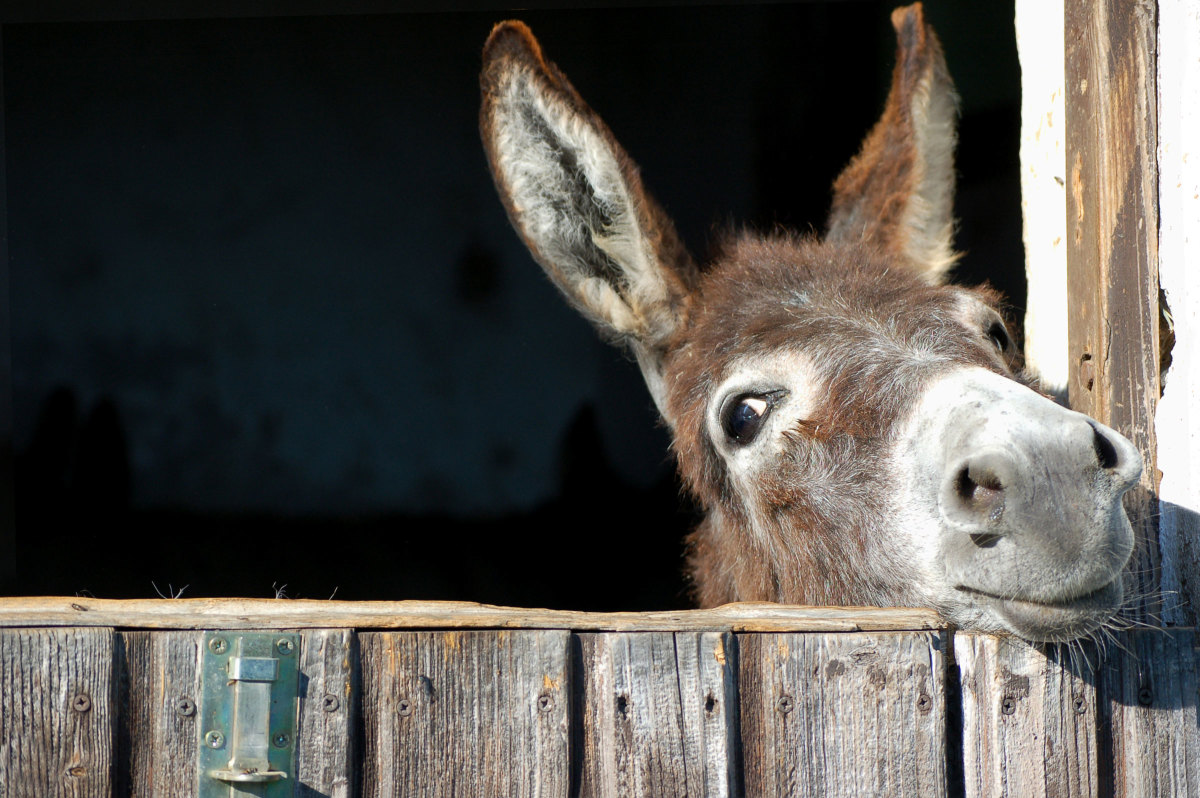
A prospective study aimed to characterize the behavioral responses of donkeys to acute surgical pain. The study was titled “Post-operative pain behavior associated with surgical castration in donkeys (Equus asinus).” It was authored by Maria Gláucia Carlos de Oliveira, Stelio Pacca Loureiro Luna, Talyta Lins Nunes, Paulo Ricardo Firmino, Amara Gyane Alves de Lima, Josiel Ferreira, Pedro Henrique Esteves Trindade, Raimundo Alves Barrêto Júnior, and Valéria Veras de Paula.
Forty healthy adult intact male donkeys ranging from 2 to 14 years of age underwent open castration under inhalant general anesthesia following premedication with xylazine and induction with guaiacol glyceryl ether and thiopental. Donkeys only received analgesia 4 hours following recovery from anesthesia, consisting of 1.1 mg/kg flunixin meglumine, 10 mg/kg dipyrone and 0.2 mg/kg morphine administered intravenously, repeated every 24 hours for 3 days.
The donkeys were filmed for 30 minutes in their individual stalls before castration (M0), 3.5-4 hours (M1), 5.5-6 hours (M2) and 23.5-24 hours (M3) after recovery from anesthesia. In an attempt to exclude the influence of flies on donkey behavior, six apparently pain-free donkeys were assessed before and after their stalls were mucked out. The video footage was assessed by the same person, and differences in frequency of various behaviors at the four timepoints was analyzed.
Twenty-five different behaviors were observed during the 80 hours of video analysis. Lifting of the pelvic limbs was the main behavior exhibited by donkeys in pain; occurring more frequently during M1 than the other time periods. Eating and water intake increased after analgesia (M2), and time spent in locomotion did not change during the four time periods. Behaviors seen in horses such as flank-watching, kicking the abdomen, pawing the ground and moving the head were not observed.
Bottom line: Lifting the pelvic limbs was the only specific pain behavior after castration in donkeys.
You can read or purchase access to this article from the Wiley online library.