This article originally appeared in the Winter 2025 issue of EquiManagement. Sign up here for a FREE subscription to EquiManagement’s quarterly digital or print magazine and any special issues.
How do you decide what prices to charge for your services? Let’s look at three common methods of price-setting: competition-based, value-based, and activity-based.
Competition-based pricing allows you to be “in the ballpark” but makes you vulnerable to damaging price wars between practices, which can seriously damage your financial security. This could involve phoning neighboring practices as a “mystery shopper” to gauge what your colleagues are charging, using benchmarks when they become available, or randomly deciding what you are worth on an hourly basis by comparing yourself to an attorney’s or a plumber’s hourly fees. Maybe you simply decide to copy what you remember from the last practice where you worked. Unfortunately, this method can leave you underprepared for the costs your practice incurs.
Alternatively, you might decide to price a service according to what you think a client is willing to pay based on its value to them—this is called value-based pricing. There is certainly a place for increasing prices for services clients believe are most important or necessitate a higher skill level, such as emergency care and lameness diagnosis, but being sure you are meeting your financial obligations and goals requires more discernment.
For overall fee setting, the best approach is likely activity-based pricing, which considers your overhead as an hourly cost in determining the necessary minimum hourly fee for your professional time. This allows you to set prices that are in relation to your financial costs for providing service.
Putting Activity-Based Pricing Into Practice
The basic concept of activity-based pricing is that the actions needed to bring something to market for consumers use up resources to produce an output (service). Services differ widely in activities required and resources consumed. To calculate a price based on activity, first determine the hourly cost of overhead. Overhead includes fixed costs that do not change much with increases or decreases in services provided or revenue earned. Fixed costs include administrative costs, collection costs, facility and equipment costs, and staff salaries and benefits. Variable costs include veterinarians’ compensation if they are paid on production and cost of professional services, also known as COPS (cost of drugs, supplies, lab, etc.). Of course, some items, such as gasoline and overtime for veterinary assistants, might vary with your workload, but you can still get a good idea of your overhead costs without considering these.
To calculate your business’s overhead, find the total expenses on your profit and loss statement (P&L), and subtract the veterinarians’ compensation (if paid on production). If the veterinarians are paid a straight salary, then those salaries are fixed costs and not subtracted. The remainder is the fixed cost of being open for business, or your overhead.
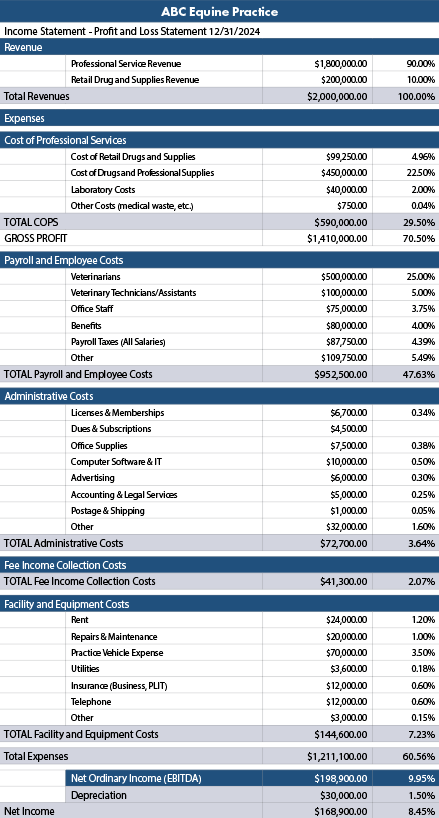
For example, using figures found on the sample P&L statement:
- Total Expenses = $1,211,100
- Veterinarians’ Compensation = $500,000
- $1,211,100 – $500,000 = $711,100
- Fixed Costs (Overhead) = $711,100
- % Overhead (Overhead/Total Revenue) = 35.55% ($711,100/$2,000,000)
Next, determine the number of work hours during which veterinarians are available to earn revenue to pay the overhead expenses. To make the calculations in the example simpler, let’s assume an average work week of 50 hours, with each doctor working 50 weeks each year. Thus, each doctor works a total of 2,500 hours. If there are four veterinarians in this practice, each working 2,500 hours, a total of 10,000 hours are available for earning revenue.
However, depending on the workflow, practice type (ambulatory vs. hospital), number of support staff, and efficiency of the practitioners, a varying proportion of those work hours will not be billable. Many tasks eat up veterinarians’ time but do not directly add to revenue, including driving between appointments, restocking the truck, making callbacks, preparing lab submissions, tending to practice management, attending continuing education, etc. You can roughly determine what percentage of practice hours are billable by keeping a log for a week of your working hours—every 15 minutes, record whether what you are currently doing is billable. If you have a multidoctor practice, all veterinarians must record their activities to determine their percentage of billable hours. Because equine practice is seasonal, you’ll need to repeat this exercise each quarter (or month, if you want more granularity) to get an accurate answer.
Let’s assume in our example that 50% of hours are billable, so the 10,000 hours spent at work include 5,000 billable hours:
- $711,100 overhead/5,000 hours = $142.22 per hour
- $142.22 per hour/60 = $2.37 per minute
- $2.37 per minute = Cost of Overhead
It is important to note that this hourly cost of overhead does not include the Cost of Professional Services (drugs, supplies, laboratory costs, etc.), doctor compensation, profit, and discounts or failure to capture all revenue. Failure to capture revenue occurs when you perform services or dispense medications but forget or choose not to add them to the invoice.
In our example, let’s assume we want a profit of 12%, doctor compensation at 25%, and we either discount or fail to capture 5% of our revenue.
To calculate the minimum price per hour of professional veterinary time, use this equation:
Minimum price per hour for professional time = Cost of overhead per hour/(1 – profit % – veterinary compensation % – discounting costs %)
In our example, the equation is expressed as:
$142.22/(1 – 0.12 – 0.25 – 0.05) =
$142.22/0.58 = $245.21 minimum price per hour for professional time.
Of course, because this is a price for professional time, it does not include the Cost of Professional Services. You must add these to the invoice separately for each service. Emergency fees, farm calls, and equipment use would be additional fees at many practices when considering invoice totals after calculating the amount of professional time.
Applying Your Minimum Hourly Rate to Veterinary Service Fees

Remember, this minimum price per hour for professional time is just that—the minimum you must charge for your time to cover expenses, pay your veterinarians (including yourself), and have a reasonable profit. This minimum hourly rate might be much less than what you charge, and that is fine. The calculation is a tool to help you manage your revenue and profit.
However, because you might not always be able to charge this calculated minimum for a service, you must make up the difference on other services. Most practices have lower prices for “price-shopped” services because they recognize them as commodities. These are services commonly sought by horse owners, readily available, and with little difference in results regardless of which vet performs them, such as vaccinations and Coggins tests. When you price commodities competitively to drive more client business, you must price less frequently performed services higher to make up for the profit loss. If you think of profit as a pile of sand distributed among buckets, you have the same total amount of sand (profit), but it is distributed in different amounts among buckets (service types). The buckets for services such as emergencies, lameness diagnosis, and treatment for illness or injury must have more sand (profit). You can usually price these services higher without difficulty because clients value them more.
To demonstrate the concept, think about the pricing of a Coggins test. Imagine you do a Coggins on a new horse one of your clients just purchased. You draw blood, take photos, and collect information for submission to GlobalVetLink. It takes 10 minutes to finish this work at the farm. When you get back to the office, you spend another 15 minutes packaging the sample for pickup and entering the information and photos into GlobalVetLink. The lab charge for running the Coggins is $15, and the GVL adds $10. If you work at the practice whose minimum professional price per hour was calculated as $245.21, what should the minimum invoice be for this service?
- Professional price per hour = $245.21/60 minutes = $4.09/minute
- Draw blood, take photos, collect horse and owner information = 10 minutes
- Prepare submission to GlobalVetLink = 15 minutes
- 25 minutes total time x $4.09 = $102.25
- Laboratory fee = $15 + $10 GVL
TOTAL: $127.25
Why wouldn’t you charge that? Because Coggins are “shopped” items, and clients might deem your practice overpriced. But by reducing the cost of this common service, you must make it up by increasing the fee for a more valued service.
After calculating the minimum price per hour for professional time that will achieve your compensation and profit goals, look at what percentage of your revenue each profit center produces, evaluate the value clients place on that service, and consider what price per hour for professional time each type of service requires to balance the contributions of commodities and more valued services. This will assist you when the practice needs to make fee changes to offset inflation and expense increases. By apportioning the total needed increase among the different activities (profit centers) that bring revenue into the practice, you can craft a pricing strategy to achieve your revenue goals by adding more robust increases to the most highly valued services and modest increases to the commodity services.
Take-Home Message
Thinking about fees in a mathematical manner using profit and loss statements can help you achieve financial security and success. In times of economic uncertainty, this method allows you to make deliberate decisions based on your financial obligations while meeting client and patient needs.
Related Reading
- Should I Buy This Piece of Veterinary Equipment?
- Business Briefs: Handling the Financially Stressed Client
- The Business of Practice: Compensation for Equine Veterinary Associates
Stay in the know! Sign up for EquiManagement’s FREE weekly newsletters to get the latest equine research, disease alerts, and vet practice updates delivered straight to your inbox.
![[Aggregator] Downloaded image for imported item #19733](https://s3.amazonaws.com/wp-s3-equimanagement.com/wp-content/uploads/2026/04/31141855/EDCC-Unbranded-19-scaled-1-768x512.jpeg)
![[Aggregator] Downloaded image for imported item #19998](https://s3.amazonaws.com/wp-s3-equimanagement.com/wp-content/uploads/2026/05/29122748/EDCC-Unbranded-5-scaled-1-768x512.jpeg)