This article originally appeared in the Spring 2025 issue of EquiManagement. Sign up here for a FREE subscription to EquiManagement’s quarterly digital or print magazine and any special issues.

Some veterinary workplaces now employ up to five generations of veterinarians, and communication between generations can be difficult without some understanding of their differences. The newest generation in the workforce, Gen Z, also known as the Zoomers, was born between 1997 and 2012 and is currently 12-28 years old. They number 74 million and are expected to be 30% of the workforce by 2030. As the second-youngest generation, the Zoomers have Millennials coming before them and Generation Alpha after.
A Snapshot of Gen Z’s Demographics
Demographically, Gen Z is significantly more racially and ethnically diverse than previous generations, with a much lower percentage of non-Hispanic whites, a larger share of Hispanic/Latino people, and a more prominent representation of Asian and Black populations. Gen Z is the last generation where a majority identifies as non-Hispanic white and has a higher percentage of individuals identifying as multiracial than any previous generation. Gen Z is also more likely to have at least one immigrant parent compared to older generations. In veterinary medicine, and particularly equine veterinary medicine, there are very few non-white doctors. Intentional efforts to encourage a more diverse population of veterinarians will be important in the future to attract this generation to the field.
Like every generation, Gen Z’s behaviors are shaped by the events they encountered while growing up. Zoomers have experienced the onset of climate doom, multiple school and other mass shootings, isolation caused by the COVID-19 pandemic, fears of economic collapse, and increasingly hateful political division. Some were in nursery school or kindergarten during 9/11.
For many of the Zoomers, their early years included the country’s first Black president and the legalization of gay marriage. Many also grew up amid nontraditional family structures such as single-parent households, multiracial households, or households where gender roles were blurred. As a result, they are more accepting than previous generations of differences in race, sexual orientation, or religion. Over half of Gen Z believes in more than two genders, compared to about a third of all other generations, according to a 2021 Nationscape study.
Gen Z is the first generation that has never known a world without the internet. They are comfortable with technology and eager to use it for a multitude of purposes. By 2012, half of Americans owned a smartphone, just five years after the iPhone was introduced. The resultant change in communication, social life, entertainment, culture, and even politics has been profound. Zoomers spend an average of 23 hours per week watching video streams. When looking for any kind of information, including world news, they search the internet. They travel in an online world between websites, apps, and social media feeds. Having grown up with ubiquitous social media, Zoomers carefully curate their online presence. Technological change now happens at a rapid pace, and Gen Z expects and applauds that, unlike older generations that have often just learned how to use the previous iteration when they are stymied by a new version.
Entering the Workforce
Generation Z is the most educated generation ever, with 57% of 18- to 21-year-olds enrolled in college in 2022, compared to 52% of Millennials at the same age. Many have an increased interest in trade schools and certifications that can help prepare them for good-paying jobs, perhaps because they experienced the Great Recession. In their employment, they value flexibility and purpose and often prefer having control over their work hours. In 2023, almost half of Gen Z workers earned their living with freelance work as opposed to permanent jobs. The factors they find critical when choosing jobs include work-life balance and respect for mental health concerns. In addition, they are likely to choose the location where they want to live and then find a job, rather than the opposite. Because social media is so pervasive in their lives, the social media presence of a business at which they might consider working is an important tool for judging their compatibility with the culture. In veterinary medicine, creating flexible schedules, offering a supportive culture, and focusing on the laudable purpose of ensuring animals’ health and well-being will help attract this generation. Presenting a clear and consistent brand identity on social media is critical.
Because flexibility is important, Gen Z loves individualized offerings. Companies are turning toward increased customization to please this cohort, allowing them to design the role they want. These young people want to create their own path, and they resonate with words like becoming, belonging, journey, and story. As they become a bigger part of the workforce, businesses will need to offer increasing flexibility and encourage them to create their future by learning new skills and planning for advancement.
Many Gen Zers choose career paths they believe will be less vulnerable to automation, artificial intelligence (AI), or environmental concerns. Once employed, these young employees often push for change, particularly related to workload, the services offered to clients, learning and development, DEI, wellness, social impact, and environmental efforts. Despite this seemingly negative relationship with work, research shows that Zoomers’ sense of identity with and importance of their jobs come second only to friends and family. Their focus on maintaining a positive work-life balance contributes to their strong preference for flexible or part-time work, job-sharing options, and models such as four-day workweeks for full-time employees.
A growing body of survey research echoes the idea that employees in their early to mid-20s want control over how much they work and how much effort they expend. In a 2022 survey by Prudential Financial with more than 5,000 respondents, “43% of Gen Z workers said they went above and beyond in their jobs. More than half of millennials said they did, as did 62% of members of Gen X and 69% of Baby Boomers.” Despite this, a 2022 Gallup survey of about 15,000 U.S. workers shows younger Millennials and Gen Z respondents reported declining levels of job engagement and higher rates of stress than other workers.
Many veterinary practices have experienced Zoomers who do not understand the norms of the workplace, such as showing up on time, communicating face-to-face, and problem-solving. The remote schooling and work during the pandemic made it challenging for some young people to learn how to collaborate, find mentors, and learn professional skills. As a result, many of these workers might struggle with resourcefulness, professional networking, and communication with clients as well as team members.
Gen Z’s Priorities
The Zoomer generation spans a wide range, with the oldest having jobs and sometimes mortgages and the youngest in their preteens. Gen Z members are generally known for their idealism and socially progressive ideas. They believe in doing their part to help prevent additional environment damage that intensifies climate disasters and establish greater opportunities for all. More than any other generation, Gen Z collectively demands accountability and positive purpose, the creation of more opportunities for people of diverse and underrepresented backgrounds, and sustainable practices to preserve the environment. Their purchasing decisions are often an expression of their values and identity. For example, they are drawn to sustainable products and brands and are often willing to pay more for them. They value personalized products and brands that share their point of view on political issues.
In 2023, Deloitte conducted a survey of 23,000 Gen Zers and Millennials across 44 countries to track their experiences and expectations at work and in the world. The results show that environmental sustainability continues to be among Gen Zers’ and Millennials’ top priorities. “It is a personal concern that consistently weighs heavily on them, with roughly six in 10 Gen Zers and Millennials saying they have felt worried or anxious about climate change in the last month.”
Most of them take action to minimize their impact on the environment and feel governments should play a bigger role in addressing climate change and protecting the environment. As a result, Gen Zs and Millennials are pushing businesses to act through their career decisions and consumer behaviors. Among Gen Z members, 46% have already changed or plan to change their job or industry due to climate change concerns, 64% are willing to pay more to purchase environmentally sustainable products, and 25% have stopped or lessened a relationship with a business due to unsustainable practices. Veterinary practices that make an effort to recycle, embrace a paperless office, and explore new options such as carcass composting will likely be attractive to this generation.
Most Millennials grew up during an economic boom, while Gen Zers witnessed their parents struggle financially during the Great Recession. This created a generation driven by the need for security, so they value the stability that comes with conservative spending, stable jobs, and smart investments, despite their desire for choice and self-determination. They continue to be shaped by the economic pressures of a skyrocketing housing market. In 2023, 56% of 18- to 24-year-olds still lived with their parents compared to 19.1% of Millennials aged 25-30 years.
Based on results from the 2023 Deloitte survey, 30% of those surveyed say they do not feel financially secure, and six in 10 live paycheck to paycheck. The cost of living remains their top concern by a wide margin compared to their other leading concerns, which include climate change, unemployment, mental health, and crime/personal safety. Compared to previous Deloitte studies, satisfaction with work-life balance and employer progress on DEI, societal impact, and environmental sustainability have improved. However, “while respondents acknowledge that their employers have made some progress, the majority remain unimpressed with businesses’ societal impact overall. Less than half believe business is having a positive impact on society.” This disappointment could lead Zoomers to participate in more social activism efforts.
Takeaways for Equine Practices
Nearly all Gen Zers want purpose-driven work, and they are not afraid to turn down jobs that don’t align with their values. According to Deloitte, “increasingly, these generations are willing to turn down assignments and employers based on their personal ethics or beliefs. Reasons for rejecting an employer or an assignment include factors such as having a negative environmental impact or contributing to inequality through noninclusive practices, and more personal factors such as a lack of support for employees’ mental well-being and work-life balance.”
Because having a sense of purpose is so important to Gen Z’s workplace satisfaction and well-
being, and the positive difference veterinary medicine makes for animals and their people is profound, practices are well positioned to provide employment to this generation if they can also provide a culture that allows the entire team to thrive.
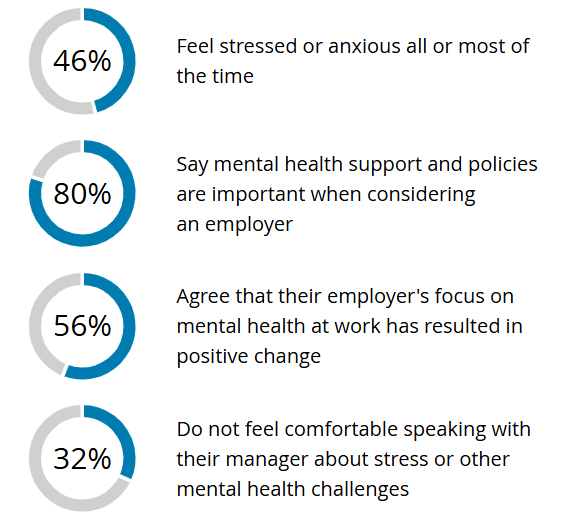
It is concerning that only about half of Gen Zers (51%) and Millennials (56%) rate their mental health as good or extremely good, according to the 2023 Deloitte study. Forty percent of Zoomers and 35% of Millennials reported that they feel stressed all or most of the time, with their job and work-life balance contributing to their stress levels, along with financial concerns, long working hours, and lack of recognition. Equine veterinary medicine certainly checks all those boxes! Recreating practice life to improve these parameters might be paramount in continuing to attract Zoomers to equine veterinary medicine.
Every generation is shaped by their early experiences, challenges, and traumas. Generation Z is no different. As they come into their own, we can expect their impact to change the world as other generations have done before them.
Related Reading
- Leaving Equine Practice: By the Numbers
- Equine Veterinary Sustainability: Creating an Effective Equine Internship Program
- Tides of Change: Equine Veterinarian Retention
Stay in the know! Sign up for EquiManagement’s FREE weekly newsletters to get the latest equine research, disease alerts, and vet practice updates delivered straight to your inbox.
![[Aggregator] Downloaded image for imported item #19458](https://s3.amazonaws.com/wp-s3-equimanagement.com/wp-content/uploads/2026/03/09142618/EDCC-Unbranded-37-scaled-1-768x512.jpeg)