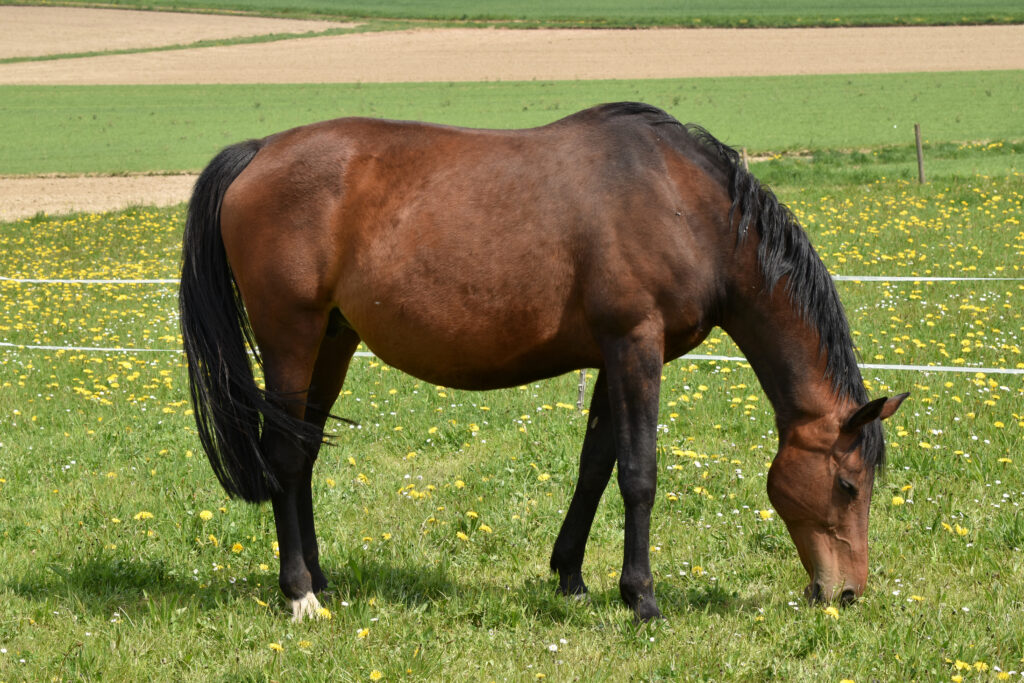
Brittany Middlebrooks, DVM, DACT, a practitioner in reproduction and fertility at Hagyard Equine Medical Institute, in Lexington, Kentucky, sees a large and diverse population of breeding stock—from your normal broodmares and stallions to your once-in-a-lifetime repro cases. The mare she discussed on this episode of Daily Vet Life, however, is the one you’ll probably encounter every breeding season.
The teenage warmblood mare presented to Hagyard after multiple unsuccessful attempts at pregnancy via both artificial insemination and intracytoplasmic sperm injection (ICSI). Middlebrooks pursued several layers of diagnostics to understand what they were dealing with and make a treatment plan going forward.
Culture and cytology revealed two different bacteria that Middlebrooks said she would typically treat with five days of uterine lavages and broad-spectrum antibiotics. But the mare’s cervix would not remain adequately dilated, so she instead administered two lavages and four days of intrauterine antibiotics.
“I was concerned about her hanging onto fluid if I continued to lavage her more than what she was saying that she needed,” said Middlebrooks. “And I suspected that she had some issues with delayed uterine clearance, which is maybe how we got to this point, because she also had some evidence of chronic inflammation on the cytologies that we got back.”
The next step was to perform another culture and cytology on the mare at her subsequent heat cycle to determine if they had adequately treated the bacterial endometritis. However, the mare didn’t cycle normally. Rather than short-cycling, Middlebrooks recommended they give the mare time to come back into heat on her own, then make sure she was clean and cycling normally before breeding. Fortunately, she said, the mare’s owner was under no time constraints and was willing to give the mare as much time as she needed.
When the mare’s uterine culture was negative and cytology showed no evidence of ongoing inflammation, she was ready to breed. As luck would have it, however, the owner’s dream cross was with a stallion locatedoverseas, making frozen semen—which is associated with lower pregnancy rates than cooled shipped or fresh semen—the only option.
While they had two doses of frozen semen, Middlebrooks opted to use only one to try to minimize the mare’s inflammatory response.
“She came into the clinic, ovulated right on time, we bred her very shortly after ovulation, did a post-breeding lavage on her, and infused some platelet-rich plasma to help with uterine clearance and inflammation,” she explained.
They also administered firocoxib and aspirin to help address inflammation and uterine blood flow. “So we did all of those things, and lo and behold, 14 days later we had a pregnancy. It was a little small, but it was there.”
Listen to the full episode to learn how Middlebrooks continued managing the mare’s pregnancy, as well as how to set realistic expectations with clients for breeding success.
About Dr. Brittany Middlebrooks
Brittany Middlebrooks, DVM, DACT, is a practitioner in reproduction and fertility at Hagyard Equine Medical Institute, in Lexington, Kentucky. She grew up in Greenville, South Carolina, and completed her undergraduate at Clemson University. After graduation, she began working at a small animal clinic where her love for veterinary medicine grew. Dr. Middlebrooks attended veterinary school at Ross University School of Veterinary Medicine on the island of St. Kitts, where she also earned her master’s degree studying immuno-contraceptives in Caribbean donkeys. She completed her clinical year at U.C. Davis, where she then stayed onfor an Equine Field Service Internship. Following her internship, she went to Colorado State University for a residency in Equine Theriogenology. She completed her residency and became a Diplomate of the American College of Theriogenologists in July 2024. In her spare time, Dr. Middlebrooks enjoys running, traveling, horseback riding, trying new restaurants, and being outdoors with her husband and their three dogs.
Related Reading
- Laser Ablation of Endometrial Cysts Can Improve Mare Pregnancy Rates
- Responsible Use of Antibiotics in Equine Reproduction
- Managing Pregnant Mares From Conception to Parturition
Stay in the know! Sign up for EquiManagement’s FREE weekly newsletters to get the latest equine research, disease alerts, and vet practice updates delivered straight to your inbox.