In this episode of the Disease Du Jour podcast, Lindsay Goodale, DVM, discussed the intersection of equine welfare and veterinary medicine. She talked about aspects of equine welfare that are overlooked, what it means to give a horse agency, strategies for communicating welfare-based recommendations to clients, and more.
This episode of Disease Du Jour is brought to you by Equithrive.
How Should Equine Welfare and Veterinary Medicine Intersect?
Goodale explained that equine welfare and veterinary medicine inherently intersect. She mentioned the Five Domains Model, a science-based framework for assessing animal welfare. This framework has five key areas: nutrition, environment, health, behavior, and mental state.
“Veterinary medicine is mostly focused, at least traditionally, on that third domain of health,” Goodale said. “I think there is increasingly some acknowledgement, though, that we can better serve our patients if we also consider the other domains.”
Goodale emphasized that veterinarians don’t need to be experts in all these domains to make a difference. She encourages her students to identify areas of interest. “For me, I am super interested in behavior especially, and that’s really helped me quite a bit in terms of even just basic interactions with horses,” she said.
Giving Horses Agency
Agency is a big piece of many animal welfare discussions. Goodale said the easiest way to understand agency is through the three Cs: choice, control, and challenge.
Choice could mean allowing the horse to decide what or when it wants to eat. Control means giving the horse the ability to effectively control outcomes by having consistent expectations. Challenge should be positive, not scary. It could involve giving the horse small training tasks to navigate, which helps build resilience.
Goodale acknowledged that it can be challenging to apply these principles in daily practice. “But I think having a conversation with the owner, especially at annual visits where you have time to chat, can be super helpful,” she said. “Encouraging owners to learn about and be empowered to use positive reinforcement training is a big way to increase the horses’ agency.” She said this can help keep veterinarians safer during appointments.
Assessing a Horse’s Welfare State
Goodale emphasized that veterinarians are already good at assessing horses’ physical health. “If you’re interested in a more holistic assessment of their welfare, there are a lot of ways you can do that,” she continued. She recommends collecting a thorough history and observing the horse in its environment. Things to look for include stereotypic behaviors and interactions with humans.
“A big one that’s part of a lot of formal welfare assessments is if you approach the stall, what does the horse do?” she said. “The ideal that gives us a sense that they have had positive interactions with people is if they approach the front of the stall door.”
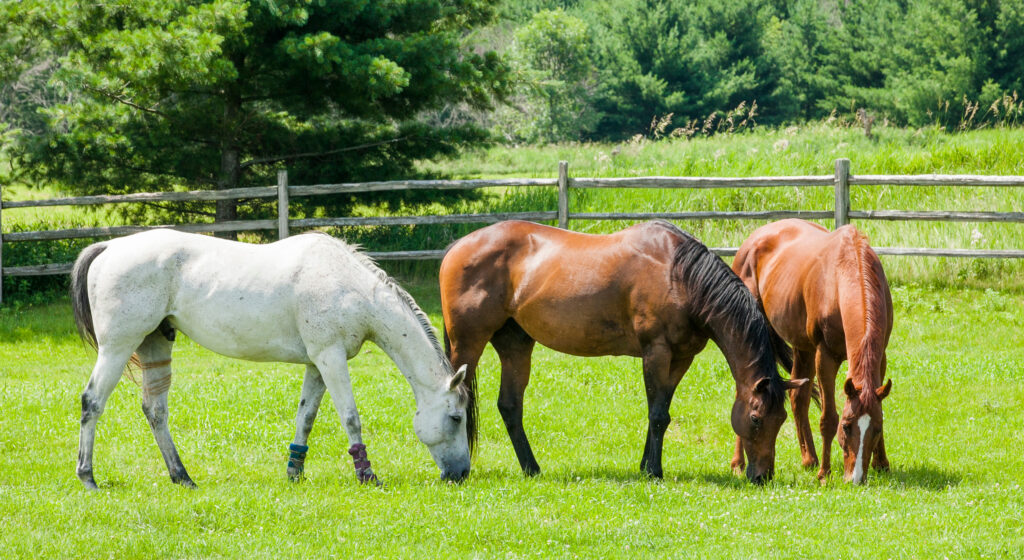
Another important piece to remember is the three Fs: freedom, friends, and forage. This means giving horses ample turnout with conspecifics and access to hay or pasture. Goodale also advocated for learning about equine body language and facial expressions, as well as incorporating Dr. Sue Dyson’s Ridden Horse Pain Ethogram into lameness exams.
Goodale reminded listeners to be understanding that many clients board their horses and have little control over their living situations. “Read the room, and try to figure out some areas where, in this particular case, this horse could have improvements.”
Applying Welfare Principles to Chronic Pain Management
Quality-of-life assessment scales can help veterinarians evaluate horses with chronic pain or illness. “Quality of life is more or less synonymous with welfare,” Goodale said.
She noted that it can be difficult for veterinarians to notice changes in patients they see frequently. In these cases, it can be helpful to bring in a second veterinarian to evaluate the horse with fresh eyes.
Goodale mentioned that some chronic pain cases warrant euthanasia. “Delayed euthanasia is seen as one of the most important welfare issues affecting horses,” she said. “Make sure everyone’s aware that that’s on the table when the horse is in pain.”
Listen to the podcast episode to learn more about equine welfare principles.
About Dr. Lindsay Goodale
Lindsay Goodale, DVM, is a senior lecturer in the Department of Animal Science at Cornell University’s College of Agriculture and Life Sciences. In this role, she teaches undergraduate and graduate students courses in equine biology and management, domestic mammalian behavior, and animal welfare. Goodale also serves as the equine extension specialist for New York State and has developed a Horse Farm Improvement Program for equine operations.
Goodale attended veterinary school at Cornell and graduated in 2012, returning to work at Cornell in her current role in 2017. She is pursuing board certification through the American College of Animal Welfare and owns an off-track Thoroughbred named Fig who enjoys clicker training.
Resources
Goodale mentioned the following resources in the episode:
- Horse Farm Improvement Program (HFIP):
- Abuse and neglect assessments: https://aaep.org/guidelines-resources/horse-owner-resources/owner-vaccination-guidelines/equine-welfare-resources/
- Fear Free Veterinary Certification -Equine: https://www.fearfree.com/course/veterinary-professional-certification-program-equine/
- Behavioral medication considerations in equine medicine seminar, Dr. Kate Anderson: https://youtu.be/fP_dJSJtqBs?si=63a-kx5fh_EJmGch
- End-of-life decision-making: https://youtu.be/sU7-vn86U8g?si=toPwe-aqs7dVnyPl
- Resources for pet grief: https://www.vet.cornell.edu/printed-and-audiovisual-materials
- British Horse Society: Quality of Life: https://www.bhs.org.uk/horse-care-and-welfare/health-care-management/quality-of-life/
- Cade Torcivia and Sue McDonnell’s Equine Discomfort Ethogram: https://pmc.ncbi.nlm.nih.gov/articles/PMC7931104/
Related Reading
- The State of Sport Horse Welfare
- The Ridden Horse Pain Ethogram
- Oral Lesions in Horses Are Associated With Behavioral Signs
Stay in the know! Sign up for EquiManagement’s FREE weekly newsletters to get the latest equine research, disease alerts, and vet practice updates delivered straight to your inbox.
![[Aggregator] Downloaded image for imported item #18711](https://s3.amazonaws.com/wp-s3-equimanagement.com/wp-content/uploads/2025/10/20105749/EDCC-Unbranded-14-scaled-1-768x512.jpeg)