Countless pre-, pro-, and postbiotic products promise gut health benefits for horses, but the research behind them is more nuanced than most labels suggest. During a presentation at the 2026 American College of Veterinary Internal Medicine Forum, Tiffany Hall, DVM, DACVIM, DACVECC, an associate veterinarian at Hagyard Equine Medical Institute, in Lexington, Kentucky, reviewed the current evidence behind each category, offered a framework for evaluating individual products, and shared how she incorporates these tools into her clinical decision-making. Here’s a breakdown for practitioners trying to separate marketing claims from meaningful research.
Defining the Terms
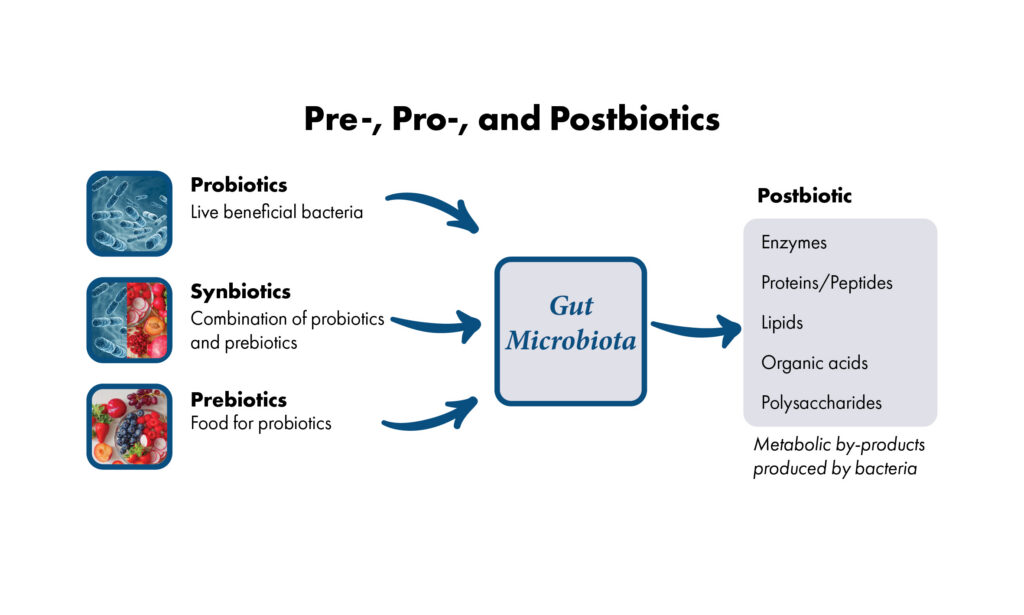
Hall began by reviewing the International Scientific Association for Probiotics and Prebiotics (ISAPP) definitions for these products:
- Prebiotics are substrates selectively utilized by host microorganisms that confer a health benefit.
- Probiotics are live microorganisms that confer a health benefit when administered in adequate amounts.
- Synbiotics combine both pre- and probiotics in a single product.
- Postbiotics are inanimate microorganisms and/or their components and metabolites that confer health benefits in adequate quantities.
Some of the most commonly discussed prebiotics—mannan-oligosaccharides (MOS), fructo-oligosaccharides (FOS), and beta-glucans—are also postbiotics, depending on how they’re sourced and used. This overlap is one reason label information and manufacturer transparency matter so much, she said.
Prebiotics
Prebiotics are natural components of most equine diets, so supplementation adds to what horses are already consuming, said Hall. She noted several documented benefits: improved microbiome stabilization via better tight-junction gut integrity, greater microbiome diversity, pathogen-binding effects (particularly with MOS, which can block pathogen adherence to intestinal mucosa), and immunomodulatory effects of beta-glucans in mares and foals.
Hall flagged a 2018 in vitro study in which the Cehak et al. found that FOS metabolism begins in the stomach, and the resulting increase in butyric acid exposure to the squamous and glandular mucosa could disrupt gastric integrity and potentially lead to ulceration. “However, to my knowledge there are no in vivo studies that support this,” she added.
Probiotics
Hall was blunt about the limitations of probiotic supplements. “We are in the early stages of understanding the equine microbiome in terms of how these various bacteria exist in the hindgut of our horses relative to one another, which taxa dominate, and which confer the biggest health benefit versus potential detrimental effects,” she said. “A lot of the probiotics that we have on the market right now for horses have been extrapolated from human research.”
Compounding this is product quality. Hall cited studies demonstrating that the products on the market are unreliable when it comes to viability of the organisms present and durability of those microorganisms through the gastrointestinal tract. “And most importantly, the formulations are quite inconsistent relative to what the label states,” she added.
Evidence in adult horses. Hall reviewed study findings involving probiotic administration in adult horses:
- Saccharomyces cerevisiae has reasonably consistent support for influencing microbiota composition, fecal pH, nutrient digestibility, and feed efficiency in growing animals.
- Bacillus coagulans has shown some ability to attenuate post-exercise inflammation, potentially aiding recovery in exercising horses.
Beyond those, the evidence is largely inconclusive:
- A landmark 1997 JAVMA study of 186 surgical colic patients found no difference in salmonella shedding, diarrhea prevalence, antimicrobial duration, or hospitalization length between probiotic-supplemented and control horses.
- A 2001 AJVR study of 246 horses found only a nonsignificant trend toward decreased salmonella shedding, with no effect on clinical signs.
- A widely cited 2005 study on Saccharomyces boulardii reporting reduced diarrhea duration was underpowered (14 horses, mixed etiologies), and a larger, more rigorous 2013 UC Davis study of 21 horses found no significant effect on days to normal fecal consistency, resolution of diarrhea or SIRS criteria, appetite, attitude, or survival to discharge.
- A 2023 study found that the tested product failed to culture the bacterial strains listed on its label and showed no direct microbiome effects from supplementation—though antibiotic administration itself did shift microbial diversity, regardless of probiotic use.
- Several other studies cited as “supportive” of probiotics have confounding factors (e.g., a sand-clearance study where the product also contained psyllium) or methodological limitations (small sample sizes, non-crossover design, baseline group differences) that weaken their conclusions.
In summary, said Hall, “I think probiotics are unlikely to harm adult horses. However, there’s pretty weak support for clinical conditions in terms of their improvement of hospitalization times and resolution of diarrhea.”
Evidence in foals. Several controlled studies—including a 2015 study of 75 foals and a 2018 study of 34 foals—found that Lactobacillus and Enterococcus species supplementation was associated with a higher incidence of diarrhea requiring veterinary intervention and, in one case, slower weight gain compared to the placebo. Other studies found no benefit at all.
Hall cautioned that one widely cited paper’s abstract claimed probiotics may be superior to antibiotics for managing foal diarrhea, but the actual study design only compared microbiome taxonomy between diarrheic and healthy foals. It never evaluated probiotic administration. “It’s a good reminder to myself that I need to go beyond abstracts,” she said.
“I do believe that (probiotics) are contraindicated in healthy foals for the prophylactic prevention of diarrhea,” she stated. “There may be a role for some probiotics in the treatment of diarrhea foals, but that too remains to be determined.”
Postbiotics
Postbiotics—inanimate microorganisms, cell wall components, and fermentation metabolites—sidestep one of the biggest limitations of probiotics: They act more like a functional ingredient than a living organism that must colonize. Hall said the most heavily researched postbiotics in horses are Saccharomyces cerevisiae fermentation products (SCFP).
Components of postbiotic products might include short-chain fatty acids (propionate, butyrate) that provide local cellular energy for gut healing, cell wall components like beta-glucans and MOS with immunomodulatory and microbiome-stabilizing effects, digestive enzymes such as cellulase and amylase, and various peptides, organic acids, antioxidants, and vitamins.
A cluster of studies, largely out of Texas A&M, the University of Florida, and Penn State, support several benefits of SCFP supplementation:
- Improved robustness and diversity of the microbiome following a transportation stress model.
- Faster recovery of cortisol-associated stress markers in young horses, suggesting a potential faster recovery window for performance horses.
- Reduced joint-localized inflammatory response following intra-articular LPS challenge, suggesting systemic effects of post-biotic supplementation beyond hindgut stabilization and digestive support.
- Improved growth-promoting activity of colostrum from supplemented mares and improved vaccination response in weanling foals whose dams were supplemented from 30 days pre-foaling through 30 days post-foaling. Direct foal supplementation in the neonatal period didn’t reduce diarrhea frequency or severity in the same studies.
- Improved vaccination response to influenza in racehorses supplemented with SCFP.
Postbiotics show promise for “immune modulation, reduced inflammation, improved recovery time, improved nutrient utilization, and many other things,” said Hall. Though, as with all these products, manufacturing process matters enormously, and findings are product-specific rather than universal, she noted.
Evaluating Supplements
Given the variability and inconsistencies across these categories, how can we assess supplements to determine which ones we can recommend and trust? Here are some of the key points Hall made to help clinicians vet individual products:
- Regulation: All equine supplements fall under the FDA’s Center for Veterinary Medicine, classified as feed or health supplements. Supplements cannot legally make disease treatment or prevention claims. “If a company is making significant claims as to a diagnosable condition, then they are not following guidelines from the FDA,” said Hall.
- Labeling rules: In the U.S., labels cannot include trademarked brand names or proprietary blend information. Ingredients must be listed by base compound (e.g., “yeast culture” rather than a branded name for Saccharomyces cerevisiae).
- Limited enforcement: FDA oversight is limited and typically only occurs in response to consumer complaints. “And even then, it’s typically a slap on the wrist,” she said. So don’t assume market presence equals compliance.
- NASC Quality Seal: The National Animal Supplement Council’s voluntary Quality Seal program demonstrates a commitment to FDA guidelines. Participating companies undergo independent third-party testing for contamination and label accuracy, and their manufacturing facilities are evaluated similarly to FDA drug facilities.
- “Safe Sport” claims: Supplements labeled as Safe Sport are not tied to any verifiable regulatory program in the U.S. In Europe, NOPS (naturally occurring products testing) offers lot-specific testing searchable online, but neither FEI nor USEF officially recognizes these claims.
- Dosing: Products that don’t scale dose to body weight are red flags, since most supporting research is based on body-weight-adjusted dosing (g/kg or CFU/day).
Clinical Incorporation
Hall said she tailors her use of these products to the clinical scenario rather than applying a blanket approach.
Acute adult enterocolitis. To support microbiome balance in these cases, Hall said she uses probiotics alongside standard medical therapy (fluids, antimicrobials as indicated, anti-inflammatories). “I use an oral GI health product that supports the gastrointestinal tract from multiple angles, and that does include a probiotic,” she said. “A postbiotic may also be beneficial, it just takes a little bit longer to work.”
Neonatal foal diarrhea. Hall said she first treats the inciting etiology (e.g., Clostridium, rotavirus), then takes steps to support GI tract function. Because 70-75% of diarrheic neonatal foals are also bacteremic, most receive broad-spectrum antibiotics. “This greatly affects their early microbiota, so I often supply foals with the mare’s poop or coprophage,” she said. While she does not support prophylactic use, “probiotics may still play a part in treating diarrheic foals, with the most promising research on Saccharomyces boulardii and fecal microbiota transplantation.”
Respiratory disease. Hall said she starts horses on postbiotics as soon as they begin receiving antibiotics, aiming to stabilize the microbiome in the face of antibiotics and stress. She cited Dr. Chris Proudman’s work linking early-life microbiome diversity to later inflammatory airway disease risk and athletic performance.
Chronic colic. “My personal approach,” she said, “is to discontinue all current supplements and to consider the influence of diet, whether that means going to an all-pelleted feed for a period of time or pelleted and grass pasture diet,” to give the gut a rest from long-stem roughage. “In addition to dietary evaluation, I use a gastrointestinal support product aimed at supporting the entirety of the gastrointestinal tract and stabilizing the hindgut, including science-backed buffering systems, digestive enzymes, amino acids critical to mucosal integrity, and postbiotics.”
Free fecal water syndrome. Research shows the horse’s microbiome responds rapidly to stress such as transport, “so postbiotics long-term before a stressful event can help prevent (free fecal water syndrome) from occurring,” she said. “At the same time, it can also treat the free fecal water syndrome by reducing inflammation in the intestines and stabilizing the microbiome.”
Performance horses on lots of supplements. Hall said her instinct is to strip back to basics: “If the gastrointestinal tract is functioning as it should, most things should not need to be supplemented.”
Take-Home Message
The strength of evidence varies considerably across pre/pro/postbiotics:
- Prebiotics have decent support tempered by possible gastric ulcer risk.
- Probiotics appear to be safe in adult horses but are plagued by weak clinical data and lack of label accuracy, with concerns around prophylactic use in foals.
- Postbiotics—particularly SCFP—currently offer the most consistent research base, including effects that appear to extend beyond the gut to systemic inflammation and immune response.
When assessing products, Hall emphasized that manufacturing process and product-specific testing matter more than the ingredient name on the label, and veterinarians are best served by scrutinizing individual products and ingredients rather than trusting category-wide claims.