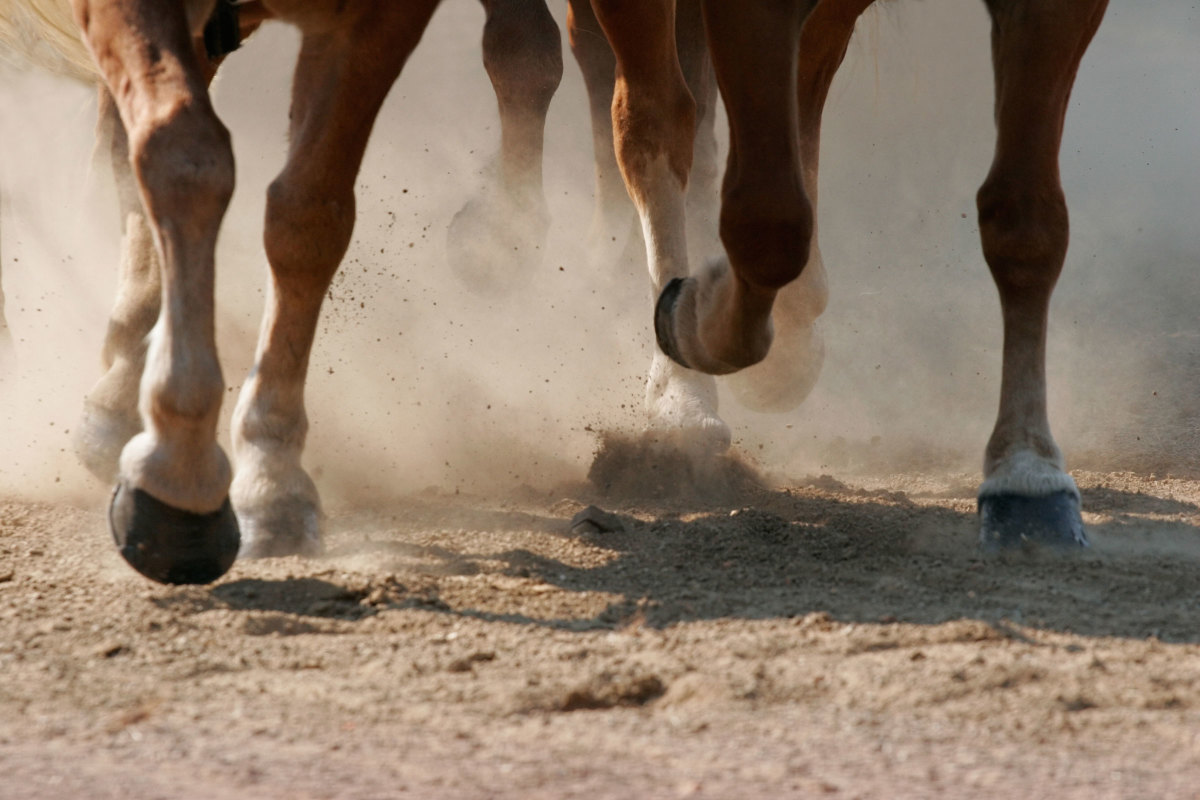
The application of horseshoes has the potential to alter a horse’s locomotion, stride length and gait. Advocates of the barefoot movement stress that it is better for a horse’s physical wellbeing and soundness to remain unshod.
In a study presented at the International Society for Equitation Science (2016), a trial was performed to examine this phenomenon on horses lunged on a 20-meter circle [Bouwman, M.; Berry, J.; Paddison, J.; and Richmond, D. An investigation into the limb phasing characteristics and stride duration of fully shod, partially shod and unshod horses on a twenty-meter circle in walk and trot gait. Journal of Veterinary Behavior, Sept-Oct 2016; vol. 15, page 89].
Seven horses were evaluated in each group: 1) shod all four feet; 2) shod just both fronts; and 3) unshod. An ETB Pegasus Limb Phasing system was used to measure the temporal sequence of each stride.
While differences were noted between the left and right rein directions, the study concluded: “The horse does not appear to adapt its stride pattern when presented in a shod or unshod condition.”
A similar study looked at the differences in stride characteristics in shod, partially shod and unshod horses and how the shoeing or lack of shoes affected their gaits [Nahum, M.; Attwood, S.; Berry, J. A pilot investigation into the limb phasing characteristics and stride length of fully shod, partially shod and barefoot horses. Harlow College in the UK].
It similarly concluded: “This study found no significant differences in the limb phasing characteristics of horses that are shod, partially shod or unshod.”
There might be other reasons that going barefoot is better for the health of a horse’s foot and that might be a desired management approach. But, according to these two studies, the horses apparently compensated just fine no matter the presence or absence of horseshoes.
![[Aggregator] Downloaded image for imported item #19543](https://s3.amazonaws.com/wp-s3-equimanagement.com/wp-content/uploads/2026/03/23132146/EDCC-Unbranded-41-scaled-1-768x512.jpeg)