This article originally appeared in the Fall 2026 issue of EquiManagement. Sign up here for a FREE subscription to EquiManagement’s quarterly digital or print magazine and any special issues.
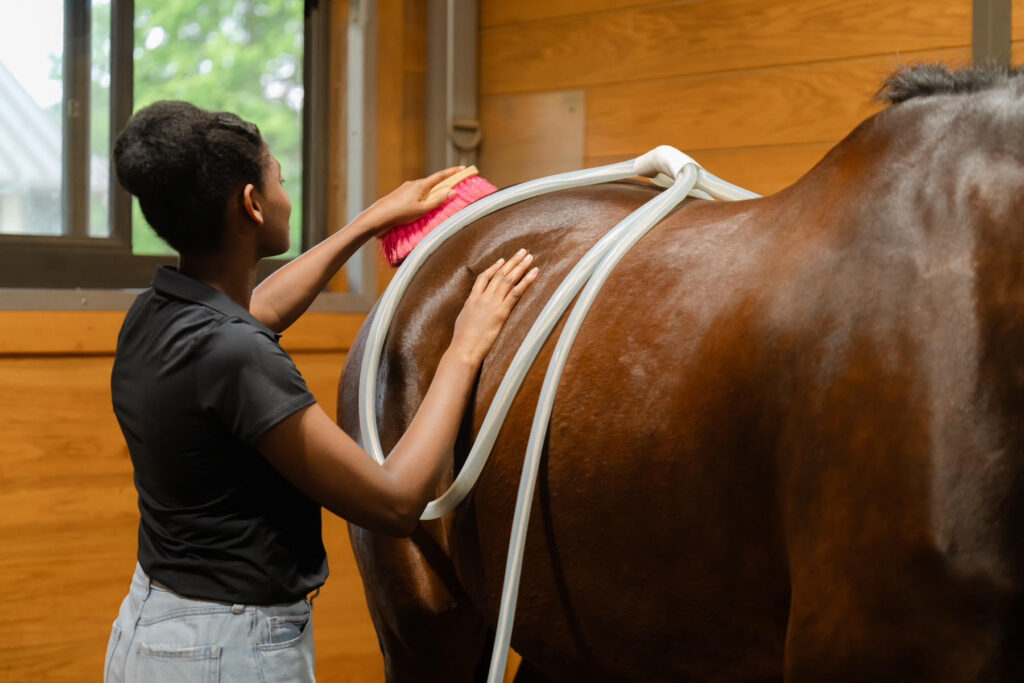
Veterinary medicine is a team sport. For an equine practitioner, being a team player often means referring a case to another doctor with specific expertise, such as a board-certified specialist. Other times, collaboration takes a different form and might include inviting a nonveterinarian paraprofessional to work on a case.
When bringing in a specialized farrier, rehabilitation specialist, or bodyworker, to name a few, who you involve matters as much as how you set up the partnership. Here are some general guidelines and practical tips for cohesive, respectful, and successful teamwork that protects all parties and keeps the horse’s best interests at the forefront of the conversation.
Communication and Collaboration
Delegating to paraprofessionals can help veterinarians maximize their own time and skill set. Referrals also allow clinicians to give their clients access to additional services, modalities, and treatments not otherwise available to them. It isn’t as simple as a “one-and-done” referral, though—the veterinarian must remain involved in the case, reevaluating progress and modifying their recommendations as needed. To be sustainable and successful, this kind of team-based approach with a referring veterinarian and various paraprofessionals requires strategic collaboration and intentional communication.
Unsurprisingly, research shows that lack of accurate communication can directly impact clinical outcomes. In veterinary medicine, communication errors are cited as a leading contributor to medical mistakes and adverse events (Oxtobyet al. 2015). Tena Ursini, DVM, PhD, DACVSMR, CERP, assistant professor of large animal sports medicine and rehabilitation at the University of Tennessee College of Veterinary Medicine, in Knoxville, agrees that ongoing communication with all team members is the most important aspect of collaborative care.
“In my experience, most communication breakdowns stem from a misinterpretation by a middle party—usually the horse owner translating veterinary information for another professional,” she points out. “Written documents help reduce information loss, but they are often watered down to be palatable to owners and don’t reach the depth that other professionals require to be successful.” With that in mind, direct verbal or written communication between the veterinarian and all other professionals involved is preferable.
Defining Roles and Professional Boundaries
“The best professionals to collaborate with are the ones who are open, observant, and ego-free,” says Katie Hawkins, BA, MA, an FEI-permitted certified equine massage therapist (CEMT) and certified equine rehabilitation therapist (CERT). Hawkins owns Unbridled Equine LLC, a massage and rehabilitation practice based out of Pinnacle Rehabilitation Center, in Fayetteville, Arkansas. “Having people who are willing to communicate, ask questions, and adjust their approach based on what the horse is telling us is everything,” she adds. “I really value farriers, bodyworkers, chiropractors, and trainers who understand that they are part of a bigger picture. They are not just doing their job in isolation; they are contributing to a long-term outcome. Attention to detail, consistency, and a willingness to stay aligned with the veterinarian’s plan go a long way.”
“As a veterinary technician, I’m wired to think about how I can help both veterinarians and our mutual patients,” says Aurora Sochan, CVT, VTS-EVN, CERP, owner of In Gait Equine, an ambulatory equine physiotherapy and rehabilitation practice based in New London, New Hampshire. “I look at things the same way in my current role [as a rehabilitation practitioner].”
Sochan encourages fellow paraprofessionals to be respectful, ask questions, and always defer to the veterinarian. She discourages diagnosing or encouraging owners to skip over their vets. “Having a clear understanding of everything on a veterinarian’s plate enables us to understand how we can help rather than interfere,” she explains. “I would also strongly advise everyone to read through the Veterinary Practice Acts of any state that they plan to work in.”
Veterinary Practice Acts define what constitutes the practice of veterinary medicine within each state, restrict which procedures nonveterinarians can perform, and specify the level of veterinary supervision (direct vs. indirect) required for certain procedures. These regulations are designed to protect both patient welfare and professional accountability. For veterinarians and paraprofessionals working together, understanding these boundaries is essential to ensuring care remains legally compliant. The Veterinary Practice Act for each state can be found on the American Association of Veterinary State Boards (AAVSB) website.
Modalities Performed by Nonveterinarians: A Gray Area
As collaboration expands to include new modalities and paraprofessionals, questions surrounding the scope of practice and veterinary oversight become increasingly important. Both dentistry and the various sports medicine and rehabilitation therapies, such as shock wave and laser, are particularly hot topics.
“I believe that dentistry should always be performed by a veterinarian, who can perform a physical examination and thoracic auscultation of the heart and lungs to rule out abnormalities that may make sedation unsafe,” Ursini says. “I personally do not think dental work is effectively and safely performed without sedation. As for shock wave, it should be administered only by veterinarians due to its transient analgesic effect. Improper use could numb areas of the horse, which could predispose him to catastrophic injury.”
Ursini notes that other rehabilitation modalities, such as therapeutic laser or therapeutic ultrasound, should be performed by a veterinarian or physical therapist with specialized training in animal rehabilitation to ensure the modality is applied properly and the animal has no contraindications. “The inclusion of paraprofessionals for specific treatments is governed by the specific state’s Veterinary Practice Act,” she adds.
Obtaining Veterinary Referral and Clearance
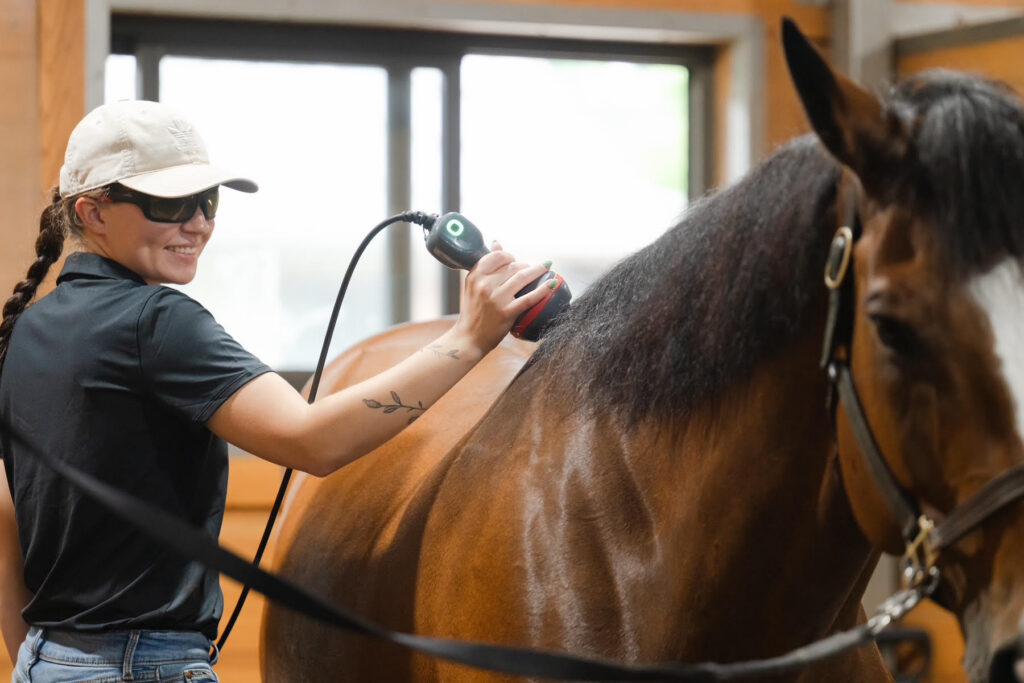
When designated as the primary doctor working on a case, a veterinarian needs to remain informed about any and all procedures, modalities, and therapies their client chooses to pursue for their horse. And as part of doing their due diligence, paraprofessionals should seek clearance and permission from the primary doctor before initiating any procedure that might affect a case’s medical management. “Most of my clients are referred to me from their DVMs,” says Sochan—an ideal scenario. “I make sure to connect with the veterinarian before treatment for any specific injury or condition requiring veterinary care. These can include soft tissue injuries, postoperative cases, back pain, or wounds. I also frequently refer clients right back to their veterinarians when I find something unexpected or concerning on evaluation.”
She admits that sometimes, a client’s funds might be limited and are better spent on additional diagnostics or certain veterinary treatments that are beyond her scope. “This is an honest conversation to have with the client and the referring veterinarian,” she says.
Collaborating With Farriers
Farriers routinely work on horses without veterinary involvement, and farriery is widely accepted as a paraprofession performed by skilled, credentialed, nonveterinary individuals. However, certain conditions—notably podotrochlosis and laminitis—often require corrective farriery as part of medical management. For this reason, one of the most common and impactful collaborations in the equine industry occurs between veterinarians and farriers. Specifically, radiograph-guided hoof care allows both professionals to base decisions on internal structures rather than external appearance alone and provides an objective assessment of progress over time. Collaboration and communication help ensure the veterinarian’s goals are carried through accurately in the farrier’s work.
“Every therapeutic shoeing case at the University of Tennessee is performed as a team,” Ursini explains. “I perform the diagnostics, such as the lameness exam and radiographs, and then communicate to the farrier specific areas I need supported, off-loaded, or modified. I trust the farrier to know which specific shoeing package will be most effective at achieving those goals and that will also successfully stay on the foot based on the environment in which the horse resides.”
The Epicenter of Collaboration: Rehabilitation Facilities
Nowhere is a team-based approach more relevant than in structured rehabilitation settings, where several veterinarians and paraprofessionals are often involved in a horse’s care over an extended period. A recent survey used to design a university degree in equine sports rehabilitation found horse handling and communication skills were deemed equally important for rehabilitation professionals (Reed & Streff, 2023). A separate international survey on the use of rehabilitation modalities in horses concluded that, in practice, these modalities are applied not only by veterinarians but also frequently by veterinary technicians and assistants, farriers, physical therapists, trainers, and other entities (Wilson et al., 2018).
At the University of Tennessee, Ursini and her team have board-certified specialists in almost every veterinary specialty. As a boarded specialist in Equine Sports Medicine and Rehabilitation, Ursini works extensively with other specialists in the field. “We collaborate with individuals throughout the hospital and community, including surgeons, internists, and farriers,” she says. “We do, however, lack in-state physical therapists who work on horses. Occasionally, we refer patients not local to Tennessee to a physical therapist with advanced animal training. These individuals have allowances in their state for physical therapists to assist in these functions; however, this is not currently allowed in Tennessee [as per the state Veterinary Practice Act].”
As the owner of Unbridled Equine, Hawkins oversees the rehabilitation of all horses in her program. Her role is to evaluate each horse as a whole, including lameness, performance, compensation patterns, mindset, and medical history. Then, in collaboration with the referring veterinarian, she creates a customized rehab plan tailored to the horse’s evolving needs as it progresses through the program.
“We most commonly manage postsurgical cases, soft tissue injuries such as suspensory and deep digital flexor tendon (DDFT) lesions, neurologic conditions such as equine protozoal myeloencephalitis (EPM), and horses coming back from chronic lameness issues,” Hawkins explains. “We also work with performance horses that may not be overtly injured but are not operating at their full potential. A big part of what we do is bridging the gap between diagnosis and return to work, making sure these horses do not just recover, but come back stronger and more confident in their bodies.”
While Hawkins knows the ins and outs of structured rehabilitation within a dedicated, fully staffed facility, Sochan offers a perspective from the field, where rehabilitation practitioners often work as part of a less centralized team but the goals remain the same. “My objective is to enhance the quality of each horse’s rehabilitation by supporting owners and improving treatment outcomes,” she says. “I look to fill in gaps with therapeutic modalities and customized exercise plans, while communicating often with each horse’s care team member—owner, trainer, veterinarian, farrier, and sometimes bodyworker. I think of the primary veterinarian as the conductor of the orchestra. The rest of us should be playing along and working well together. In my experience, having a cohesive team is often correlated with the best outcomes.”
Common Pitfalls in Collaborative Care
- The owner acting as the “translator” between their veterinarian and various professionals, relaying information incorrectly or incompletely, leading to unintentional miscommunication.
- The primary veterinarian not clearly defining everyone’s roles.
- Paraprofessionals overstepping into diagnosis or disregarding the veterinarian’s instructions.
- Conflicting recommendations given to the client by different professionals.
- Lack of documentation or follow-up from any party.
Real-Life Collaboration Success Story
One case that stands out to Hawkins is a post-kissing-spine-surgery patient. “The veterinarian had done an excellent job with the surgery and initial care, but the horse needed a very intentional and layered approach to rebuild strength,” she recounts. “We worked closely with the referring veterinarian to monitor healing, while also bringing in a skilled chiropractor and bodyworker to address compensatory tension patterns and a farrier who could support more balanced biomechanics from the ground up. As the horse progressed, we looped in the trainer to ensure the return-to-riding phase was as thoughtful as the rehab itself. Because everyone stayed in touch and aligned on the goals, we were able to make steady adjustments as we went rather than big corrections later. That horse did not just return to work; he came back happier, more comfortable, and able to perform without the resistance he had before surgery. That kind of outcome only happens when the team is truly working together.”
Final Thoughts
“The best teams are the ones who genuinely enjoy the process,” Hawkins says. “Rehab can be a long, bumpy road, but when you have a group of professionals who respect each other and recognize the small wins along the way, it shows in the horse’s comeback.”
Successful collaboration in equine practice comes down to keeping the horse’s best interest at the center of every decision. Each member of the care team—veterinarian or paraprofessional—plays a distinct and valuable role, and the best outcomes happen when those roles are clearly defined, communicated, and aligned toward a shared goal.
Related Reading
- Should the U.S. Embrace Equine Veterinary Physiotherapists?
- Disease Du Jour: Vet and Farrier Cooperation
- The Business of Practice: Equine Rehabilitation Veterinary Practices
Stay in the know! Sign up for EquiManagement’s FREE weekly newsletters to get the latest equine research, disease alerts, and vet practice updates delivered straight to your inbox.