Veterinarians and farriers often collaborate to provide exceptional care for horses and their owners. For example, a farrier might contact a veterinarian about a horse on which he or she has worked that is showing some separation of the white line or a localized sole void, raising concerns that the horse has developed white line disease.
Although the term “white line disease” is used loosely, it isn’t an accurate representation of the pathology occurring within the foot. The affected area lies just in front of the epidermal lamellae, not at the white line itself. White line disease occurs secondary to an area of separation of the hoof wall at the inner part of the stratum medium. This happens to be the nonpigmented, softest part of the hoof wall. Mechanical separation results from environmental conditions that allow microorganisms, such as fungi, yeast, and bacteria, to enter a weak spot, proliferate, and extend more proximally into the hoof wall.
The infection is usually a mix of bacteria and fungi. Any or all four feet can be affected. Areas of diseased tissue can be extensive, or the issue can be localized within a small area of a foot.
Conditions Conducive to White Line Disease
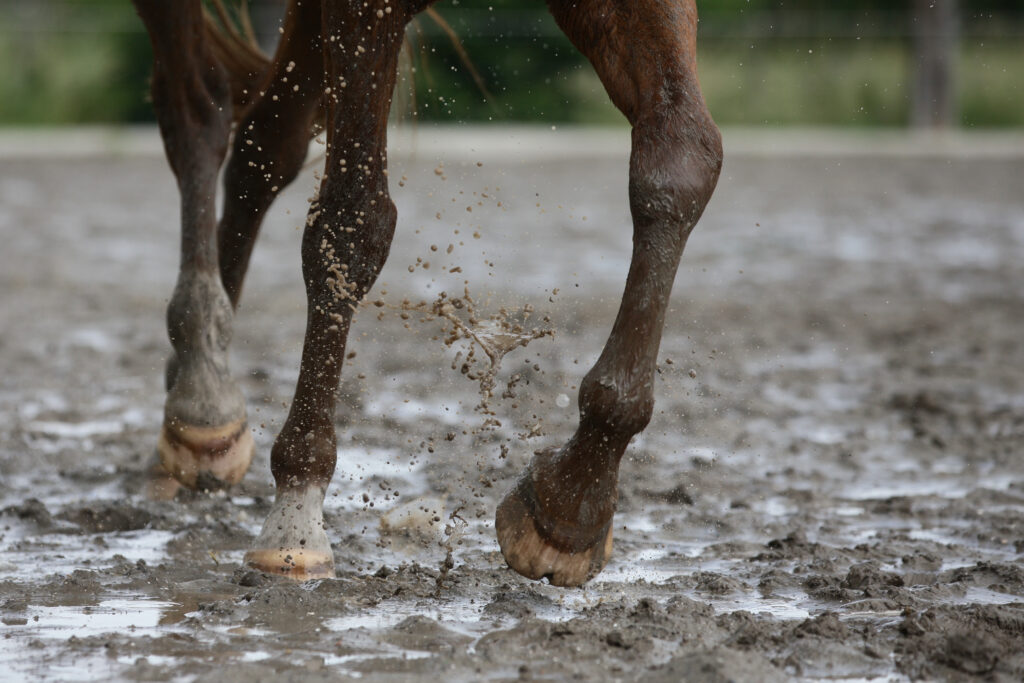
Moisture is thought to be an inciting cause because it softens the foot, allowing dirt and microorganisms entry. While white line disease is more prevalent in wet conditions, horses in arid and hot climates are also at risk. Cracks that form in dry hooves similarly set up favorable conditions for invading microorganisms.
Mechanical stressors on a hoof are primary risk factors for white line disease. Hoof wall separation results from abnormal loading patterns of a foot and/or hoof distortions such as long toe and underrun heels, club foot, sheared heels, or overgrown hooves. It can also occur after a hoof abscess. In addition, laminitis is notorious for causing hoof wall separation.
Listen: The Humble Hoof Podcast: White Line Disease
Signs of White Line Disease
In the early stages of infection with white line disease, a horse rarely shows pain or lameness until the diseased tissue becomes more extensive and/or invades into sensitive tissues. More advanced cases might compromise laminar attachment to the hoof wall and result in coffin bone rotation or sinking.
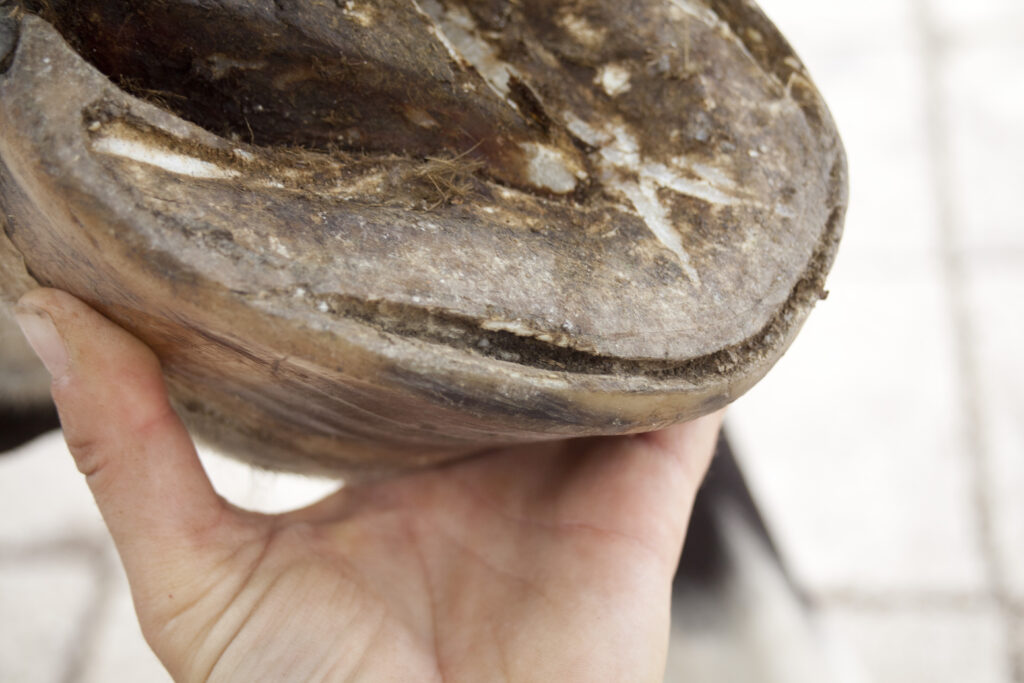
In most cases, signs include a lightly visible, chalky, or crumbly area just dorsal to the junction of the hoof wall and sole. A horse might also show a positive hoof tester response around the affected area, but many don’t experience tenderness.
The hoof capsule can develop asymmetric dishing or bulging, representative of distortion forces on the hoof. The more advanced the case, the more likely it will form a hollowed-out area within the hoof wall. It might be audible when tapping the wall with a hammer or hoof testers.
Unless a horse is already showing discomfort, farriers usually detect white line disease during routine hoof care. Removal of dead sole with nippers or a hoof knife allows visualization of the hoof wall-sole junction on the bottom of the hoof.
With white line disease, an abnormally deep cavity within the inner layer of the hoof wall is visible. Early recognition is important to prevent the infection from spreading upward in the foot, which is more difficult to manage.
Any concern about an abnormality associated with hoof wall separation should prompt veterinary consultation and radiographic imaging of the hoof from different angles. This is especially true if the horse is lame, painful, and/or sensitive to hoof testers. Radiographs can help identify white line disease and differentiate from laminitis.
Treatment and Prevention
A critical element of treatment is addressing and resolving causes of hoof wall distortion and unloading the diseased area of hoof damage. The veterinarian or farrier will debride and remove the diseased tissue to get back to healthy tissue with a solid attachment of lamellae to the hoof wall. Infection begins at the ground and moves upward, so debridement follows this path.
Usually, debridement does not extend into bleeding tissue, because white line disease typically doesn’t affect nonsensitive tissues of the foot.
Exposure to air is good for restoring and maintaining hoof health. This also applies to opening up hoof cracks that tend to collect debris.
Continuity of pressure is key to growing healthy hoof horn. One strategy is to affix a horseshoe that bridges missing portions of the diseased hoof that have been removed. A horseshoe also minimizes weight bearing on the sole. Have a plan in place for applying a shoe before removing extensive portions of the hoof wall.
Another important strategy is to back the toe up by setting the shoe back a little from the end of the toe. This moves the breakover to relieve pressure on the toe and minimize pinching at the junction of normal hoof wall and the resected area.
Depending on the location of diseased tissue, an egg-bar shoe might provide a protective advantage. A glue-on shoe might be another appliance of choice.
Although it is tempting to replace a hoof defect with polymethylmethacrylate composite, this tends to be counterproductive in these cases. Heat from curing of a composite material potentially drives organisms deeper into the hoof. Infection can “simmer” beneath the composite unnoticed until the horse becomes overtly lame from a building infection.
In addition, it is important to keep the horse’s feet dry by eliminating wet areas in the paddock or turnout, such as puddles by the water tank, gutter run-off, or wet spots that collect on uneven ground.
Affected horses should not be turned out in wet or dewy grass, mud, or pasture along creek areas. They should have clean bedding that’s changed frequently to avoid the build-up of urine and manure, which can further degrade the hoof horn through contact.
Use a wire brush and debridement for hoof cleaning when necessary. Although plenty of commercial topical medications are available, studies have demonstrated that a hoof with white line disease benefits more from wire brushing than from topical treatments, provided bad tissue is debrided and the hoof is kept clean and dry.
At times, the use of iodine, methylene blue, or Thrushbuster as a dye marker might help outline diseased areas needing further debridement.
Prevention involves maintaining a clean, dry hoof along with regular farrier care, relief of hoof distortions, and exploration of any suspect area of the sole that appears compromised.
Horseshoes can hide insidious problems, so farriers play an important role in identifying suspect areas within the sole and near the white line when pulling shoes and trimming hooves. Horses that have developed white line disease are also prone to recurrence, so monitor those horses regularly.

Returning to Work
The amount of time a horse with white line disease needs off work depends on the extent of hoof wall loss from the resection, how much support the coffin bone still has, and how many feet are affected. Normal hooves usually take nine to 12 months to grow out, with the heels and quarters taking less time. In most cases, a horse is pulled from active exercise to facilitate healing without setbacks or other hoof damage. A horse with resection halfway up the hoof wall might need as long as four to six months for full recovery.
In some instances, a horse can be put back to work before full regrowth of new hoof. If the resection only extends about a third of the way up the hoof, then the horse can return to work provided there is no pain or lameness following resection. The horse should be fitted with an appropriate, protective horseshoe that distributes the load and promotes easy breakover to relieve pressure on the resected hoof tissue.
The Bottom Line
The cause of white line disease is not always evident. Treatment objectives rely on debridement and removal of all diseased tissue. Horses require ample time for hoof growth before returning to work. Veterinarians and horse owners must remember to practice patience.
Preventive measures for white line disease revolve around maintaining the strength of the hoof and hoof capsule, as well as minimizing hoof distortions through competent farrier care.
Horses living in moist conditions should be monitored regularly, and wet ground conditions must be resolved. Healthy environmental conditions, exercise, good nutrition, and regular farrier visits all contribute to management that optimizes a horse’s genetic propensity to grow solid, healthy hooves.
Related Reading
- Tips and Tricks to Acquiring Great Equine Foot Radiographs
- Horse Hoof Changes Over an 8-Week Growth Period
- What to Do When a Sole Abscess Ruptures but the Horse Is Still Lame
Stay in the know! Sign up for EquiManagement’s FREE weekly newsletters to get the latest equine research, disease alerts, and vet practice updates delivered straight to your inbox.