This article originally appeared in the Summer 2026 issue of EquiManagement. Sign up here for a FREE subscription to EquiManagement’s quarterly digital or print magazine and any special issues.
According to the American Association of Equine Practitioners’ (AAEP) 2025 publication Borrelia Burgdorferi Infection and Lyme Disease Guidelines, “Many horses infected with B. burgdorferi will remain asymptomatic and never develop clinical disease, and it is generally considered that infection is common, but clinical Lyme disease is rare.”
And yet, equine practitioners like Jeanine Messak, DVM, associate veterinarian at Rood & Riddle Equine Hospital, in Saratoga, New York, and Lauren Holley, BVSc, DACVIM, internal medicine specialist at Rhinebeck Equine, also in New York, report that owners frequently believe their horses are showing signs of Lyme disease. Clinical signs owners attribute to Lyme disease predominantly include general malaise, stiffness, and lameness but might also include weight loss, low-grade fever, muscle tenderness, and poor performance.
While it’s possible that Lyme disease causes these signs, the AAEP states that only limited evidence exists supporting lameness as a clinical sign. Instead, documented syndromes attributable to Lyme disease include neuroborreliosis, cutaneous pseudolymphoma, nuchal bursitis, and uveitis. The 2018 ACVIM Consensus Statement on B. burgdorferi further states, “The association of B. burgdorferi infection with stiffness and lameness in horses is not well documented, and there is no evidence of the infection causing laminitis. … The actual range and specific clinical signs associated with Lyme disease needs further experimental and epidemiological evaluation.”
Holley says Lyme disease seems to be one of the most common conditions owners ask her about for essentially any kind of presentation. “I feel that the general perception regarding Lyme is that, if my horse is not doing well, whether it be performance or illness, Lyme is a possibility, which is just not true,” she says. “Even with mild changes or a horse that isn’t quite right, so many people are quick to jump on the fact that it may be Lyme. Additionally, it always comes up in history as well! Either they have been treated for Lyme for two months, or the horse had a bout of Lyme two years ago.”
Both Messak and Holley are located in the Northeastern United States, where Lyme is endemic and infection risk is high relative to other regions where Ixodes spp. are not typically found. Nonetheless, these practitioners, together with John Madigan, DVM, DACVIM, DACAW, professor emeritus from the University of California, Davis, believe Lyme disease is overdiagnosed and horses are unnecessarily being treated with doxycycline, oxytetracycline, or minocycline.
According to the AAEP, “The diagnosis of clinical Lyme disease in horses should be based on compatible clinical signs, evidence of exposure to B. burgdorferi (generally achieved through serology), and perhaps most importantly ruling out other possible causes.”
This latter line is one near and dear to Madigan’s heart. “I have never confirmed an equine case of B. burgdorferi seeing referral cases in California when I was practicing, and believe me, I looked,” he says. “I always found another cause of the clinical condition of the horse, including subclinical laminitis in lameness cases presenting for Lyme evaluation.”
The ACVIM Testing Protocol
The ACVIM published a flow diagram detailing the proposed criteria for antemortem diagnosis of equine Lyme disease in its 2018 Consensus Statement co-authored by Madigan. The first three steps in the diagram (pictured below) are of paramount importance.
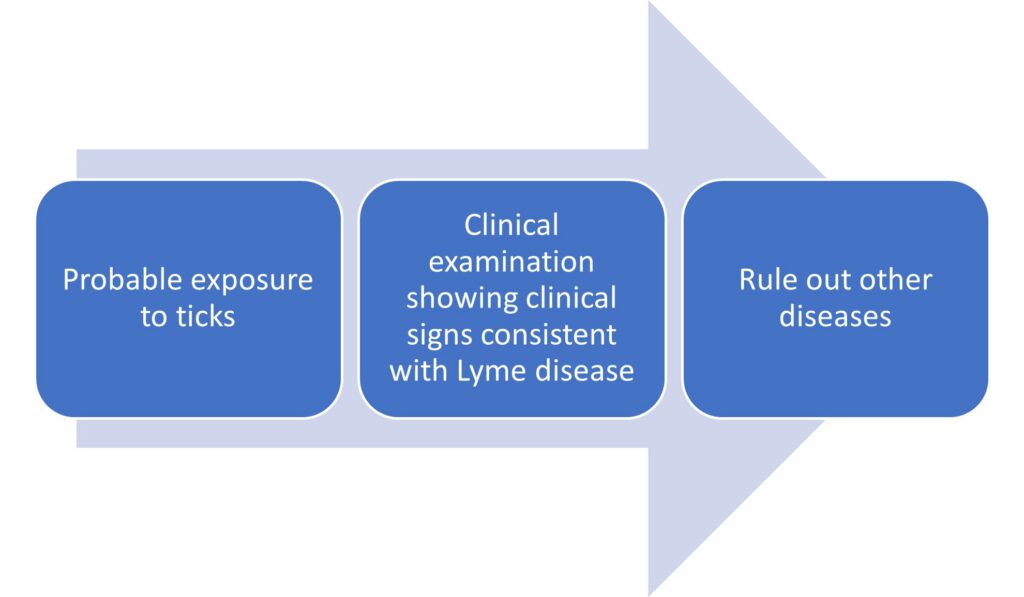
Even in the face of appropriate clinical signs, which do not include poor performance or acute fever, testing is not indicated until all other diseases potentially explaining the horse’s clinical signs have been ruled out. This latter step, however, is frequently bypassed.
“The majority of people ask for Lyme testing with any sort of visit, almost as an adjunct to all the other diagnostic tests that we recommend performing,” says Holley. “This in itself is quite problematic, as it is an antibody test and only indicates exposure. So many horses in the Northeast are going to be positive and not actually have clinical or even subclinical disease.
“I think as practitioners we need to do better to put the clinical picture into perspective and not use Lyme disease as a crutch or as an answer when we cannot find another one,” she adds. “I think Lyme results need to be interpreted in relation to actual clinical disease, which is actually quite rare, with very few properly described disease processes in the literature.”
Available Testing Options and Considerations
“B. burgdorferi doesn’t lend itself to PCR because it doesn’t have a circulating phase,” explains Madigan. “There are no viral particles like herpesvirus, making diagnosis a real challenge.”
Instead, practitioners rely on serologic assays, which we know only confirm exposure or vaccination and should not be used as a standalone test for Lyme disease.
“None of the seroassays are capable of differentiating exposure to B. burgdorferi from clinical Lyme disease,” the AAEP reports.
Several serologic assays are nonetheless available, including ELISA, Western blot, ELISA SNAP, IFAT, and the ELISA Multiplex assay developed and offered by Cornell University’s Animal Health Diagnostic Center. This quantitative test detects antibodies to three outer surface antigens of B. burgdorferi in a single equine serum, called OspA, C, and F. According to Cornell’s description of the test, OspA is typically seen in vaccinated horses while OspC and F are indicators of early and chronic infections, respectively.
“Cornell is offering more than the quick tests, and I would certainly do that but, again, a titer does not equal clinical infection,” Madigan says.
In fact, the 2018 ACVIM Consensus Guidelines state, “Regardless of test methodology, a positive result does not prove causation of current clinical signs (clinical infection) nor does a positive result predict whether infection is likely to cause clinical signs in the future. There is no known correlation between magnitude of titer and likelihood of disease.”
“A blood test revealing an immune response to this agent or other infectious disease agents does not mean the horse is now sick. It can mean the horse developed an immune response to the agent,” Madigan adds. “That is basic evolutionary survival. When we test for that, we must be very careful to not overinterpret such a result as the cause of a horse’s symptoms. Exposure does not equal disease.”
Holley, Messak, and Madigan all liken Lyme test results to those for EPM.
“A titer for EPM alone isn’t useful,” says Messak. “It simply means the horse was exposed and not that the horse is clinically infected.”
“When using these rapid tests and considering the specificity and reliability that the animal we are testing actually has the disease and is accounting for the clinical signs is a real big leap. It’s become an oversimplification,” says Madigan. “We always want an experimental model for what we are suspecting, and we just don’t have that.”
Practical Tips for Diagnosing Lyme
To best diagnose Lyme, Madigan recommends establishing a good problem list. “In an endemic area, etymology shows a high percentage of ticks are infected,” he says. “But it’s still important to go through other potential causes for the list of reported clinical signs, such as gastric ulcers and osteoarthritis.”
He recalls a case involving a very lame horse that tested positive for Lyme. However, necropsy showed the horse simply had noninflammatory wear-and-tear-related osteoarthritis.
“There can be any number of reasons that a horse shows clinical signs owners attribute to Lyme,” he says. “Veterinarians often get pressure from clients to treat for Lyme, but we need to use caution. Even if Lyme is a tentative diagnosis and the horse ‘relapses,’ is Lyme really the cause or is there something else causing the clinical signs?”
Holley says she gets horses referred to her that are being managed for Lyme disease yet do not seem to be responding, even though “this worked the last time.”
“More often than not, we end up finding another cause for the clinical symptoms and that Lyme was likely never a factor,” she explains. “I also blame the anti-inflammatory effects of tetracyclines and the fact that the horse simply ‘feels better’ because of this.”
According to the ACVIM Consensus Guidelines: “Recommendation for serologic testing of horses at select examinations (e.g., prepurchase or wellness exams) in the absence of compelling clinical signs compatible with Lyme disease is not supported by current literature or research data.”
To Treat or Not to Treat? And With What?
“Clients tend to use even the Multiplex assay results as a clear diagnostic and want to treat if it is positive, which some veterinarians are willing to do,” says Messak. “And some veterinarians are willing to treat even without testing. It’s a hard topic in veterinary medicine right now. And even the Multiplex assay has gray zones, making it difficult to interpret in some cases. The most useful result from any of these tests is a negative result.”
Messak’s general approach to Lyme testing is discussing the horse’s clinical signs, testing, and if the Multiplex assay supports the diagnosis, she will consider treating. “It’s important to appreciate that the treatment isn’t always benign,” she adds. “Doxycycline has an analgesic effect, and I think that’s what owners are seeing a response to.”
Treatment with antimicrobials such as tetracycline also isn’t benign. Any horse can develop antibiotic-induced colitis, which can be life-threatening in some cases, as Davis et al. (2026) reported when studying doxycycline pharmacokinetics.
As additional incentive to reduce rote treatment of horses for Lyme disease, Holley says doxycycline has poor bioavailability—only 2.7%, according to the Merck Veterinary Manual.
Finally, prescribing practices for suspected or presumptive Lyme disease do not align with good antimicrobial stewardship. The consequences of poor stewardship include fueling the generation of “superbugs” and rendering current antimicrobials ineffective.
Veterinary and Client Education Needs
“I think, like many things in the equine world, misinformation spreads like wildfire, and every person, horse, and their dog end up thinking Lyme is so prevalent and the cause of all the problems,” says Holley. “It ends up being a ‘fad diagnosis.’ I certainly cannot blame owners for this perception and, unfortunately, without client education, this perception would be difficult to change.”
That said, Holley does believe some veterinarians shy away from conversations about Lyme.
“It can be hard to change people’s perception and what they have believed (and everyone else around them believes), making it a constant battle in our profession,” she says. “Additionally, the owner often really wants it to be Lyme so they can treat it with a course of doxycycline and be done with it, rather than facing potentially more diagnostics and more extensive treatment/rehabilitation plans.”
According to Machtinger et al., even veterinarians could benefit from brushing up on their tick-borne disease knowledge base to better inform clients about such diseases as well as tick bite prevention. In a 2023 survey of equine veterinarians, Machtinger et al. found that while 75% of survey respondents (n=60) could correctly identify a blacklegged tick, only half of them correctly indicated blacklegged ticks were associated with Lyme disease. Survey respondents also noted that while clients frequently ask for information about ticks, only one-quarter of veterinarians said they had had coursework on ticks in vet school. The surveyed veterinarians did, however, say they desired additional continuing education regarding ticks, tick prevention, tick control, and tick-borne diseases.
Concluding Thoughts
Messak and Holley suggest that, as a whole, veterinarians must look harder for the true cause of the clinical signs owners believe are attributable to Lyme.
“We need to do better and to put the clinical picture into perspective and not use Lyme disease as a crutch or as an answer when we cannot find another one,” says Holley. “Lyme results need to be interpreted in relation to clinical disease, which is actually quite rare, with very few properly described disease processes in the literature.”
“In my opinion, it can be a bit of a disservice to continue treating horses for ‘chronic Lyme’ without offering to dig deeper,” Madigan concludes.
Related Reading
- Most Common Equine-Associated Tick Species in the U.S.
- Unearthing the Secrets of Anaplasmosis in Horses
- Disease Du Jour: Lyme Disease in Horses
Stay in the know! Sign up for EquiManagement’s FREE weekly newsletters to get the latest equine research, disease alerts, and vet practice updates delivered straight to your inbox.