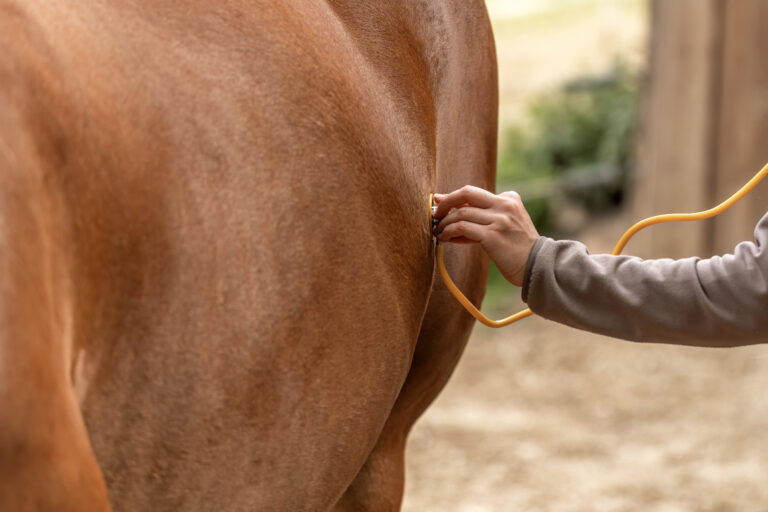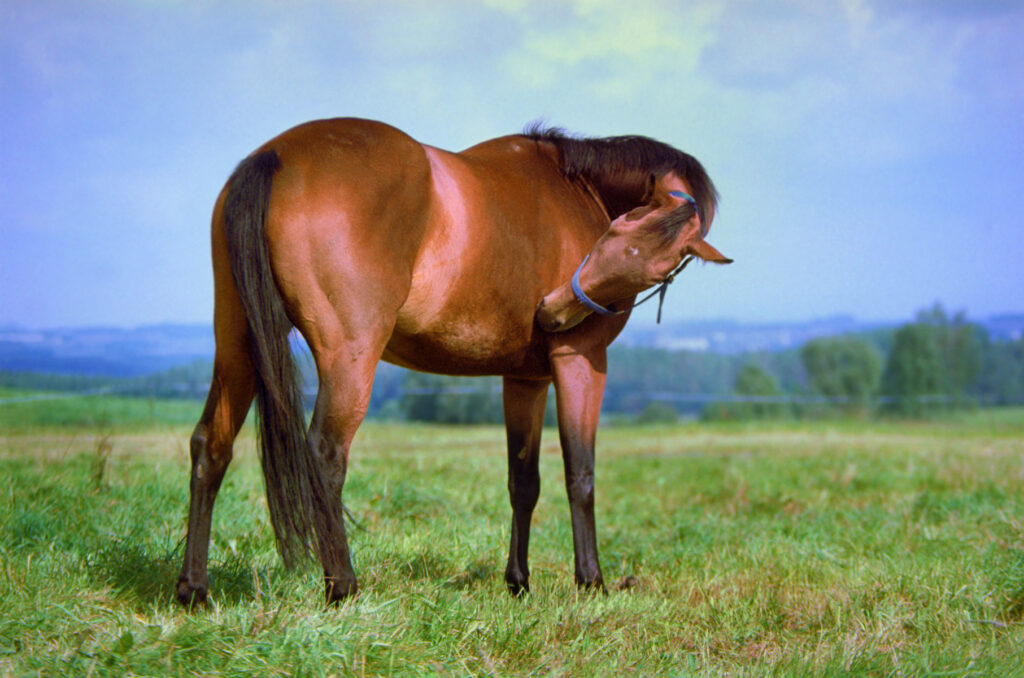
In this episode of the Disease Du Jour podcast, Chelsea Luedke, DVM, MS, cVMA, joined us to discuss gastric ulcers in horses. She talked about risk factors for glandular and squamous disease, offered tips for performing gastroscopy, reviewed treatment options, and more.
This episode of Disease Du Jour is brought to you by Bimeda.
Squamous vs. Glandular Ulcers
Luedke explained that horses experience the highest density of squamous lesions on the margo plicatus, though they can also have lesions above the margo on the lesser curvature. “It’s basically areas where there’s more acid contact,” she said. “We know that horses are very acidic compared to humans. Their pH is in the twos resting, especially after a starch meal.” Thoroughbreds on the racetrack eating high-concentrate diets, for example, experience significant pH drops after feeding that predispose them to developing squamous ulcers.
Glandular lesions occur in the darker pink mucosa in the bottom half of the stomach and pyloric antrum. “Those tend to be different causes,” she explained. “We’re thinking a disruption of the mucosal barrier, so that’s why a lot of times we’ll use prostaglandin analogs to help create a better mucus layer.”
Clinical Signs That Warrant Gastroscopy
Clinical signs of gastric ulcers are often vague and nonspecific. “I no longer tell people that I can predict very well what kind of ulcers we’re going to find because I do feel like the clinical signs are so variable,” Luedke said.
She usually feels confident that horses with mild recurrent colic or those that eat their hay but not their grain have squamous disease. Horses with glandular disease might experience colic a day or two after receiving Bute or Banamine. Ridden horses with gastric ulcers might be reactive to the rider’s right leg or display girthiness, but Luedke noted that these can also be signs of muscular pain.
Tips for Performing Gastroscopy
“It’s definitely a steep learning curve for gastroscopes,” Luedke said.
She said getting a 3.5-meter scope has made a big difference in visualizing the pylorus on every horse, especially the large warmbloods in her practice. She also advocated for proper patient restraint to help prevent nosebleeds. She starts most horses with 5 mg of Dormosedan.
“We find that lighter than that, they’re shaking their head and moving, which increases your chance of nosebleeds,” she said. “More than that, I feel they have a much more delayed swallow reflex, and so then you have a chance of getting into the oral cavity. You can get the end of your endoscope chomped pretty easily pushing through when they’re not on a swallow, and that’s a sad mistake because it takes your scope out for several weeks.” In Luedke’s practice, technicians drive the scope, and DVMs pass it.
Luedke offered more tips on performing gastroscopy in the podcast episode.
Treating Squamous and Glandular Lesions
For squamous disease, Luedke recommends treating with FDA-approved oral omeprazole. She often doesn’t treat horses with Grade 1 lesions unless they exhibit significant clinical signs. For Grade 2 lesions, she recommends a full tube of omeprazole for 28 days. For Grade 3 or 4 horses, she will treat for 28 days and rescope. “Some of those need a full 56 days,” she said.
“The No. 1 thing I coach people and clients through is making sure it’s on an empty stomach,” Luedke continued. “It has to make it all the way into the duodenum and small intestine to get absorbed as a proton pump inhibitor, and that whole cycle won’t work if you give it recently fed.”
For horses with glandular lesions, Luedke typically recommends treating with misoprostol for 21-28 days, as long as the horse is not actively colicking. She also recommends giving sucralfate three to four times a day for five to seven days, especially if the horse is having major performance issues or colic.
Listen to the podcast episode for more insights on gastric ulcers in horses, including Luedke’s advice on tapering treatment and her experience with extended-release injectable omeprazole.
About Dr. Chelsea Luedke
Chelsea Luedke, DVM, MS, cVMA, is a veterinarian with a passion for equine sports medicine, holistic therapies, and helping animals (and their humans) navigate complex care with compassion. She earned her bachelor’s degrees (biochemistry and microbiology), master’s degree, and DVM from Colorado State University. She completed a competitive internship at Piedmont Equine Practice in Virginia and later worked at a high-volume clinic in Wisconsin before returning to Colorado, where she and her husband now own and operate Heritage Equine Clinic.
A certified veterinary acupuncturist, Luedke continues to explore integrative approaches to animal care. When she’s not seeing patients, you’ll find her at the barn, with her family, or on the mic cohosting the Unhinged and On Call Podcast.
Related Reading
- Updates on Treatment of Equine Gastric Disease
- Commercial Feed Additive Aids in Equine Gastric Ulcer Healing
- Identifying New Biomarkers for Equine Gastric Ulcers
Stay in the know! Sign up for EquiManagement’s FREE weekly newsletters to get the latest equine research, disease alerts, and vet practice updates delivered straight to your inbox.
![[Aggregator] Downloaded image for imported item #20304](https://s3.amazonaws.com/wp-s3-equimanagement.com/wp-content/uploads/2026/06/03153709/EDCC-Unbranded-26-300x200-1.jpeg)