In this episode of the Disease Du Jour podcast, Ashley Boyle, DVM, DACVIM, joined us to discuss managing equine strangles outbreaks. She reviewed the pathogenesis of strangles and discussed diagnostic approaches, the role of guttural pouch sampling, environmental contamination, biosecurity protocols, and more.
This episode of Disease Du Jour is brought to you by Bimeda.
Pathogenesis of Strangles
Strangles is caused by the bacterium Streptococcus equi subspecies equi, which enters through the horse’s palatine and pharyngeal tonsils and spreads to the submandibular and retropharyngeal lymph nodes, causing an upper respiratory infection.
The incubation period for strangles is three to 14 days, Boyle said, and the first clinical sign is usually a fever of 103 degrees F or higher. “If you were monitoring the horse’s temperature daily or twice daily and caught that fever right away, you have about 48 hours before they become contagious,” she said.
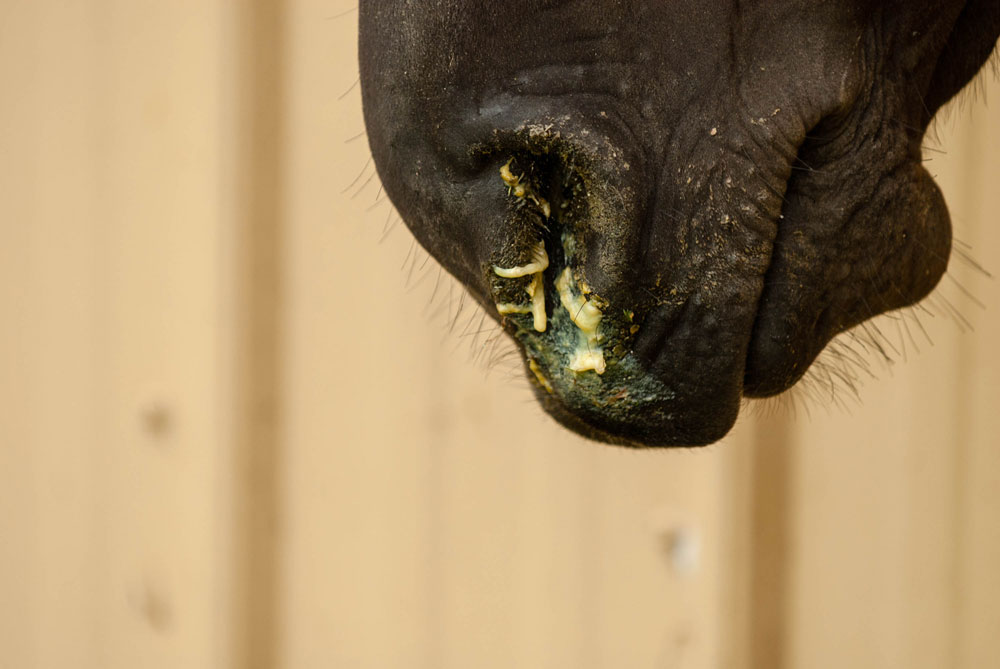
Clinical signs such as nasal discharge and lymph node swelling typically last for about two to three weeks, but horses can remain contagious for much longer.
“There are times when horses can remain positive for many months to potentially up to years after having an infection, depending on whether they keep that bacteria in the guttural pouch,” Boyle said. “They will intermittently shed into the nasal pharynx or into their throat and then intermittently shed into the environment and into the neighboring horses.”
First Steps When Responding to an Outbreak
Boyle said veterinarians responding to a potential strangles outbreak should quickly test and isolate sick horses and recommend twice-daily temperature monitoring for the other horses on the farm.
She reminded listeners that sick horses might not test positive for strangles right away. “They can not shed for about 48 hours, and so you may not pick up the organism on testing immediately,” she said. “Sometimes repeated testing is required.”
For overtly sick horses with lymph node enlargement, Boyle recommends sampling the affected lymph node. If you suspect strangles before the lymph nodes have enlarged, she recommends collecting samples from the nasal pharynx or guttural pouch, noting that the guttural pouch might not yet be infected early in the disease process.
Boyle explained that polymerase chain reaction testing is the most sensitive diagnostic method and can be performed on any of these samples, but she noted that it is often useful to run both a PCR and a culture. “The advantage of that is you will get the cycle count number of the PCR, so it can tell you whether you’re detecting a low number of DNA versus a high number of DNA,” Boyle said. “But the benefit of the culture is multifold. You can use it for culture and sensitivity if you’re having a difficult time treating a horse, and it can also be used for genomic testing as well as determining what bacteria isolate it is, which you cannot do on the PCR samples.”
How to Confirm That a Horse Is No Longer Shedding
Boyle said guttural pouch endoscopy is the gold standard for determining that horses are no longer shedding S. equi. She explained that horses can test negative on PCR while still harboring congealed pus or chondroids in the guttural pouch.
If the veterinarian does not have an endoscope or is not comfortable performing guttural pouch endoscopy, Boyle recommends repeated nasopharyngeal washes. “You do usually need multiple samples when you’re just doing the nasopharynx because you’re trying to catch when that guttural pouch is shedding the bacteria into the nasopharynx intermittently,” she said.
She noted that veterinarians have also used radiographs to visualize the guttural pouch, but this technique is less effective.
Lavage is a mainstay treatment for persistent shedders, but time is also an important factor. “Sometimes it takes a while, so having them in a separate facility is helpful,” she said.
Protocols for Introducing New Horses to a Property
To help prevent a strangles outbreak when introducing a new horse to a property, Boyle advised considering where the horse came from and whether its history is known. “The practicality of every horse going under a guttural pouch endoscopy is probably not realistic,” she said. Instead, she recommends quarantining new horses for three weeks and checking their temperatures daily.
Boyle recommends guttural pouch lavage for horses coming from sale barns and for horses with a limited or unreliable history. “It’s better to do it at the end of quarantine, because then if something is happening or starting to happen, you’re more likely to catch it on that sample,” she explained.
Listen to the podcast episode to learn more about the role of vaccination, tracing exposed horses, potential complications, and more.
About Dr. Ashley Boyle
Ashley Boyle, DVM, DACVIM, obtained her DVM from Cornell University. She did her internship at Littleton Equine Medical and Surgical Center in Colorado and obtained her Diplomacy in Large Animal Internal Medicine after completing her residency at UCDAVIS in 2004. She is a professor at Penn Vet New Bolton Center in the Section of Field Service. Her research interests include infectious disease with a focus on Streptococcus equi subsp. equi and the testing methods associated with disease to help improve herd management.
Related Reading
- Update on a New Strangles Vaccine
- Diagnosing Respiratory Ailments in Horses: Wash or Lavage?
- Preventing Strangles Outbreaks in Horses
Stay in the know! Sign up for EquiManagement’s FREE weekly newsletters to get the latest equine research, disease alerts, and vet practice updates delivered straight to your inbox.