Elevated postprandial insulin levels are of major concern in horses, with concentrations of ≥ 200 uIU/ml associated with an increased risk of laminitis. At the 2025 American Association of Equine Practitioners (AAEP) Convention, Michelle Coleman, DVM, PhD, DACVIM, discussed the use of 5% 1-deoxynojirimycin (1-DNJ) to help decrease horses’ postprandial blood glucose and insulin.
1-DNJ is derived from the white mulberry leaf. It is thought to lower postprandial insulin by inhibiting intestinal glucosidase and mitigating carbohydrate absorption. It also improves insulin sensitivity and decreases circulating inflammatory mediators, especially LPS, IL-6, and TNF-α. Previous studies showing these effects were performed in diabetic humans and mice but not in horses.
Coleman described a study that aimed to determine if 1-DNJ is tolerated and effective at modulating postprandial glucose and insulin responses in healthy horses and horses at risk of metabolic disease.
The study had three phases:
- Tolerance study.
- Dosage safety study in horses at risk of metabolic disease.
- Timing of administration relative to an oral sugar test (OST), where insulin peaks at 60-90 minutes following administration of a glucose challenge.
Tolerance Study
In the tolerance study, researchers gave six healthy horses an escalating dose over a 28-day trial period. Analysis of twice-daily physical exams, CBC and blood chemistry panels, markers of systemic and gastrointestinal inflammation, and feces demonstrated that the drug is well-tolerated and palatable. There was no evidence of systemic or gastrointestinal inflammation or dose-associated changes in TNF-α. CBC, blood chemistry panels, and feces pH and biota were unchanged.
Dosage Safety Study
In the initial dosage safety study, researchers compared 500, 2,500, and 5,000 mg administered twice daily at 30 minutes after feeding. Horses experienced a significant reduction in postprandial glucose, which was dose-dependent with the highest decrease in fasting insulin achieved with the 5,000 mg bid dose.
The researchers concluded that 1-DNJ is well tolerated in horses up to 5,000 mg bid and achieves suppression of insulin and glucose.
The next step was to look at 1-DNJ in horses at risk of equine metabolic syndrome (EMS) and insulin dysregulation (ID). The study included five horses with ID that did not receive medical therapy during the study period. They evaluated the same parameters as in the initial safety study, with oral sugar testing performed on Days 1 and 7. The results showed that 1-DNJ is well-tolerated and palatable, and that clinical and hematologic parameters remain stable. The highest dosing of 5,000 mg twice daily yields the best results.
Final Study Phase
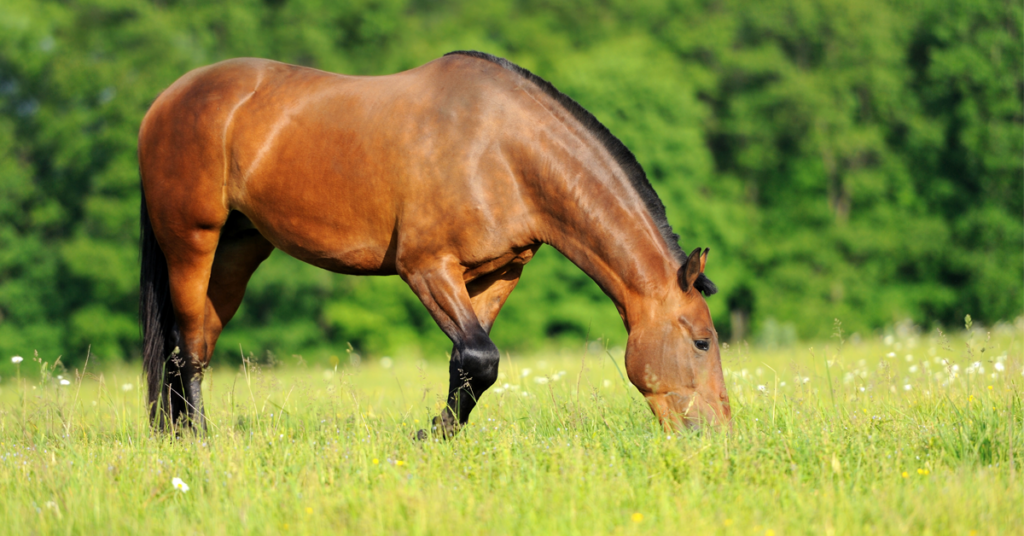
In the final study phase, the researchers looked at six horses with a history of EMS grazing on free-choice pasture. Because 1-DNJ is a reversible inhibitor, they examined the duration of action for insulin suppression at different doses over a longer time and duration:
- 2,500 mg twice daily for 4 weeks followed by a 2-week washout.
- 5,000 mg twice daily for 4 weeks.
OST was done after each four-week dosing period.
The results are encouraging:
- Fasting insulin decreased after 4 weeks on 5,000 mg twice daily.
- Horses did not develop laminitis when receiving the 5,000 mg twice daily dose, despite grazing free-choice pasture. No horses in the study had active laminitis at the start of the study.
- There was a dose-dependent decrease in oral sugar insulin values at 0, 1, 2, and 3 hours following administration of the 2,500 mg twice daily.
- There was a similar decrease in insulin values for several hours after the start of the OST following four weeks of 1-DNJ administration at 5,000 mg twice daily.
- Horses displayed the most profound effects two hours immediately following administration but maintained decreases in insulin and glucose for several hours after the OST. The effects lasted up to three hours following the oral sugar test.
- Looking at insulin concentrations over time, the researchers compared 2,500 and 5,000 mg twice daily administration at Weeks 1 and 4. There were mild changes in insulin concentrations with the 2,500 mg dose. However, the higher 5,000 mg dose resulted in significantly decreased fasting insulin at Week 4.
The authors concluded that the peak effect occurs at up to two hours after administration of 1-DNJ and extends beyond a glucose challenge with an oral sugar test. Horses had consistently lower fasting insulin after four weeks at 5,000 mg twice daily dosing.
Reference
Whitfield-Cargile C, Coleman M, Hart K, Gomes D, Berghaus L, Duberstein KJ, Ellis K, Tinkle A, Shirzad R. Evaluation of the tolerance and effects of 1-deoxynojirimycin on insulin and glucose dynamics in healthy horses and horses at risk for insulin dysregulation. J Vet Intern Med. 2026 Mar 2;40(2):aalag074. doi: 10.1093/jvimsj/aalag074. PMID: 42008488; PMCID: PMC13094544.
Related Reading
- Researchers Assess Prevalence of ID and Subclinical Laminitis in Sport Horses
- Updates on SGLT2 Inhibitors for Horses
- Effects of Pasture and Obesity on ID and Adiponectin in Horses
Stay in the know! Sign up for EquiManagement’s FREE weekly newsletters to get the latest equine research, disease alerts, and vet practice updates delivered straight to your inbox.