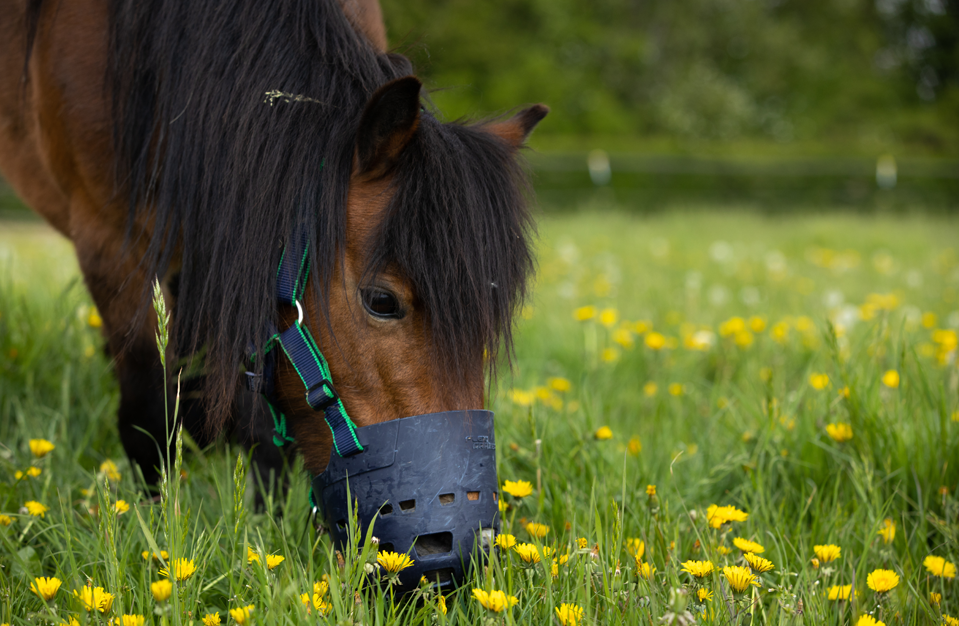
Many horse owners use grazing muzzles on their overweight or insulin-dysregulated animals. To learn more about the prevalence and efficacy of this restrictive grazing method, Morgan Askins, MS, PhD student at the University of Kentucky’s Gluck Equine Research Center, conducted a nationwide survey of equid owners and managers.1
Survey: Prevalence and Efficacy of Grazing Muzzles
The survey included 559 respondents across 44 states. Among the participants, 91.5% had used or tried a restrictive grazing method, most commonly grazing muzzles (81.5%) or a dry lot (81.3%). The most cited reasons for using grazing muzzles were to prevent horses from developing laminitis or becoming overweight. The majority of respondents reported that grazing muzzles provided “somewhat excellent welfare,” exceeding stabling, dry lot, or arena turnout. Most used them in spring and summer for 9-12 hours per day.
Research Project: Effect of Grazing Muzzles on Insulin Responses
In late summer 2025, Askins conducted another research project2 to evaluate the effect of grazing muzzles on insulin responses in ID horses over a 10-hour grazing period. The study included nine mixed breed, mixed sex horses with an average age of 19 years. All had insulin dysfunction with insulin > 50 uU/ml at 60 minutes using an oral sugar test. Two horses also had PPID.
The study used a replicated 2×2 crossover model comparing control (non-muzzled) horses to muzzled horses. Each horse acted as control and non-control twice.
During acclimation and the two-week collection period, horses had ad libitum access to pasture and water. On each of the four sampling days, the researchers collected peripheral blood, heart rate, ambient temperature, and pasture samples every 2 hours for a 10-hour period (9:00 a.m. to 7:00 p.m.). They evaluated plasma insulin, glucose, and pasture NSC.
Pasture NSC ranged from 6-13.8% with an average sward height of 4 inches, which is considered optimal. The horses’ insulinemic responses were significant:
- Insulin levels for the control and muzzled horses were similar at 9:00 a.m., since that was baseline when the muzzles were placed.
- In the non-muzzled horses, insulin increased throughout the day from 11 a.m.-7 p.m.
- In muzzled horses, insulin decreased from 9-11 a.m. and stayed consistently low throughout the day.
In conclusion, grazing muzzles are effective at reducing insulin responses in ID horses on late summer pasture with NSC 6-13.8%.
Askins recommends future research to replicate the study on pastures with higher NSC and to compare warm- versus cool-season grass forage. It would also be valuable to replicate the study in different seasons. To reduce the effects of individual variability, future research could also compare horses with moderate and severe ID, as well as divide ID and PPID horses into separate categories.
References
- Askins, Morgan J., “MANAGING DIETARY NONSTRUCTURAL CARBOHYDRATES IN INSULIN DYSREGULATED HORSES: PASTURE, LONG-STEM FORAGE, AND RESTRICTIVE GRAZING STRATEGIES” (2026). Theses and Dissertations–Veterinary Science. 74.https://uknowledge.uky.edu/gluck_etds/74
- Morgan J. Askins, Patricia A. Harris, Margaret E. McClendon, Amanda A. Adams, Short-Term Effects of Grazing Muzzles on Insulin in Horses with Insulin Dysregulation out at Pasture, Journal of Equine Veterinary Science, 2026, 106095, ISSN 0737-0806, https://doi.org/10.1016/j.jevs.2026.106095.
Related Reading
- 1-DNJ Decreases Horses’ Blood Glucose and Insulin Levels
- Updates on SGLT2 Inhibitors for Horses
- How to Feed Horses Prone to Endocrinopathic Laminitis
Stay in the know! Sign up for EquiManagement’s FREE weekly newsletters to get the latest equine research, disease alerts, and vet practice updates delivered straight to your inbox.