In this episode of the Disease Du Jour podcast, Bo Rainbow, DVM, discussed periodontal disease in horses, including clinical signs, diagnostic approaches, treatment and management strategies, and more.
This episode of Disease Du Jour is brought to you by Bimeda.
What Is Equine Periodontal Disease?
Periodontal disease occurs when the horse’s gingiva recedes, causing feed to become packed between the teeth. This leads to an overgrowth of bacteria and weakening of the periodontal ligament.
While periodontal disease can occur in any horse, it is especially common in senior horses because their teeth narrow with age. Periodontal disease can also occur in horses with malocclusions that haven’t been managed properly, which can cause teeth to rotate and create gaps where feed becomes trapped.
“You end up with anaerobic bacteria getting into that stagnated feed, and then that weakens the periodontal ligament a little bit more and causes some inflammation, and it’s painful,” Rainbow said. “It’s a vicious cycle, because then the periodontal ligament loosens more, and then sometimes adjacent teeth begin to have weakened periodontal ligaments and more periodontal disease. We’ll get adjacent gaps all the way down an arcade sometimes, or on an opposing arcade.”
Rainbow emphasized that periodontal disease is extremely common, affecting 40-80% of horses, according to published reports.
Clinical Signs of Periodontal Disease in Horses
Common clinical signs of periodontal disease that owners might notice include dropping grain, leaving feed, avoiding hay, and quidding. Horses often have a foul odor in the mouth.
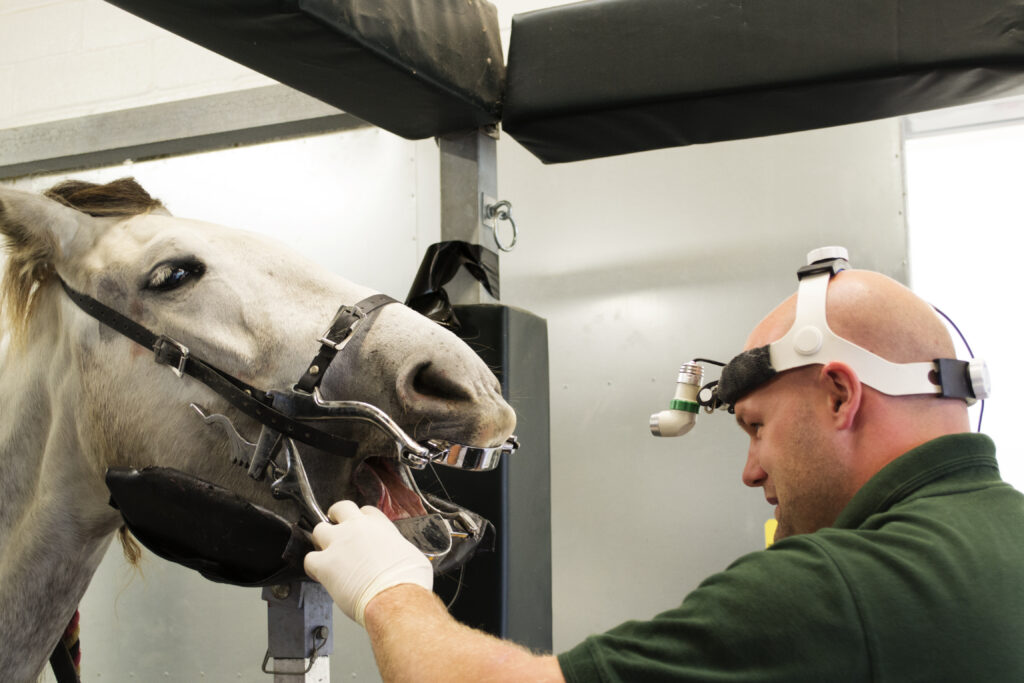
After rinsing out the horse’s mouth, Rainbow often reaches inside with his hand before applying the speculum to feel the topography of the arcades. “If I felt loose teeth, or I felt something that’s really tall or my hand comes out with a smell, those are pretty big clues that I’m probably going to find some degree of periodontal disease,” he said.
If the mirror exam reveals feed stuck between the teeth after the horse’s mouth has already been thoroughly rinsed, that is another clear sign of periodontal disease.
“We’re looking for diastemas, and we’re always calling out if there’s feed, is it a diastema that’s narrow or wide, and is the diastema open or valve?” he said. “That describes the shape of the gap between the teeth to let us know what technique we might need to remedy the periodontal disease.”
Diagnosing and Grading Periodontal Disease
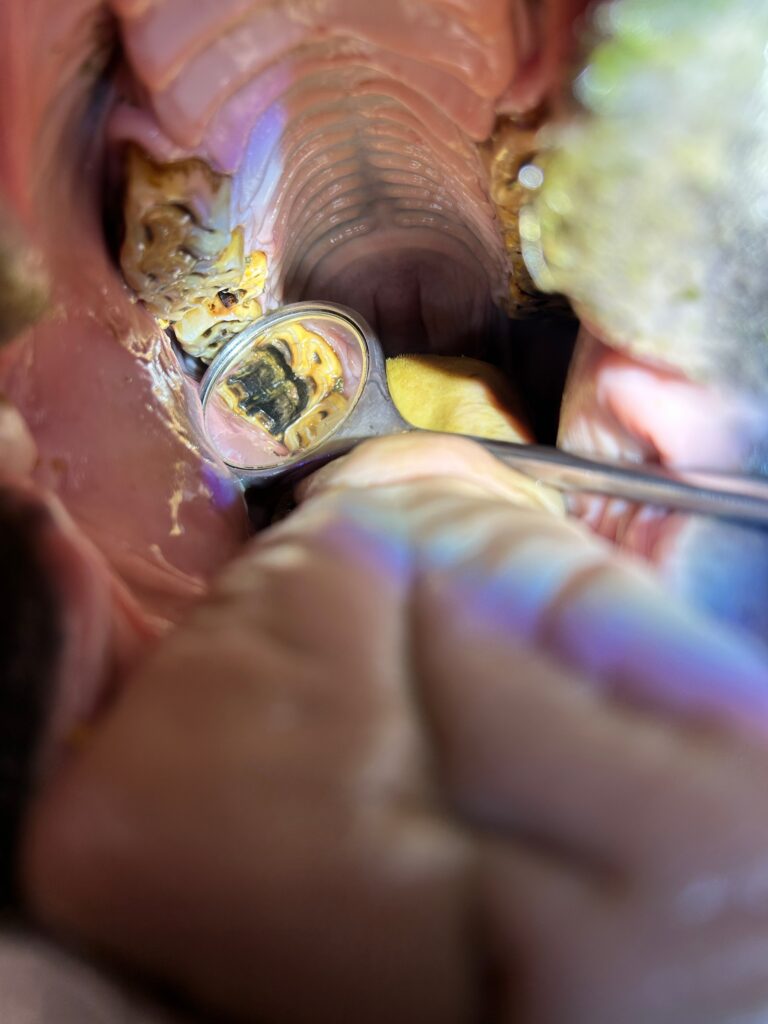
Rainbow said periodontal disease is very easy to diagnose in the field using a mirror exam and a periodontal probe.
He advised inserting the periodontal probe into areas that appear diseased and noting the depth of the periodontal ligament. “It should be 3 millimeters or less,” he said. “If you’re getting it to sink a lot more than that, you have periodontal disease.”
Oblique radiographs allow veterinarians to visualize how much bone has been resorbed between the teeth. Rainbow said horses need to be open-mouthed, sedated, and not wearing a halter to obtain high-quality diagnostic images.
When grading severity, Rainbow considers how deep the periodontal probe sinks next to the tooth and how tall and mobile the tooth is.
“If you bury a periodontal probe 10 mm, but the tooth is 40 mm long, that’s something that hopefully you can treat. Extraction’s a long way away,” he said. “However, if you’re burying a periodontal probe 10 mm and the tooth is only 15 mm long, then you know that this tooth is probably more mobile, is more likely moving in the socket, packing more feed, and this could be a more severe prognosis.”
Rainbow rates mobility on a Grade 1-3 scale:
- Grade 1: The teeth move medially and laterally.
- Grade 2: The teeth move mesially and distally.
- Grade 3: The teeth move up and down in the socket, indicating that the periodontal ligament has effectively been destroyed and the tooth will never have a secure anchor into the horse’s arcade. Rainbow said these teeth typically require extraction.
Treating Periodontal Disease
Rainbow said the first step in treating periodontal disease is flushing the gaps between teeth (he carries a periodontal flushing unit on his truck). He advises rechecking frequently with a mirror to ensure all forage has been removed. He often uses periodontal probes if water alone does not remove all the forage.
Next, Rainbow assesses whether odontoplasty is necessary to take the diastema out of occlusion. If the diastemas are deep enough, he often packs them with metronidazole tablets.
If the horse still has bleeding or unhealed diastemas after treatment, dietary changes might be necessary. Rainbow recommends removing hay and offering hay pellets, hay cubes, or senior feed in a soupy consistency. He said horses can still graze on green pasture.
If the horse has not improved with flushing, odontoplasty, metronidazole, and nutritional changes, additional procedures such as diastema widening or occlusal relief cuts might be required.
“The other option, of course, if the disease has gotten severe enough, is extraction,” Rainbow said. “Occasionally, that leads to the dominoes falling with adjacent teeth, but that’s an option for us.”
Listen to the podcast episode to learn more about how Rainbow manages periodontal disease in his patients.
About Dr. Bo Rainbow
William “Bo” Rainbow, DVM, is from Ocala, Florida, where he grew up on a commercial Thoroughbred farm. Following graduation from Davidson College, he was accepted into the prestigious Darley Flying Start Program to study the Thoroughbred industry around the world for two years. During this time, he knew that veterinary medicine would be his calling, and he was accepted into the University of Florida College of Veterinary Medicine. After graduating in 2012, he worked for the Hagyard Equine Medical Institute and then did stints in Western Australia and Texas before returning to the Bluegrass. He is an owner of Kentucky Equine Dental Specialists in Versailles, Kentucky.
Related Reading
- Ins and Outs of Equine Dental Extractions
- Disease Du Jour: Equine Dentistry Overview
- Disease Du Jour: EOTRH
Stay in the know! Sign up for EquiManagement’s FREE weekly newsletters to get the latest equine research, disease alerts, and vet practice updates delivered straight to your inbox.