This article originally appeared in the Summer 2026 issue of EquiManagement. Sign up here for a FREE subscription to EquiManagement’s quarterly digital or print magazine and any special issues.
More information continues to become available on the ever-changing approaches to managing gastric ulcer syndrome (GUS) in horses. In a webinar presented by Epicur, Dave Rendle, BVSC, MVM, CertEM (Int Med), DECEIM, FRCVS, RCVS, presented the latest updates.
He stressed that no matter the medical approach, failure to address underlying risk and management factors will interfere with resolution of gastric ulcer disease. Basic management strategies include constant access to forage; elimination of grains, especially starches; minimizing stress in training, competition, travel, and at home; and limiting duration of exercise. He suggested offering two liters of fiber before exercise to provide normal matting lower in the stomach and to control mucosal exposure to acid juices.
Esomeprazole (ESO)
The first medication Rendle reviewed is esomeprazole (ESO). While similar to omeprazole (OMP), ESO is absorbed more rapidly and consistently, is metabolized more slowly, is less affected by feeding, and offers a fivefold greater pronounced acid suppression with a longer time at pH > 4. In essence, ESO is equivalent to a double dose of OMP.
He advised using ESO for severe cases of equine squamous gastric disease (ESGD) and for equine glandular gastric disease (EGGD) where extended-release injectable omeprazole (ERIO) is not an option. It can also be used to extend treatment time after the 2-3-week ERIO injection protocol ends.
Rendle noted that ESO use in horses is not FDA-approved at this time. With this in mind, it is important to acquire informed owner consent when using non-FDA-approved medications that have not completed safety studies in horses.
Extended-Release Injectable Omeprazole
Compared to oral OMP, the extended-release injectable OMP achieves superior acid suppression, with a pH elevation above 4 within 24 hours of the first dose. Its effects begin to lessen by Day 5, but ERIO still provides better acid suppression than oral OMP at Day 7. In a study of 24 Australian Thoroughbreds, 100% of ESGD lesions resolved at two weeks after two injections. Seventy-five percent of EGGD lesions resolved at two weeks, and the remaining 25% improved by at least one grade.
In another study of 29 horses receiving ERIO and 27 given oral OMP, 97% of squamous lesions treated with ERIO healed after two weeks compared to 67% using oral OMP. The researchers noted a significant difference at four weeks. For glandular lesions, 82% healed with ERIO compared to 50% with oral OMP.
A study on endurance horses in training—100 with ESGD lesions ≥ 2/4 and 88 with EGGD lesions ≥ 2/4—showed a fourfold difference in healing: 79% of squamous lesions healed with ERIO compared to 21% with oral OMP; 42% of glandular lesions healed with ERIO compared to 10% healing when treated with oral OMP.
At the Equine Colic Research Symposium in July 2024, a Utrecht study compared the use of oral OMP, OMP combined with sucralfate, and ERIO. The study authors saw a significant reduction in ulcer scores using ERIO as well as using a combination of OMP and sucralfate. The most significant result of this study is that oral OMP alone did not change EGGD lesions.
ERIO 5-Day versus 7-Day Treatment
Studies have demonstrated that treating EGGD horses with ERIO every five days results in better outcomes than injecting every seven days. Researchers compared 43 horses treated with ERIO at five-day intervals to 39 horses treated at seven-day intervals.1
- For healing to Grade 0: 69% healing with five-day interval vs. 38% with seven-day interval.
- For healing to Grade 0 to 1: 93% healing with five-day interval vs. 63% with seven-day interval.
The recommendation is to administer two to three ERIO injections for squamous lesions and three to four injections for glandular lesions, preferably at five-day intervals.
When treating squamous lesions, the researchers saw no significant difference in healing between five-day and seven-day intervals (95% and 83% healing, respectively).
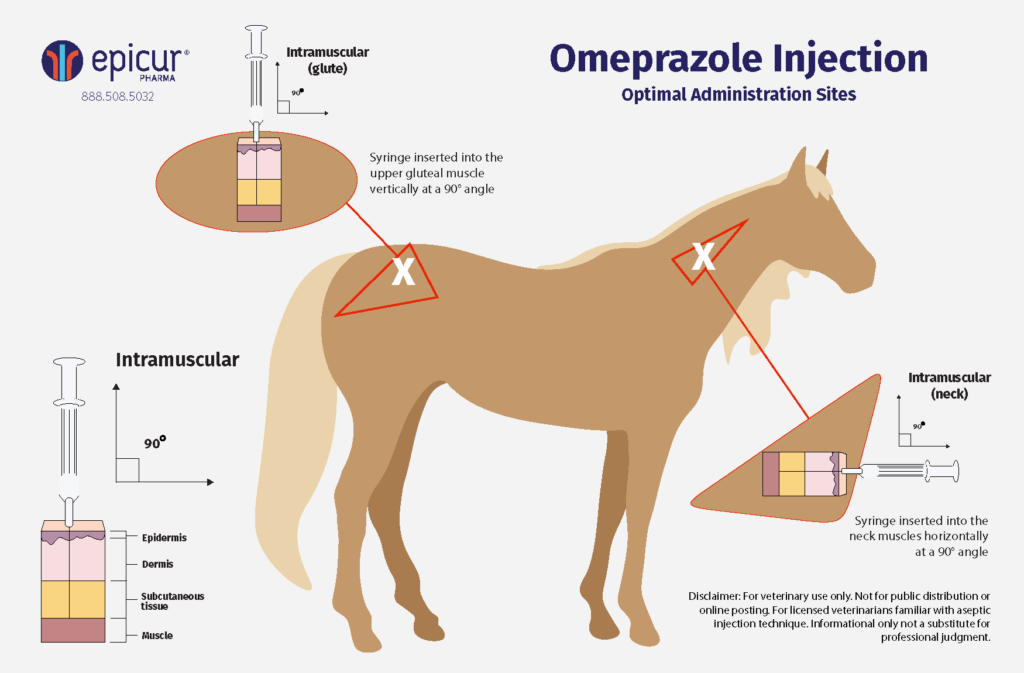
Rendle said the ERIO injection can cause a localized inflammatory reaction, so it is best to alternate muscles with subsequent injections to avoid irritation. He recommends using the gluteal muscles or the neck and avoiding the pectorals or hamstring muscles.
Safety studies on more than 214,000 doses demonstrate that localized swelling occurs in 1 in 20-50 horses; abscesses form in 1 in 1,000 horses; and 1 in 50,000 might suffer a systemic reaction. Always aspirate before injecting. Warm the material prior to injecting, shake well to reconstitute, and use an 18-gauge
1 ½-inch needle. It is important not to split the dose but rather give all 20 milliliters in one injection site. Rendle said it’s OK to redirect the needle in the same muscle group rather than splitting the dose into two different muscle sites. He cautioned against using more than four to six doses at 4 mg/kg. This oil-based ERIO is not recommended for preventive treatment due to its potency.
Take-Home Message
Treating ESGD involves feeding and management strategies as well as medication. For cases refractory to oral OMP, Rendle recommends administering oral ESO or two doses of ERIO injected every five days.
Treating EGGD requires a more holistic approach, said Rendle. He suggested potential benefit from administering other medications that do not specifically target acid suppression, such as misoprostol (a prostaglandin E analog to promote mucosal healing), sucralfate to stimulate mucus secretion and other favorable effects, and pectin/lecithin to assist mucosal protection. Corn oil (45 ml daily) can also help reduce acid and increase prostaglandin E. Pre- and probiotics have not been shown to alter the microbiome but might help keep ESGD lesions from getting worse.
In summary, ERIO is more effective than alternatives but can only be used for short therapeutic courses of up to four doses every five days. Long-acting intramuscular omeprazole significantly improves the lesion score for both ESGD and EGGD, even when these lesions had not responded to prior treatment with oral omeprazole. ERIO can also be combined with sucralfate for potential added benefits. For all GUS issues, Rendle stressed: “Treatment is irrelevant if management is not effective.”
Reference
- Sundra T, Kelty E, Rendle D. Five- versus seven-day dosing intervals of extended-release injectable omeprazole in the treatment of equine squamous and glandular gastric disease. Equine Vet J. 2024 Jan; 56(1): 51-58.
Related Reading
- Commercial Feed Additive Aids in Equine Gastric Ulcer Healing
- Identifying New Biomarkers for Equine Gastric Ulcers
- Activated Charcoal: Potential Treatment for Equine Gastric Ulcers?
Stay in the know! Sign up for EquiManagement’s FREE weekly newsletters to get the latest equine research, disease alerts, and vet practice updates delivered straight to your inbox.