In this episode of the Disease Du Jour podcast, Courtney Mangano, DVM, joined us to talk about New World screwworm (NWS). She discussed the status of the current outbreak, the organism’s lifecycle, clinical signs and differential diagnoses, risk factors and transmission, biosecurity and sampling protocols, the AAEP’s new guidelines, and more.
Mangano works for the New York State Department of Agriculture and Markets, Division of Animal Industry. She oversees all reportable equine diseases for New York as well as foreign animal disease investigations. She is a member of the AAEP’s New World Screwworm Task Force and a co-author on the AAEP’s NWS Guidelines.
This episode of Disease Du Jour is brought to you by Bimeda.
Update on the Current NWS Outbreak
At the time of recording, there were 11 confirmed NWS cases in cattle and small ruminants in Texas and one case in a dog in New Mexico. Mangano directed listeners to the USDA’s New World Screwworm dashboard at screwworm.gov for updates on confirmed NWS cases. The dashboard also tracks wildlife, feral animals, and NWS fly detection in flytraps.
“Unfortunately, we don’t know where [NWS] is going next, but this is the work of modelers at USDA to help us know where we may see the next detections,” she said.
Overview of the NWS Organism
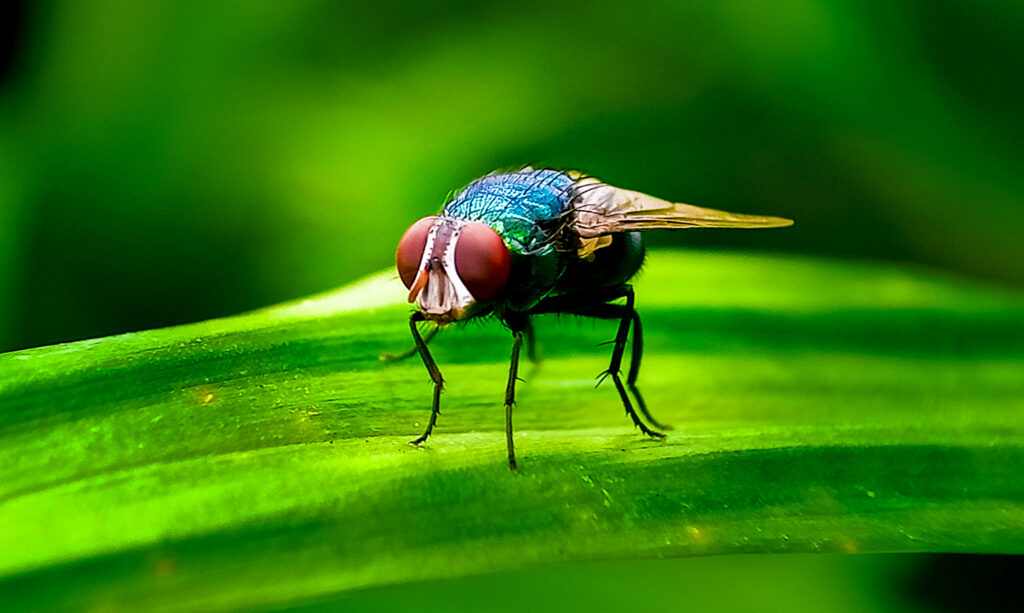
Mangano explained that NWS infestation is caused by Cochliomyia hominivorax, a parasitic blowfly not native to the U.S. The blowfly’s larvae consume only the living flesh of warm-blooded animals, making it unique from other native blowflies in the U.S.
Female flies mate only once in their lifetime, but they can lay hundreds of eggs at a time and lay eggs more than once. Eggs hatch within 12 hours and begin feeding on living tissue at the edges of a wound or near a mucous membrane.
“As they feed, they burrow down into the skin, making wounds look deeper and larger,” Mangano said. “The larval feeding creates secretions and little oozes and a scent that attracts more flies.”
Larvae become visible to the naked eye within three days. After a week, larvae fall off the wound, burrow into the ground to pupate, and emerge from the soil as flies in seven to 65 days. They breed, and the cycle repeats.
“Other myiasis cases can look similar at a distance, which is why this warrants a more thorough exam,” Mangano said. “Non-New World screwworm myiasis lesions are more superficial. They occur on dead and dying tissue, and maggots can be seen in the matted hair or other discharge. But New World screwworm lesions are going to be in living tissues, which continue to get larger and deeper over time.”
Risk Factors for NWS
Horses are at increased risk for NWS infestation if they have a wound from an injury, surgery, medical procedure, or certain husbandry practices.
“Keep in mind, horses that are living in high-risk areas that are undergoing elective husbandry practices where wounds can be created, like clipping, branding, gelding, possibly dental procedures, we need to be sure to monitor these horses carefully and check those wounds and practice excellent wound care management,” Mangano said.
She reminded listeners that feral horses and horses that aren’t halter-broken could succumb to NWS infestation because they are not examined closely.
Clinical Signs of NWS Infestation
Clinical signs of NWS infestation that veterinarians should watch for include non-healing wounds that are getting larger and deeper over time. Wounds can have a blood-tinged ooze or a foul smell. You might see maggots within the wound or white eggs on the edge of the wound laid in a shingle-like pattern.
Mangano said wounds can be as small as a tick bite. She urged veterinarians to watch for changes in the horse’s behavior. Is the horse acting aggressive, quiet, or trying to isolate itself? Is it shaking its head, stomping, or trying to look at the wound area? Has it stopped eating?
“We want you to look everywhere,” she said. “Take off the fly mask. Take off tack where a rub could be.” She also advised looking inside horses’ mouths and ears, lifting their tails, checking their sheaths and udders, and checking the umbilicus of foals.
Potential Spread to Lower-Risk States
Mangano explained that NWS infestation requires competent NWS flies in an area, as well as animals with wounds.
“Vets in low-risk states, like myself up here in the Northeast, we need to be aware of the disease and that it could spread if there’s illegal movement of infested domestic animals or movement of infested wildlife, which introduces it to a new area,” she said. “Some of these infested but untreated animals that have wounds could be in the early larval stages of development that we can’t yet see with the naked eye.”
Immediate Steps for Suspected NWS Infestation
If a veterinarian suspects NWS infestation in a horse, they should immediately isolate the animal, ideally on a surface that prevents the pupa from burying into the ground, such as on concrete or in a stall.
Next, the veterinarian should contact their state’s regulatory officials, who might advise them to administer a topical larvicide.
“You want to collect multiple larvae from around the wound, because you could have different types of larvae,” Mangano said. “Some could be New World screwworm, some could be secondary.”
After removing the larvae needed for sampling, the veterinarian should clean all larvae from the wound and dispose of them securely, with guidance from their regulatory official. Then, clean the wound, keep it covered, implement good wound management, and treat the animal with an FDA-approved product.
“Fewer treatment options exist specifically for horses, and those products that are approved are also approved for other species as well, which can create a high demand for these treatments,” Mangano said. “So, plan ahead. If you’re in a high-risk area, you may want to have some of those [treatments] in stock.”
Mangano directed listeners to the AAEP’s New World Screwworm Guidelines for more guidance on collecting samples.
Final Thoughts
In closing, Mangano addressed a misconception she has seen circulating among horse owners that NWS is just fly strike. “This is not regular fly strike. Animals are going to pay a consequence if owners continue to think that this is regular fly strike,” she said.
She reminded veterinarians that reporting suspected cases and identifying infested areas are the only ways to enable eradication efforts using the Sterile Insect Technique (SIT). “SIT works, but it takes several rounds to be effective,” she said. “Failure to identify these cases allows for the proliferation and spread to new areas, which is exactly what we don’t need.”
Listen to the podcast episode to learn more about New World screwworm.
About Dr. Courtney Mangano
Courtney Mangano, DVM, works for the New York State Department of Agriculture and Markets, Division of Animal Industry, which is the State Veterinarian’s Office in New York.
She graduated in 2002 from the University of Illinois at Urbana-Champaign and has been at the department for 20 years. She manages many programs for the state, most notably overseeing all the reportable equine diseases. She also oversees foreign animal disease investigations.
She became a foreign animal disease diagnostician in 2015, which involves specialized training generally reserved for regulatory and military veterinarians to help investigate and manage confirmed or suspected outbreaks of highly contagious or exotic diseases in livestock and poultry.
She has been an AAEP member for over 10 years and recently became a member of the Infectious Disease Committee. She is now part of the AAEP’s New World Screwworm Task Force.
Resources
Related Reading
- New World Screwworm Update: What Equine Veterinarians Need to Know
- USDA Confirms Presence of New World Screwworm in the United States
- Update on New World Screwworm Cases
Stay in the know! Sign up for EquiManagement’s FREE weekly newsletters to get the latest equine research, disease alerts, and vet practice updates delivered straight to your inbox.