In early June, industry partners from Colorado collaborated with veterinarian leadership at the USDA and the Colorado Department of Agriculture to provide up-to-date information about New World screwworm and what to do to keep livestock and horses safe.
During the webinar, Colorado State Veterinarian Maggie Baldwin, DVM, urged veterinarians to focus on what they can do through preparation to mitigate risk and keep clients informed. Assistant Colorado State Veterinarian Eryn McGrath, DVM, described the parasite’s ecology and shared important facts about screwworm’s potential impact on different areas.
- The parasite prefers tropical, subtropical, and temperate climates with warmth and humidity. All life cycles are highly weather dependent.
- Flies are inactive at less than 65 degrees Fahrenheit. In areas of freezing temperatures, low humidity, and high elevation, screwworm flies are not likely to be abundant or even present. McGrath said Colorado’s foothills, Eastern Plains, and Western Slope have favorable conditions at certain times of the year, especially microhabitats with vegetation and water.
- Eggs hatch within 12-21 hours at 95 degrees F.
- Larvae are temperature sensitive and create their own heat while feeding in mass. They may not be visible until reaching the third instar phase, which can take about three days.
- Pupae can take 6-8 days to develop in optimal temperatures but as long as 54 days in cooler temperatures. Their hard casing makes them immobile, and while they don’t need soil, they need shelter and cannot survive for a sustained time below 46 degrees F.
- Male screwworms live 2-3 weeks; females live about 10 days but can survive up to 30 days.
- Females mate only once per lifetime. Mating with a sterile male does not produce viable eggs. This is critically important relative to sterile screwworm release programs. A fertile population dies over a few life cycles.
- Screwworms typically fly for only 13 seconds at a time but might fly as far as 2 miles to an area with high host density or up to 12-15 miles with low host density. Distance traveled depends on host animal movement and congregation.
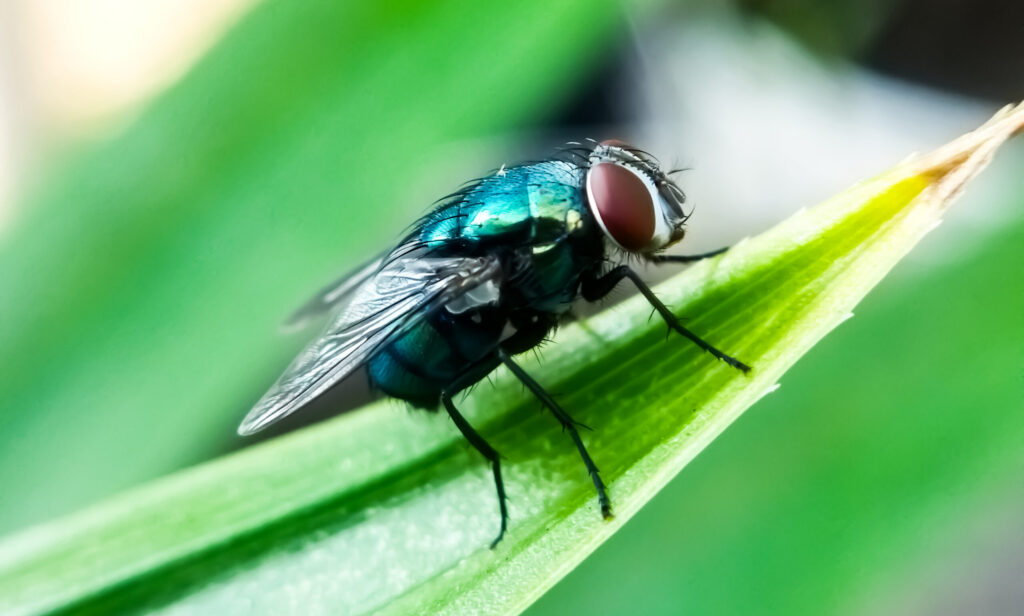
Female flies are attracted to wounds and orifices such as the nostrils, eyes, orbits, and navels of foals. Areas of recent surgery and even tiny tick bites are at risk of infestation. Unlike other myiasis infestations that invade rotting flesh, screwworm larvae burrow in and feed on living flesh, creating extensive tissue damage.
Current Outbreak Status
While New World screwworm was eradicated in the United States in 1966, a short-lived outbreak occurred in 1971. The Mexico-U.S. Screwworm Eradication Commission formed in southern Mexico in 1972. In 2016, an outbreak among Florida wildlife endangered Key deer, but eradication was successful. The Darien Gap in Panama has provided a barrier to further northward movement until 2023, when this biological barrier was breached. The Panama-United States Commission for Eradication and Prevention of Screwworm (COPEG) previously and currently focuses on this area of biological control, yet screwworm populations have invaded Mexico and have now entered Texas and New Mexico.
As of June 3, 2026, officials have reported more than 172,000 cases in animals and more than 2,070 in humans. Most cases are in cattle and occasionally in dogs and a goat.
The USDA protocols have outlined specific zones for potential control:
- Infested zone (IZ), which immediately surrounds an infested premise or location with at least a 20-kilometer (12-mile) perimeter.
- Adjacent surveillance zone, which is a 20-kilometer perimeter beyond the IZ perimeter.
- Fly surveillance area, which extends out to 200 kilometers (124 miles) and is based on environmental assessment for fly habitat and geographic range.
Prevention Strategies
Prevention of New World screwworm spread hinges on multipronged strategies:
- Sterile fly production and dispersal of about 500 million flies per week. Currently, the COPEG center in Panama is only able to produce 100 million flies per week. Mexico built two new sterile fly dispersal centers last year, and a fruit-fly production facility in Mexico is being converted during the summer of 2026 with hopes of producing 100 million flies per week by the end of the year. In addition, the Moore Air Base in Texas is hoping to generate 300 million flies per week but realistically might produce 100 million flies per week by November 2027.
- The sterilized fly pupae are dyed with a fluorescent dye powder that shows up on their head structure. This does not impact mating behavior but distinguishes between sterile versus nonsterile flies.
- Fly surveillance strategies are critical and include sticky fly traps in 13-by-6.5-inch irrigation pipes. These are used for passive trapping, especially at sites of high host density for livestock or wildlife; the lure scent travels downwind into preferred vegetation and trees. Active fly trapping with liver-baited net traps are also being used with real-time observation by trained trappers.
- Animals should be inspected and monitored daily via mounted inspections, detection-trained dogs, game cameras, and drones in rugged terrain.
- Insecticide can also help control infestations.
- Management strategies include eliminating or changing timing of dehorning, castration, branding, or tail docking of livestock. Enclosures and pastures should be checked for sharp objects that could wound animals. Umbilical cords and wounds should be treated with approved insecticide, and flea and tick control implemented where appropriate.
- Relationships should be established with local veterinarians to enable rapid diagnosis and reporting along with faster access to wound management and treatment with approved prescription medications. Movement of animals is to be documented and within compliance of regulatory requirements, along with operation-specific surveillance. Coordination and communication across agencies, industries, livestock markets, brand inspectors, and livestock officials is essential to provide adequate control. Livestock movement from Mexico is completely restricted at this time.
Surveillance and Movement Requirements
Companion animals are also susceptible to screwworm infestation. Western Slope field veterinarian Morgan McCarty, DVM, recommends regular inspection of wounds, hot spots, tick and flea bites, and ear infections, especially in dogs with long hair. Any wound that enlarges, drains excessively, or has a foul odor or visible larvae should be evaluated and treated promptly. Remove any larvae found in a wound using forceps and submit them to State animal health officials for identification, even if it’s just a bot fly, because multiple myiasis parasites often invade a wound. Veterinarians should wear gloves and remove larvae from several sites and depths within open wounds and put them into a container with 70% isopropyl alcohol or ethanol. Do not submit live larvae.
An accredited veterinarian in the origin state must issue a Certificate of Veterinary Inspection (CVI) of all warmblooded animals from infested zones within five days of movement with a statement that all animals were inspected and found free of evidence of New World screwworm infestation. All animals are inspected upon arrival at their destination. Specific show and fair guidance is forthcoming.
Resources
- New World Screwworm Response Playbook: www.aphis.usda.gov/sites/default/files/nws-response-playbook.pdf
- NWS Information for Veterinarians: https://www.fda.gov/animal-veterinary/safety-health/new-world-screwworm-information-veterinarians
- New World Screwworm Producer Resources: www.Bqa.org/screwworm (While this site is cattle oriented, it features good information for everyone as this situation evolves.)
- Import Regulations: www.aphis.usda.gov/live-animal-import
- Information about prevention and drug approval to manage Screwworm myiasis: https://www.fda.gov/animal-veterinary/safety-health/new-world-screwworm-information-veterinarians
- https://www.fda.gov/animal-veterinary/cvm-updates/fda-issues-emergency-use-authorization-topical-powder-prevent-and-treat-new-world-screwworm-multiple
- General drug facts: https://www.fda.gov/search?s=NWS
- NWS Reportable Disease Information: https://www.aphis.usda.gov/sites/default/files/nws-ows-case-definition.pdf
Related Reading
- USDA Confirms Presence of New World Screwworm in the United States
- New World Screwworm Poses Threat to U.S. Horses
- Disease Du Jour: Equine Infectious Disease Patterns and Threats
Stay in the know! Sign up for EquiManagement’s FREE weekly newsletters to get the latest equine research, disease alerts, and vet practice updates delivered straight to your inbox.