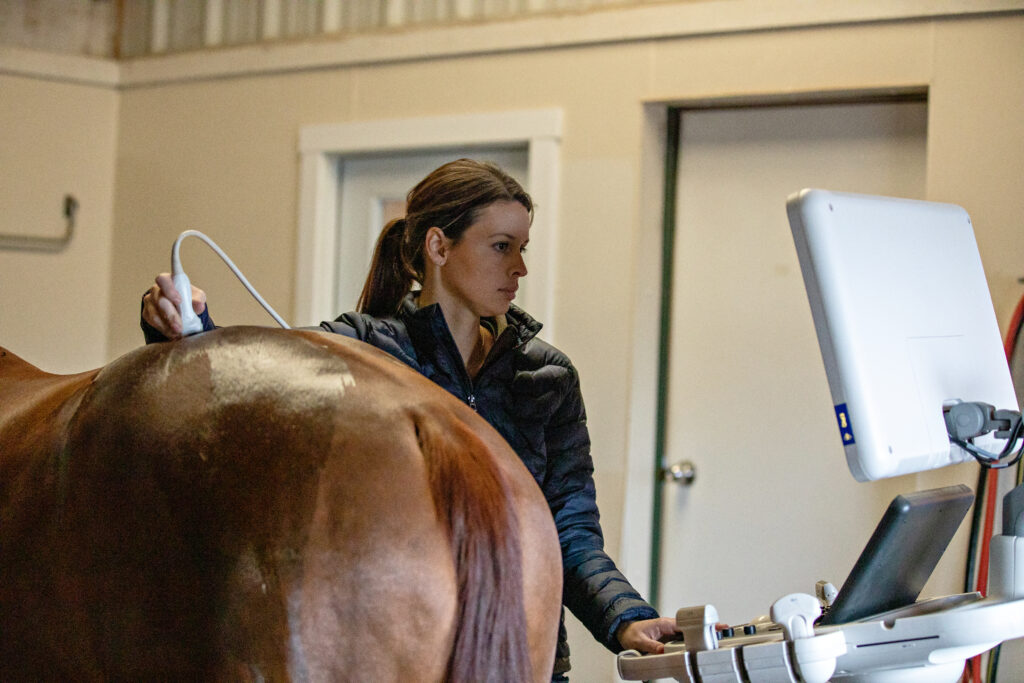
During a “Burst” session at the 2024 American Association of Equine Practitioners Convention, Sherry Johnson, DVM, MS, PhD, Dipl. ACVSMR, senior partner at Equine Sports Medicine and Rehabilitation, LLC in Pilot Point, Texas/Scottsdale, Arizona, offered tips for performing equine ultrasounds in the field.
Clip the Horse
In these scenarios, she urged practitioners to clip the region of interest whenever possible, then wash the region well with soap and water. Ideally, the owner can clip, wash, apply ultrasound gel, and cover with a damp standing wrap so the skin has had a chance to soften by the time you arrive for the exam.
“You get much better image quality when the horse is clipped,” said Johnson.
Adjust Your Machine Settings
For deeper structures or regions that don’t image as easily, decrease the frequency to produce more diagnostic images.
“After decreasing frequency, then increase gain as needed. Do not just crank up the gain without addressing frequency first due to losses in image resolution,” Johnson advised.
Use the time gain compensation (TGC) sliders to remove aberrant white TGC lines that might course across the image and reduce image quality. They correspond to image regions from top to bottom.
Next, turn off your harmonics (contrast harmonic imaging) to optimize imaging of more superficial tissues.
“The single hourglass icon indicates harmonics are off,” said Johnson.
Use the “presets” to optimize softness and contrast.
“The presets are machine-dependent. You’ll need to work with your ultrasound provider to decide which preset is best for you and to identify which preset to use for each anatomic region,” said Johnson.
Consider Your Stand-Off Options for Equine Ultrasounds
Finally, consider your stand-off options. Johnson recommended retiring the bulky standoffs and stepping into the world of “superflab.” This is an industrial plastic that comes in sheets that stick to the leg once gel is applied. There is much less artifact than the bulky standoffs that fix directly to the probe, but they require a bit of a learning curve to use.
“You can’t always control hairy legs, patient cooperation, or the barn lighting, but you can control your ultrasound settings!” said Johnson.
Related Reading
- Rehabbing Equine Hind Proximal Suspensory Ligaments
- 2024 AAEP Convention Research Highlights
- Imaging Techniques for Equine Maxillary Cheek Teeth
Stay in the know! Sign up for EquiManagement’s FREE weekly newsletters to get the latest equine research, disease alerts, and vet practice updates delivered straight to your inbox.