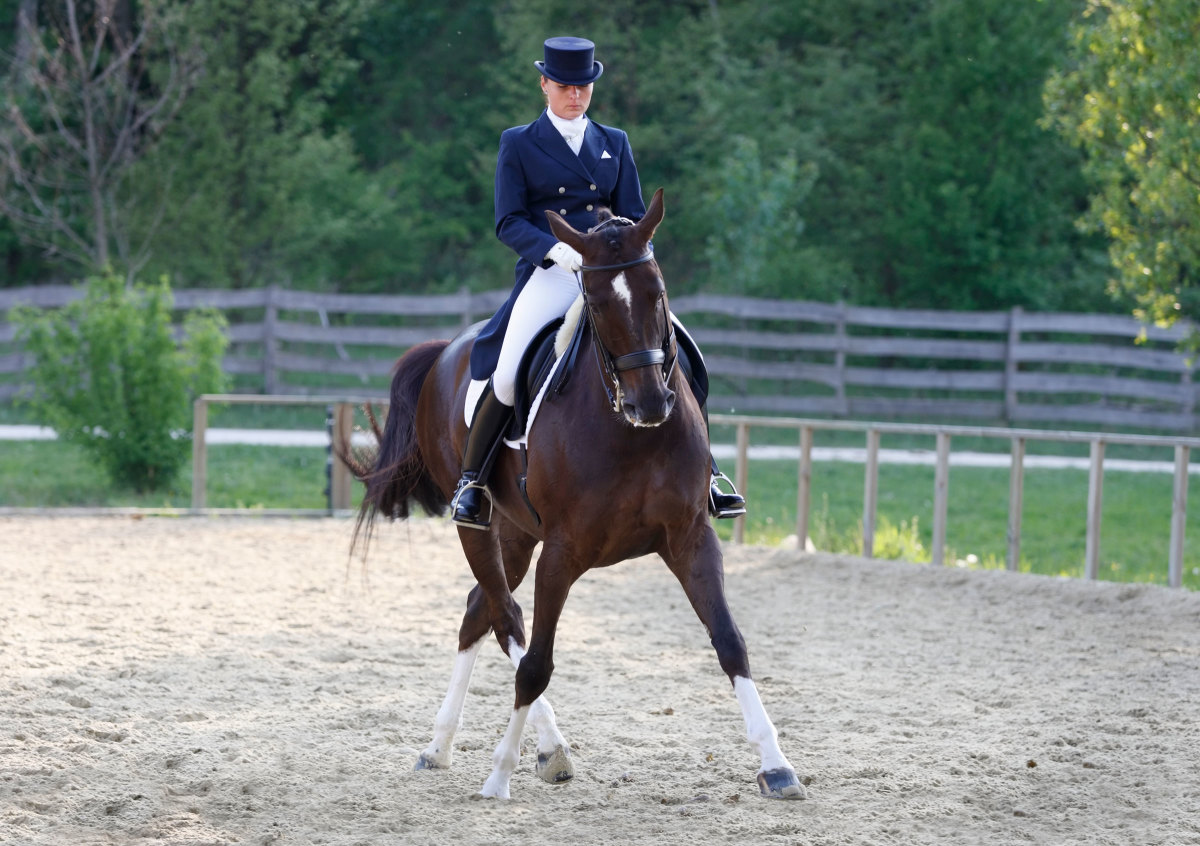
Biosecurity is an essential strategy to limit the spread of equine disease, both at home and at equestrian events. A Canadian two-day dressage horse show was used for a model study on minimizing spread of equine influenza virus [Spence, K.L.; O’Sullivan, T.L.; Poljak, Z.; Greer, A.L. Estimating the potential for disease spread in horses associated with an equestrian show in Ontario, Canada, using an agent-based model. Preventive Veterinary Medicine, March 2018, vol. 151; pp. 21-28].
Sixty-nine horses attended the Canadian dressage show, and 710 horses (non-attendees) were impacted at 38 respective barns upon the show horses’ return home. Using a simulation model based on that scenario, the researchers “infected” one show participant with equine influenza. Infection in this model occurred only due to direct contact rather than including fomite contact.
Vaccination against influenza virus decreases appearance of clinical signs, probability of transmission and duration of illness. Assuming that vaccination is about 50% effective, this model estimated that vaccinated horses had a 47% probability of transmission per effective contact.
The model also assumed a minimum of at least 36% vaccination rate for horses at the show and, similarly, for non-attendee horses left at home. Thee study looked at three possible interventions:
- quarantine of horses attending the show upon return to home facility—two days, five days, or 14 days;
- targeted increases in the initial facility-level vaccine coverage prior to show season, from 36% vaccination of the herd to 50% and 75% vaccination coverage;
- a combination of the preceding two strategies.
Historically, the duration of an outbreak lasts from 18-30 days (Canadian event) or 14-20 days (Japan) in a partially vaccinated population. These attack rates and duration were considered the base-case scenario. Also taken into account was the number of horses at each home facility, along with a different number of potential owners.
Horses quarantined for five or 14 days had a significantly reduced attack rate—by about 91%. As might be expected, the longer quarantine duration yielded the best protection against an outbreak. Quarantine for five days resulted in an illness duration of 8.9 days; a 14-day quarantine resulted in an illness duration of 7.75 days. Increasing vaccination to 75% (but without quarantine) within barns of four or more horses led to the lowest attack rate, at 36% less than the base-case scenario.
If horses were vaccinated but only quarantined for two days, the attack rate decreased by 23% compared to the base-case scenario, although illness duration was similar to the base-case scenario. A combination of quarantine with increased numbers of horses included in herd vaccination resulted in the largest decrease in attack rate.
In summary, while a 14-day quarantine is best, compliance is often an issue and therefore, a five-day quarantine is acceptable, especially when 75% of the herd is vaccinated. These quarantine periods can reduce attack rates by 91%.
The report stated that, “A 14-day quarantine period would be most beneficial for facilities with any level of vaccine coverage, or when the vaccination status of individual horses within the facility is unknown. At a higher level of vaccine coverage, two- or five-day quarantine periods could be used to minimize the potential for an outbreak when quarantine for 14 days would not be feasible.”