
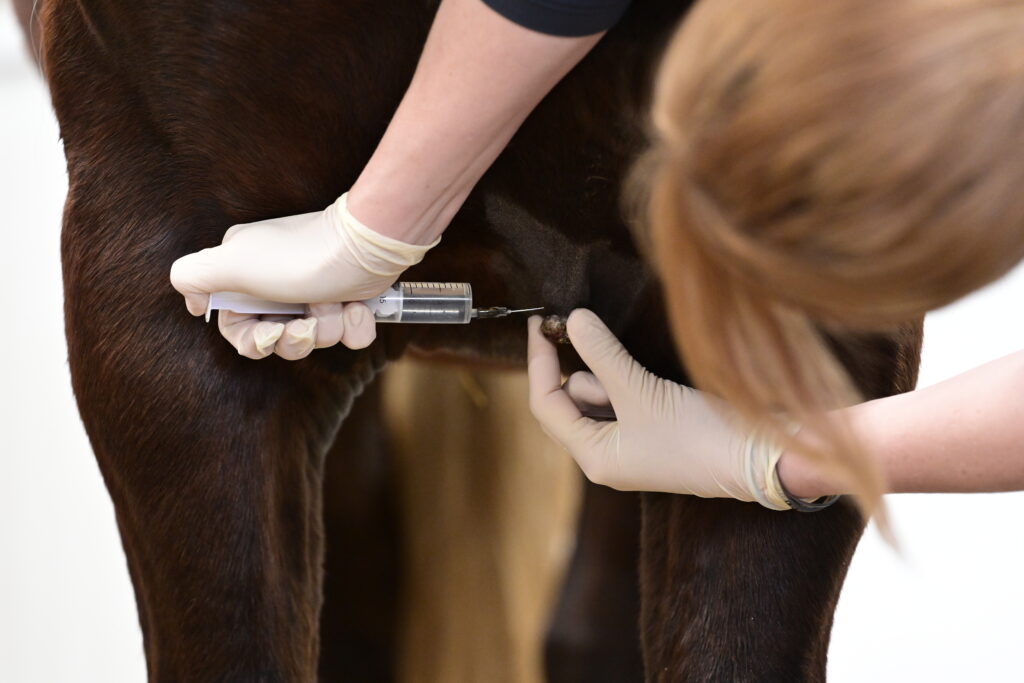
Sophie Bogers, BVSc, MVSc, PhD, DACVS LA, from the Department of Large Animal Clinical Sciences at the Virginia-Maryland College of Veterinary Medicine, explained how to treat cutaneous skin tumors in horsesduring a presentation at the 2025 American Association of Equine Practitioners Convention. She recommended equine veterinarians have a solid plan for the surgical excision of masses as well as postoperative carein the case of incomplete excision.
She provided conference attendees a list of “Golden Rules” for good surgical approach to equine skin neoplasia:
1. Choose a surgical dose
Using sarcoids as an example, Bogers recommended basing “surgical dose” on anatomic location.
“Can you get surgical margins? Is the tumor near vital structures, or is it in on the trunk or abdomen where you can get good lateral and deep margins?” Bogers asked.
Margins will vary depending on tumor type and previous biopsy results. For example, a radical surgical excision or partial amputation might be needed for penile squamous cell carcinoma or an auricular sarcoidversus a marginal excision for a melanoma. Further, Bogers said the horse has a history of a previous surgery and a sarcoid has regrown, for instance, scar tissue is likely going to be present. Wider, deeper margins will be beneficial.
2. Plan resection margins
“Drawing helps,” Bogers emphasized. “Use sterilized markers or Sharpies before the final scrub, ensuring you mark vital structures underneath the mass. Stick to your planned resection margin, and create a fusiform incision. Be sure to do any necessary math before surgery not intraoperatively.”
Bogers added that if you use a marker or a Sharpie, wipe away scrub with saline not alcohol, which removes Sharpies unless they’re a specialized kind.
3. Plan your closure
Before starting, plan any skin grafts, sliding, flaps, and triangles to create fusiform incisions that will close nicely. Preplaced tension-relieving sutures or Y- or Z-shaped closures with a drain might facilitate closure. And choose a drain site away from vital structures.
4. Perform surgery with oncological technique
Prepare and block the incision far away from the tumor to avoid tendrils of tumor reaching the margins. For example, performing a ring block far from the incision will prevent a needle stick from seeding distant areas with tumor cells.
“Avoid contact with the tumor at all costs,” advised Bogers.
She also reminded practitioners to incise the skin at right angles and use good surgical technique to avoid seromas.
“Seromas are not good. They will spread the tumor under the skin widely,” she warned.
Finally, perform a decontamination step—discard used instruments and don new gloves between tumor removal and wound closure.
5. Get histologic proof of surgical success
“It’s always worth the cost of the histopathology so we know if we need to repeat the surgery or seek chemotherapy,” said Bogers.
Medical coverage from the 2025 AAEP Convention is brought to you by American Regent Animal Health.
Related Reading
- Bacteria Can Help Treat Periorbital Sarcoids in Horses
- Novel Equine Sarcoid Treatment
- Disease Du Jour: Ocular Squamous Cell Carcinoma
Stay in the know! Sign up for EquiManagement’s FREE weekly newsletters to get the latest equine research, disease alerts, and vet practice updates delivered straight to your inbox.
![[Aggregator] Downloaded image for imported item #18890](https://s3.amazonaws.com/wp-s3-equimanagement.com/wp-content/uploads/2025/11/17113845/EDCC-Unbranded-3-scaled-1-768x512.jpeg)

