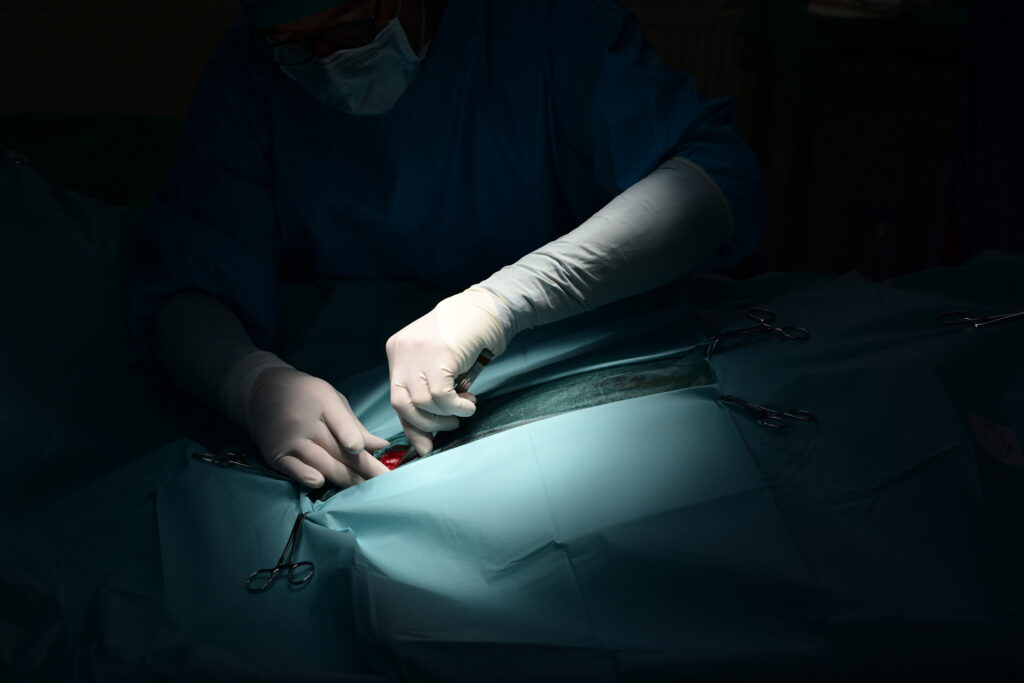
Surgical site infections (SSIs) are common complications in horses that undergo colic surgery. Approximately 10-37% of postoperative colic patients develop SSIs. That risk jumps up to 87% following repeat celiotomy in the early postoperative period. These statistics are important because surgical site infections lead to longer hospitalization, increased cost, delayed return to work, and up to 12 times increased risk of ventral midline hernia formation.
During a Burst session at the 2025 American Association of Equine Practitioners Convention, Jesse Tyma, DVM, DACVS-LA, of Rhinebeck Equine, walked practitioners through her process of diagnosing and managing SSIs.
Clinical Signs
Early clinical signs of an SSI include discharge at the incision site, a low-grade fever, sensitivity to palpation, and localized swelling.
“It’s important to note that localized swelling in the absence of other clinical signs can also be normal and may be more prominent in bandaged vs. unbandaged abdomens,” said Tyma. “I personally prefer to send most postoperative colic patients home unbandaged for more careful incisional monitoring over a perceived improvement in incisional protection.”
She said ultrasound with a linear transducer can help identify subcutaneous pockets of fluid, but clinical signs of discharge and local, focal pain are often sufficient.
“If you feel that your patient likely has an SSI, communicate with the operating surgeon to collaborate on appropriate management,” said Tyma. “Open communication among primary, emergency, and referral care teams in paramount for optimizing care, delineating clear expectations, and improving patient outcomes.”
Treating and Managing the Infection
The goals of SSI management are establishing drainage, managing infection, and supporting the abdominal wall. Be prepared with appropriate physical and chemical restraint, including an experienced handler, a twitch or a lip chain, and IV sedation. Tyma listed the supplies she uses:
- Sterile saline.
- Local block.
- Gauze sponges.
- A culturette swab.
- Suture scissors.
- Staple remover.
- Mosquito hemostats
- A 15 blade and a blade handle.
She then aseptically prepares the ventral midline, noting that she prefers to use saline over isopropyl alcohol on what will be an open wound.
“For incisions that are already draining, I insert hemostats at the drainage site and bluntly separate the skin at this level, followed by sampling the subcutaneous space with a culturette swab,” Tyma explained. “If the skin is healed over, I block and use the 15 blade to make a stab incision adjacent to the site of drainage or over a sonographic fluid pocket. I use hemostats or a finger to explore the wound cranially and caudally and then my two index fingers to bluntly dissect the skin until no skin shelf remains, ensuring adequate dependent drainage of any trapped necrotic debris.”
She removes any staples or skin or subcutaneous sutures in the septic region and lavages the wound.
If the linea alba is exposed, ensure it’s intact with no gapping. “If there is gapping, this is an emergency,” said Tyma. “Immediately place a belly bandage and contact the surgeon. This horse is at risk of evisceration.”
Otherwise, lavage the open wound to remove debris and discharge. While culture results can guide antimicrobial therapy, Tyma said she often finds systemic antimicrobial therapy unnecessary with good drainage and diligent wound care. She does administer NSAIDs for several days following the procedure.
Bandaging and Body Wall Support
Bandaging helps protect the incision and support the body wall. “Since we usually don’t have a hernia support band on hand at the initial evaluation of an SSI, I bandage as I would for a routine postoperative belly bandage,” said Tyma. “I use medical-grade cotton wrap folded over as a primary layer over the incision and secure it with several rolls of brown gauze and elastic tape.”
For ongoing bandaging, rigid body wall support is crucial for preventing hernia formation. Tyma said her product of choice is the CM Hernia Belt, which is custom-sized to the individual horse, provides firm inelastic pressure tothe body wall, and is designed to not slip back.
“Other products are available,” she added. “The important thing is it must be inelastic.”
Owners should be prepared for their horses to be in a bandage for four to eight weeks, or at least two weeks beyond complete granulation. Once granulated, the risk of herniation drops.
Ongoing Care
Initially, Tyma recommends cleaning and changing the dressing daily, then every other day as the wound becomes less productive. “Once the wound is open, clean, and free of all necrotic debris, granulation tissue typically develops within a week and can take up to a month to fully cover the linea alba,” she explained.
Stall confinement and exercise restriction are essential to minimize herniation risk. “After establishment of drainage and granulation has begun, these horses can be hand-walked, but it’s imperative to avoid unrestricted exercise until at least one month after complete granulation,” she said. “The way I think about it is the postoperative return to exercise time resets to Day 0 at the time the wound is completely granulated. I encourage the use of anxiolytics (e.g., trazodone, acepromazine) for behavioral management and stall enrichment to combat boredom.”
Take-Home Message
Tyma’s five key components of SSI management are:
- Early recognition.
- Adequate drainage.
- Rigid body wall support.
- Judicious antimicrobial use.
- Communication across care teams.
“Healing of postoperative SSIs is predictable when drainage is established and appropriate body wall support is provided,” she said. “Anecdotally, horses with postoperative SSIs managed with this open drainage technique rarely develop ventral midline herniation thus optimizing outcomes overall.”
Related Reading
- Colic Surgery’s Impact on Show-Jumping Horses’ Careers
- Chlorhexidine vs. Alcohol Antisepsis for Equine Surgical Procedures
- Smart Antimicrobial Use in Equine Surgical Settings
Stay in the know! Sign up for EquiManagement’s FREE weekly newsletters to get the latest equine research, disease alerts, and vet practice updates delivered straight to your inbox.