This article originally appeared in the Fall 2025 issue of EquiManagement. Sign up here for a FREE subscription to EquiManagement’s quarterly digital or print magazine and any special issues.
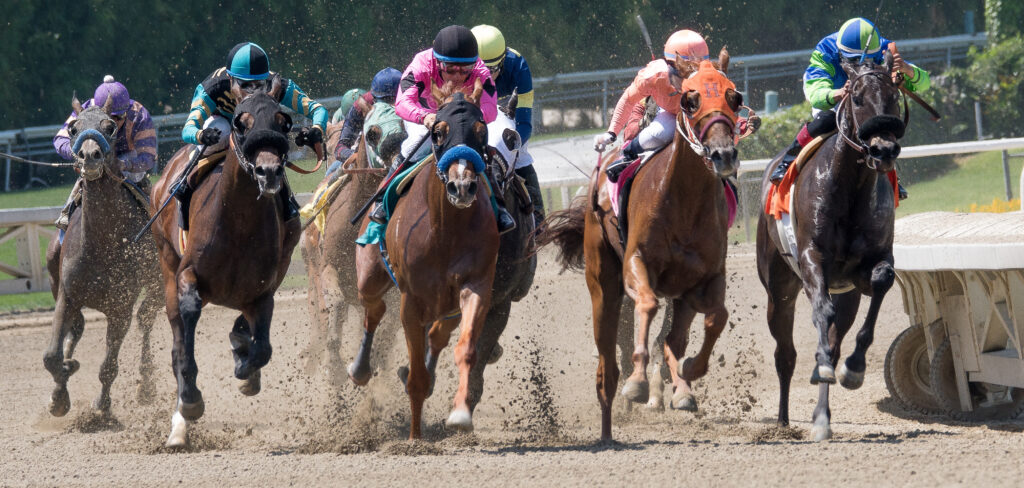
Among the organizations driving innovation in Thoroughbred racehorse safety, the American Association of Equine Practitioners (AAEP) and the Horseracing Integrity and Safety Authority (HISA) are leading the pack. Created in 2020, HISA’s purpose is to establish and enforce national uniform safety and integrity rules in a sport previously governed by individual state racing commissions. These rules are now applicable to 41 Thoroughbred racetracks across 19 states. Specifically, HISA’s Racetrack Safety Program includes operational safety rules and national racetrack accreditation standards focused on enhancing equine welfare and minimizing horse and jockey injury.
“HISA’s mission is to enhance the safety and welfare of horses and riders and improve the integrity of the sport,” explains Jennifer Durenberger, DVM, HISA’s Director of Equine Safety & Welfare and a member of the AAEP Racing Committee.
HISA Success and the AAEP Safety Forum
Racetracks operating under HISA’s rules recorded an aggregate racing-related fatality rate of 0.90 per 1,000 starts for 2024, representing a 35% decrease from the rate of 1.39 reported by the Equine Injury Database in 2021—the last full year prior to the launch of HISA’s Racetrack Safety Program. It’s also a 27% decrease from the rate of 1.23 per 1,000 starts in 2023. This represents a 55% decline from 2.00 fatalities per 1,000 starts reported in 2009 when the Equine Injury Database first began reporting such fatalities.
Data from the first quarter of 2025 are equally promising, showing only 0.85 racing-related fatalities per 1,000 starts.
While certainly laudable, fewer racing fatalities aren’t the only measures of safety and success. In 2023, a team of 23 private racetrack practitioners, regulatory veterinarians, surgeons, and radiologists explored additional ways to reduce racehorse injuries at the AAEP’s Forum on Thoroughbred Safety & Injury Prevention. Durenberger was a key member of this Forum, as was Sara Langsam, VMD, the Chair of AAEP’s Racing Committee, a member of AAEP’s Board of Directors, a member of HISA’s Horsemen’s Advisory Group, and the medical director of TFB Equine’s Belmont Park Division.
Nine safety recommendations in three categories stemmed from that meeting:
1. Identification of the Horse at Increased Risk of Injury
- Issue a request for proposal (RFP) for a cost-effective wearable biometric sensor from qualified manufacturers.
- Employ post-entry screening by regulatory veterinarians to help identify horses at increased risk based on training and racing records.
- Pre-entry screening exams to be performed by the trainer’s private attending veterinarian in all U.S. racing jurisdictions.
2. Improved Access to Higher-Level Diagnostic Technology
- Create regional positron emission tomography (PET) scan centers at centrally located racetracks throughout the United States.
- Explore sustainable funding options for subsidization of advanced imaging tools to increase accessibility for all classes of racehorses.
3. Other Recommendations
- Adopt improved trainer data and injury reporting systems in U.S. racing.
- Create continuing education for trainers, racetrack management, and veterinarians about injury prevention.
- Update racetrack maintenance equipment and protocols to measure racetracks’ moisture content more precisely and identify best practices to ensure consistency of the racing surface.
- Encourage racetrack management groups to update Wi-Fi and camera surveillance capabilities in the barn area and on the racetrack.
“Of the nine recommendations, the biggest one was a request for proposal for biometric sensors focusing on musculoskeletal injury detection, and that project is running now,” says Langsam.
While all nine recommendations are indeed relevant and will contribute to the overall safety of racing Thoroughbreds, in this article we’ll focus on three topics: wearable biometric sensors, positron emission tomography (PET) scanning, and pre- and post-entry screening.
Wearable Biometric Sensors
Wearable technologies are electronic devices designed to be worn on the body that have sensors to collect personal data. In Thoroughbreds, wearable biometric sensors can detect gait changes and evaluate stride, potentially prompting trainers and veterinarians to more closely evaluate an individual horse.
Langsam’s vision is to see such wearables on every racehorse for every high-speed exercise event, including breezing and racing.
“Sensors that look at stride can identify a horse with concerning data … changes in their stride. We can then take that horse for evaluation,” says Durenberger.
Such evaluation can include PET to look for lesions or injuries, but this data might just prompt an alteration in how the horse is trained.
Durenberger says the goal is to equip trainers with the tools to identify potentially at-risk horses before injury occurs. Langsam has put forth great effort since 2023 to provide trainers with these tools.
Soon after the AAEP Forum on Thoroughbred Safety & Injury Prevention in 2023, Langsam and colleagues received 12 preproposals from industry members for different sensors. A review committee of eight veterinarians whittled that list down to six, and those six companies from around the globe prepared full proposals. Langsam’s biosensor team then engaged in aggressive fundraising efforts and collected sufficient funds to test all six sensors (see bit.ly/4e7QmWH).
“Starting Jan. 1, 2025, we began testing the biosensors in 2-year-olds during high-speed work. Each of the six biosensors have enrolled at least 100 horses during this yearlong study,” she says.
Langsam and colleagues selected the 2-year-old population for this study because they’re “mostly a blank slate.” She says an estimated 30-40% of 2-year-olds will develop some type of musculoskeletal injury, such as bucked shins or condylar bruising, that a sensor might be able to recognize.
“This project actually requires very little from the trainers,” says Langsam. “Each week the horse breezes, the trainer notes distance, time, and track conditions. The six sensors are unique, with most of the sensors girth- or saddle-pad-based. There is one that wraps around the tail base.”
The sensor team gives each breeze a green (everything is fine), yellow (slight change), or red (a horse could be brewing an injury) score. This rating is only reported to the AAEP study database, the trainer, and the owner of that horse each week. It is neither public nor available to any regulatory body.
“The hope with these biometric sensors is that they are a true screening tool for gait abnormalities,” says Langsam. “Advanced imaging like PET isn’t a screening tool, and biomarkers of bone turnover that can screen for musculoskeletal lesions are a few years off still. And it’s important to note that biosensors won’t replace the role of the veterinarian; they are simply going to be used to identify horses deviating from their normal gait and stride patterns, raising a flag for when a veterinarian needs to delve into that horse a bit further.”
Once the data is fully analyzed in 2026, Langsam says they will be able to see which of the biosensors are viable options.
“Maybe none of them are ready yet and need more work, but maybe all of them are ready to use,” Langsam notes. “If a biosensor proves valuable, we will then make our recommendations to HISA, and they will decide whether to begin phasing in the sensors that we show are effective.”
She adds, “My ultimate goal one day is to see a set of sensors that would be sanctioned that owners/trainers can choose from so we can track these horses and have an alert system on them.”
These sensors aren’t just useful for preventing catastrophic injuries but also for detecting the early onset of all musculoskeletal injuries. Langsam says the biosensors’ data could simply identify horses that require time off and can then rejoin the racing population as stronger horses.
“If we can intercept injury early on, it’s good for the business, keeping our racehorses sounder longer,” Langsam adds.
For Durenberger, who has worked on the regulatory side of racing since 2003, wearable technologies are game-changers.
“Musculoskeletal injuries are insidious,” she says. “It’s rare that something happens to an athlete in the moment. Instead, a lot of musculoskeletal injuries are a manifestation of a process. Horses are programmed to not show discomfort when they’re distressed. They are really good at hiding it from us.”
Independently, HISA is working with a biosensor company for cardiac monitoring.
PET Scanner Recommendations
Two recommendations from the 2023 Forum designed to improve racehorse safety included:
- Creating regional PET scan centers at centrally located racetracks throughout the United States.
- Exploring ways to subsidize this advanced imaging modality, increasing accessibility for all classes of racehorses.
“Santa Anita in California has had PET on-site for six years now, and they’re ahead of the game. A PET scanner is now available at Rood and Riddle in Saratoga, New York, as well as some hospitals in Kentucky and Florida,” says Langsam.
Langsam’s and the AAEP’s hope is to make PET scanning affordable and geographically available to a larger population of racehorses.
“We are trying to figure out a way to fund this so that the $20,000 claimer can get into the machine, not just the Grade 1 horses,” she says. “California is subsidizing PET scans with research projects associated with the Dolly Green Fund, and New Bolton has received some funding associated with a study of their own, so there are different ways to do this. Making PET scanning economically viable for all horses is important.”
Why the focus on PET scanning? Radiographs are good first-line diagnostics but, as we know, they have limitations. Most catastrophic injuries occur in the fetlock, and PET is a great imaging tool for fetlocks. PET also gives three-dimensional functional imaging that can be performed in the standing, sedated horse. For more comprehensive information, PET can be combined with other diagnostic imaging techniques, such as CT scan. Mathieu Spriet, DVM, MS, DACVR, DECVDI, professor of diagnostic imaging at the University of California, Davis, School of Veterinary Medicine, has performed extensive research on PET imaging and fetlocks.1,2
Pre- and Post-Entry Screening
At many tracks, a trainer’s private veterinarian will perform pre-entry screening exams before entering a horse in a race.
“This process is meant to encourage a dialogue between the trainer and their veterinarian about a horse’s suitability to race,” explains Durenberger, noting that these screening exams are currently being conducted in California, Kentucky, New York, and Gulfstream Park in Florida.
The next step in the process is post-entry screening performed by regulatory veterinarians like Durenberger instead of the private veterinarian. The post-entry screening helps identify horses at increased risk of injury by analyzing training and racing records. Specifically, regulatory vets review the horse’s past performance, training history, treatment records (e.g., injury and lameness diagnostics, intra-articular corticosteroid injection history), and other relevant information, such as layups and previous injuries, after the horse has been entered in a race.
“HISA has developed a tool to assist with post-entry screening. It uses AI to mine the data and help spot patterns that we weren’t previously able to recognize,” explains Durenberger.3,4
Concluding Thoughts
The Forum on Thoroughbred Safety & Injury Prevention and the formation of HISA have resulted in much-needed improvements in Thoroughbred racehorse safety, preventing both injury and fatalities.
“But more is required,” says Langsam. “We can continue to make progress by embracing innovative technologies and improved risk-assessment processes, ultimately ensuring that the health and safety of the racehorse is the priority for the racing industry.”
References
- Spriet M, Arndt S, Pige C, et al. Comparison of skeletal scintigraphy and standing 18F-NaF positron emission tomography for imaging of the fetlock in 33 Thoroughbred racehorses. Vet Radiol Ultrasound 2023;64(1):123-30.
- Pye J, Spriet M, O’Brion J, et al. Longitudinal monitoring of fetlock lesions in Thoroughbred racehorses using standing 18F-sodium fluoride positron emission tomography. Am J Vet Res 2022;83(10).
- HISA. 2023, Dec. 5. HISA and Palantir Develop AI-Enabled Tool to Help Identify Horses at Increased Risk of Injury Before They Race. bit.ly/3HDTei9.
- HISA. 2024, Nov. 12. HISA Introduces HISA Horse In-Sight. hisaus.org/news/hisa-introduces-hisa-horse-in-sight.
Related Reading
- EVJ Highlights Ongoing Work to Improve Racehorse Safety
- Disease Du Jour: AAEP’s Wearable Biometric Sensor Research Project
- Exercise-Associated Sudden Death in Horses
Stay in the know! Sign up for EquiManagement’s FREE weekly newsletters to get the latest equine research, disease alerts, and vet practice updates delivered straight to your inbox.
![[Aggregator] Downloaded image for imported item #18374](https://s3.amazonaws.com/wp-s3-equimanagement.com/wp-content/uploads/2025/09/30140012/EDCC-Unbranded-28-scaled-1-768x512.jpeg)
![[Aggregator] Downloaded image for imported item #18375](https://s3.amazonaws.com/wp-s3-equimanagement.com/wp-content/uploads/2025/09/30140031/EDCC-Unbranded-26-scaled-1-768x512.jpeg)