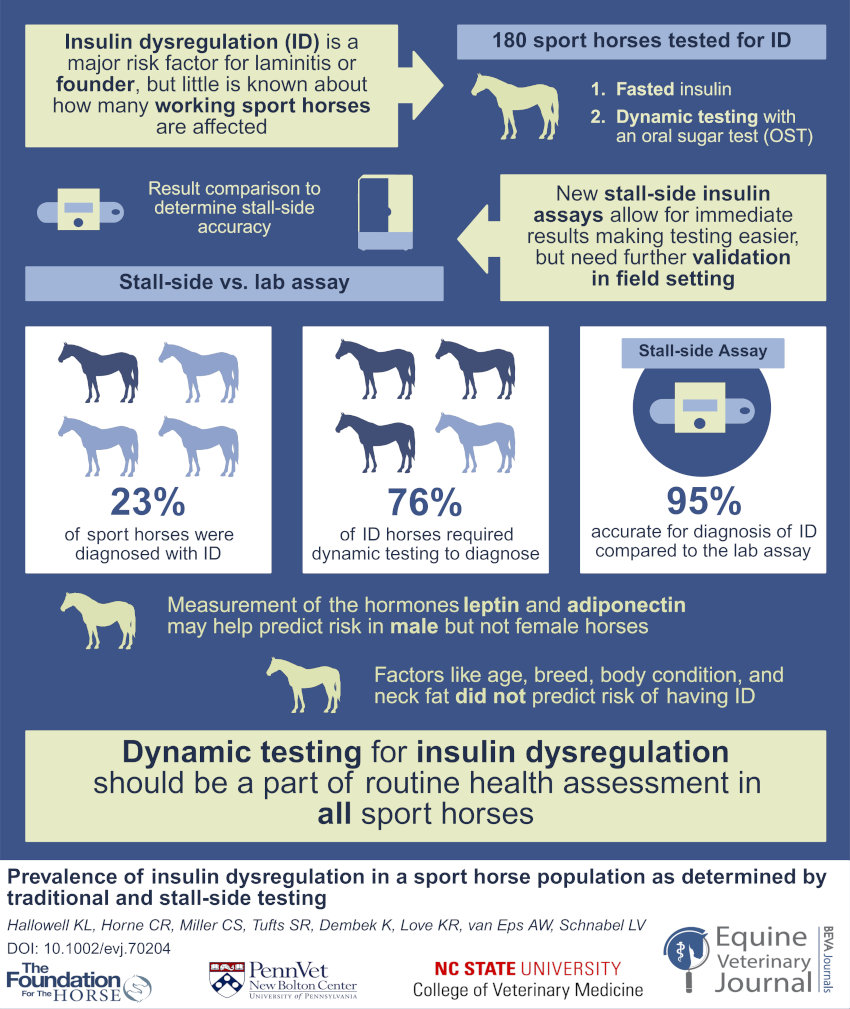
Veterinarians and horse owners often assume that sport horses are less likely to develop insulin dysregulation (ID) because of regular exercise and the physical demands of equestrian sport. However, researchers from North Carolina State University’s College of Veterinary Medicine diagnosed 22.8% of sport horses in a recent study with ID.
In that study, Hallowell et al. used an oral sugar test (OST) to determine ID prevalence in a sport horse population and compared stall-side test results to validated laboratory assays for insulin quantification.
The study included 180 sport horses at least 2 years of age with no previous history of equine metabolic syndrome or laminitis. Forty were evaluated at their resident farm, and 140 were presented for an orthopedic evaluation at the university hospital. The researchers recorded each horse’s body condition score (BCS) and cresty neck score (CNS) and measured serum leptin, adiponectin, and insulin concentrations at baseline. An OST was then performed, in which each horse was administered a dose of light corn syrup by mouth and repeat insulin measurement was performed after 60 and 90 minutes. Insulin was measured with both a validated fluorescence enzyme immunoassay (FEIA) in the lab and a stall-side lateral flow assay (LFA, Wellness Ready) for comparison.
Study Findings
Forty-one of the 180 tested sport horses (22.8%) were diagnosed with ID. Of those 41, only 11 (26.8%) had an increase in fasted insulin above the reference laboratory’s diagnostic threshold. The remaining horses were diagnosed based on dynamic testing with the OST. In male horses only, an increasing leptin/adiponectin ratio was a significant predictor of ID. Each 0.1 increase in the leptin/adiponectin ratio increased the odds of ID in male horses by 10%, but it was not predictive of ID in female horses. Leptin and adiponectin are hormones produced by fat cells. Leptin typically increases with increasing fat mass, while adiponectin is decreased with more dysfunctional fat—their ratio has been shown to predict complications of metabolic disease in humans better than each hormone alone.
The FEIA and LFA insulin values following dynamic insulin testing correlated well, except the LFA readings exceeded the FEIA readings by 13.62 uIU/ml. Still, the researchers reported that the LFA is “excellent at correctly classifying ID status” and a useful field screening tool for a horse’s risk of developing ID and/or laminitis.
“Although historically considered a disease of overweight and obese horses, neither BCS nor CNS were significant predictors of ID risk, indicating that practitioners cannot rely on the appearance of the horse for clinical decision-making,” the authors wrote, noting that 60.5% of sport horses in this study population were overweight. “This study underscores the importance of ID in our equine athletes and provides practitioners with valuable information regarding the importance of dynamic insulin testing and case selection.”
Reference
Hallowell KL, Horne CR, Miller CS, et al. Prevalence of insulin dysregulation in a sport horse population as determined by traditional and stall‐side testing. Equine Veterinary Journal May 2026, DOI: 10.1002/evj.70204
Related Reading
- How Endocrine Disorders Impact Equine Athletes
- Researchers Assess Prevalence of ID and Subclinical Laminitis in Sport Horses
- Recognizing Early Lamellar Structural Failure in Performance Horses
Stay in the know! Sign up for EquiManagement’s FREE weekly newsletters to get the latest equine research, disease alerts, and vet practice updates delivered straight to your inbox.