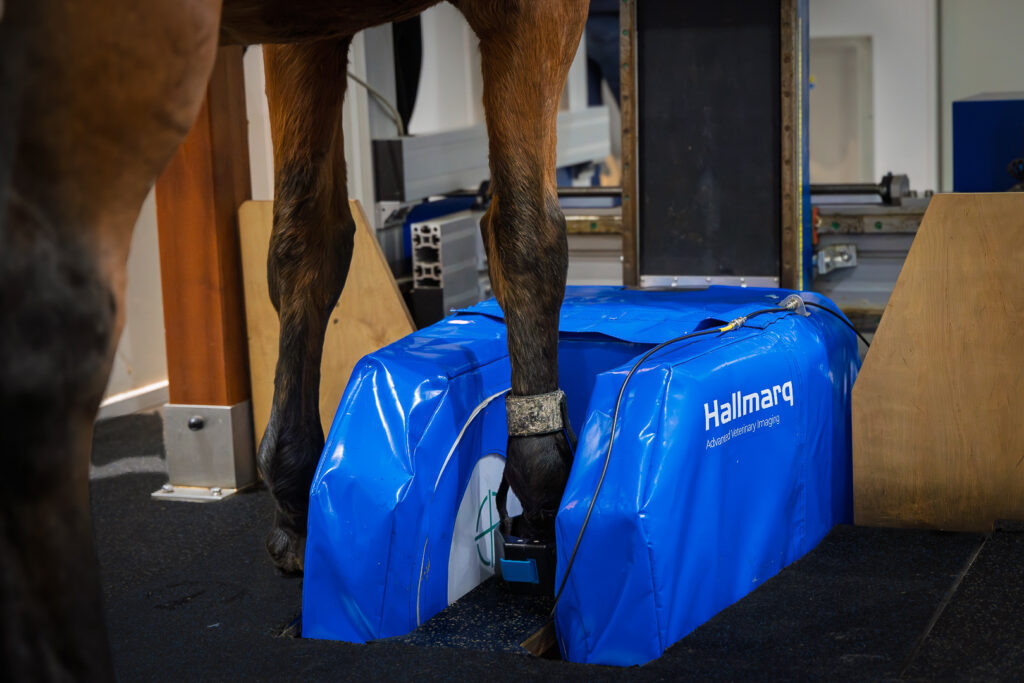
Hallmarq Veterinary Imaging provides advanced MRI and CT solutions specifically designed for veterinary practice. Its Standing Equine MRI is widely considered the gold standard for imaging the lower limb of the standing sedated horse. Hallmarq continues to develop the product, and in September it highlighted its new iNAV software at BEVA, the UK’s biggest congress for equine veterinarians.
What Is Hallmarq’s iNAV?
Developed as part of the company’s ongoing commitment to innovation, Hallmarq’s iNAV is transforming the way equine vets can diagnose and treat complex equine lameness cases. iNAV’s cutting-edge technology enables clearer and more clinically diagnostic MRI scans, especially in the previously harder to image proximal limb.
By building on already established Hallmarq motion correction software techniques, iNAV tracks real-time movement in the horse’s limb even more closely and corrects for motion artifact when processing the images.
Minimizing motion artifacts enhances image quality, enabling vets to pinpoint conditions with greater accuracy and greater diagnostic confidence, resulting in quicker results and treatment plans.
“Our commitment to innovation ensures that standing MRI continues to evolve, with iNAV setting a new standard in what’s possible in veterinary diagnostics,” said Annie Makin, chief commercial officer for Hallmarq.
“Where previously scans may have been non-diagnostic due to patient movement, iNAV delivers transformational results to drive better patient care.
“The higher limb is notoriously difficult to image, and motion can prove a problem. iNAV significantly reduces the impact of limb movement during image acquisition, helping to maintain diagnostic integrity.”
Case Study
One case where iNAV helped ensure an accurate diagnosis was in a patient seen by Donnington Grove Equine Vets in Berkshire, UK.
The horse had sustained an avulsion fracture of the right forelimb proximal suspensory origin six months prior to referral. Despite a structured rehabilitation program, lameness persisted, and the condition failed to fully resolve.
Follow-up radiographic and ultrasonographic assessments were challenging due to the extent of the injury and failed to provide a definitive explanation for the ongoing lameness.
Given these limitations, a Hallmarq standing equine MRI was performed using iNAV to obtain a more detailed evaluation of the affected region and, therefore, more comprehensive evaluation of the injury and its stage of healing. Despite increased patient movement, the resulting iNAV images were of high diagnostic quality. Previously, such motion would likely have resulted in non-diagnostic scans and an inconclusive diagnosis.
As a result, a rehabilitation plan was created, and the patient’s follow-up MRI three months later showed huge progress, allowing the horse to be gradually reintroduced to exercise.
Holly Johnson, equine clinical product manager for Hallmarq, said: “For our existing standing MRI users, iNAV is already available on their system.
“Whether managing subtle lameness, complex soft tissue injuries, or ambiguous cases where traditional scans fall short, iNAV’s enhanced motion correction helps unlock answers that might otherwise remain elusive.
“We hope this will reassure equine veterinarians that their nearest referral centers have the specialist knowledge and equipment to help deliver better outcomes for them and their patients.”
Industry Praise
Industry experts have been quick to praise the transformational qualities of iNAV, with Dr. Natasha Werpy, a world-renowned diplomate of the American College of Veterinary Radiology (ACVR), saying: “The introduction of iNAV has dramatically advanced magnetic resonance imaging of the standing horse and strengthened our confidence in diagnosing clinically significant injuries in the proximal limb.”
Meanwhile, Ben Anghileri, Clinical Director at Oakham Veterinary Hospital, UK, said: “The updated iNAV is amazing. I was genuinely astonished by the quality of the T2W scans on a fidgety patient.
Based on the amoung of motion, I was expecting the scan to look like mush, but it was beautiful and looked better than the T1s.”
Looking Ahead
Looking ahead, standing MRI is not standing still. Hallmarq’s focus is firmly on AI-enhanced imaging. Its state-of-the-art AI algorithms promise iNAV-quality images with significantly reduced scan times, proving that speed and clinical excellence can go hand in hand.
Stay in the know! Sign up for EquiManagement’s FREE weekly newsletters to get the latest equine research, disease alerts, and vet practice updates delivered straight to your inbox.