This article originally appeared in the Winter 2025 issue of EquiManagement. Sign up here for a FREE subscription to EquiManagement’s quarterly digital or print magazine and any special issues.
Do you wish for immediate results to achieve real-time diagnoses and initiate targeted treatment plans rather than waiting days for results? Advances in point-of-care testing (POCT) are bringing that dream to life, and many tests are not only available but also validated for use in equine practice.
The SAA Success Story
Serum amyloid A (SAA) POCT was introduced several years ago. In 2018, Nicola Pusterla, DVM, PhD, DACVIM, and colleagues compared one proprietary SAA against a reference standard using both plasma/serum and whole blood (Schwartz et al. 2018). The assay tested had acceptable accuracy and precision when used with serum/plasma up to SAA concentrations of 1,000 µg/mL compared to SAA values generated by a reference laboratory. Thus, the stallside test can differentiate healthy horses with low SAA from horses with an acute phase response when SAA values fall between 0 and 1,000 µg/mL. As we know, though, some horses have SAA values far exceeding 1,000 µg/mL.
Another concern Pusterla and colleagues reported was the type of sample being used. They noted a significant difference in SAA between whole blood and serum/plasma samples, with whole blood providing lower SAA values.
“The POC assay should be run on whole blood as it is a stallside assay,” says Pusterla. “Serum can be used to bank samples or retest samples at a later time.”
This study, among others, highlights the need for validating assays against reference standards. In this article, we’ll describe the advantages of POCT, share examples of available devices, and discuss how you can implement them into practice.
The Benefits of POCT
Small, handheld devices capable of performing assays once confined to a bench top began infiltrating the human market several decades ago and are now flowing freely into equine practice. Features that make a POCT appealing include:
- Good sensitivity and specificity.
- A user-friendly design with few steps to perform and no complex equipment.
- Rapid turnaround time allowing prompt treatment initiation.
- Validation against gold-standard tests.
- Affordability.
According to Slovis et al. (2020), “Advantages include rapid results that reduce initial guesswork and promote diagnosis-targeted patient care, which may ultimately provide better clinical outcomes.”
Additionally, POCTs can abrogate issues surrounding sample handling that can increase preanalytical error and inaccuracy (Berryhill et al. 2023). For example, adrenocorticotropic hormone (ACTH) can degrade preanalytically when stored at room temperature (Prutton et al. 2015, Johnston et al. 2025).
“Currently, POCT in veterinary medicine, especially equine, is most applicable to acute diseases,” says Pusterla. “Recently, we have witnessed the emergence of pathogen detection in real time, which is really exciting.”
Metabolic & Endocrine Testing
Insulin
Veterinarians diagnose equine metabolic syndrome (EMS), characterized by hyperinsulinemia and potentially hyperglycemia, relatively commonly. This condition occurs even in young, fit, athletic horses, not just the “easy keepers” or horses and ponies with obese phenotypes and cresty necks (Sundra et al. 2024).
“Given ease of testing and immediacy of results, a readily available, validated POCT could dramatically increase the number of horses tested for insulin dysregulation, which could result in a larger number of horses receiving appropriate screening and treatment for potentially life-threatening conditions,” wrote Emily Berryhill, DVM, DACVIM, assistant clinical professor of equine internal medicine at the University of California, Davis, in a 2022 study.
In its 2024 Recommendations for the Diagnosis and Management of Equine Metabolic Syndrome and Insulin Dysregulation, the Equine Endocrinology Group (EEG) recommends an oral sugar test (OST) for diagnosing hyperinsulinemia and EMS. Alternatively, vets can measure resting insulin concentrations using a single blood sample when the horse is in a fed state (hay or pasture but not grain). In addition to diagnosing hyperinsulinemia and EMS, veterinarians must routinely measure a horse’s insulin levels to gauge treatment response. Further, according to EEG guidelines, “Testing should also be considered as part of wellness or prepurchase examinations or when considering corticosteroid administration in at-risk populations.” Thus, there are ample opportunities for POC insulin testing.
Berryhill’s study was designed to validate a POC insulin test (Wellness Ready Test). This lateral flow assay measures insulin by exposing the analyte to a target antibody. The analyte-antibody complex is then exposed to a test strip with a secondary antibody. The analyte concentration can be measured quantitatively because the intensity of the red color at the test line is proportional to the concentration of the insulin in the whole blood (EDTA) sample. After a 15-minute incubation, the signal converts to a concentration. The samples must be run within two hours of collection.
Berryhill et al. collected whole bloodfrom the jugular vein of three horses with anticipated low (20-40 μIU/mL), intermediate (> 40-60 μIU/mL), and high (> 60 μIU/mL) insulin concentrations. They measured inter- and intra-assay and linearity using the test kit and compared values with a radioimmunoassay (RIA). The assay showed good precision, linearity, and association with the RIA across the three insulin concentrations. This test uses whole blood, which means the sample does not need to be centrifuged and is therefore a true stallside assay.
Glucose
The EEG guidelines recommend testing glucose at the same time as insulin when performing the OST. The glycemic pellet challenge also requires measuring glucose (Thane et al. 2024). One stallside glucometer (AlphaTrak 3) with an equine-specific algorithm was recently validated by the research group of Bobby Cowles, DVM, MS, MBA, Equine Technical Services at Zoetis (Velineni et al. 2024). They presented their results at the 2023 American Association of Equine Practitioners Convention.
In the study, the device was tested using two different protocols. First, the research team collected whole blood samples from 60 horses and artificially adjusted the glucose levels to generate a set of 129 blood samples with glucose levels ranging from 29 to 479 mg/dL.
“Results showed the accuracy of the device were maintained across a broad range of blood glucose values, including both artificially adjusted and unaltered blood glucose levels,” says Cowles. “Further, consensus error grid plots showed that deviation of the test results from the reference standard was low and would not change the clinical interpretation and would not lead to a misdiagnosis of the glucose concentration.”
The device was then tested in a hypoglycemic field study. The researchers collected whole blood samples from 96 horses and subjected them to glycolysis to deplete blood glucose and achieve a glucose range of 66 to 105 mg/dL.
“When looking at consensus error grid with standards set for measuring glucose for clinical evaluation, the AlphaTrak 3 was within the allowable variation with 99.2% of the samples,” says Cowles. “This was demonstrated over a large range of glucose concentration (66-479 mg/dL).”
He adds that the device has not been evaluated for glucose concentration greater than 479 mg/dL.
“It is rare that a horse will ever have a glucose greater than 300 mg/dL, so the reader will accurately cover expected glucose concentration in medical cases,” he explains. “In EMS horses, they have a normal or slightly elevated glucose concentration. Insulin is the more critical issue in EMS horses.”
Respiratory Pathogens
Equine influenza virus (EIV) and EHV-1 are prevalent respiratory pathogens causing nasal discharge, cough, fever, and lethargy. These conditions are clinically indistinguishable, making testing imperative not only for diagnosis but also for implementing biosecurity protocols.
“Equestrian show venues are encouraged to have the ability to test febrile horses for EHV-1 and other respiratory pathogens,” says Pusterla.
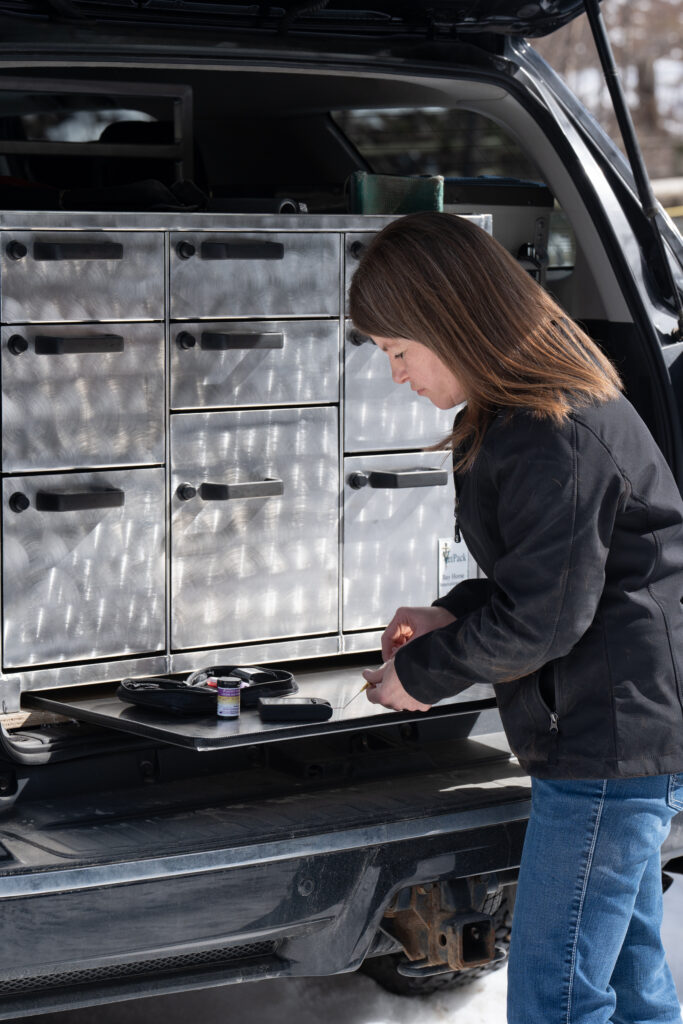
Consider large shows in Florida or California, for example, with hundreds of horses stabled on a small footprint, suboptimal biosecurity, and only some voluntary monitoring of rectal temperatures.
“Those are stressed young horses and athletes … you’re going to get circulating respiratory pathogens just like people at an airport,” says Pusterla. “Being able to test all febrile horses and isolate horses positive for EHV-1 prevents spread and avoids a potential outbreak. POCT screening can help support a diagnosis of EHV-1 in a sick animal but should not be used to screen healthy horses or the environment. The acute febrile horse is what we’re screening.”
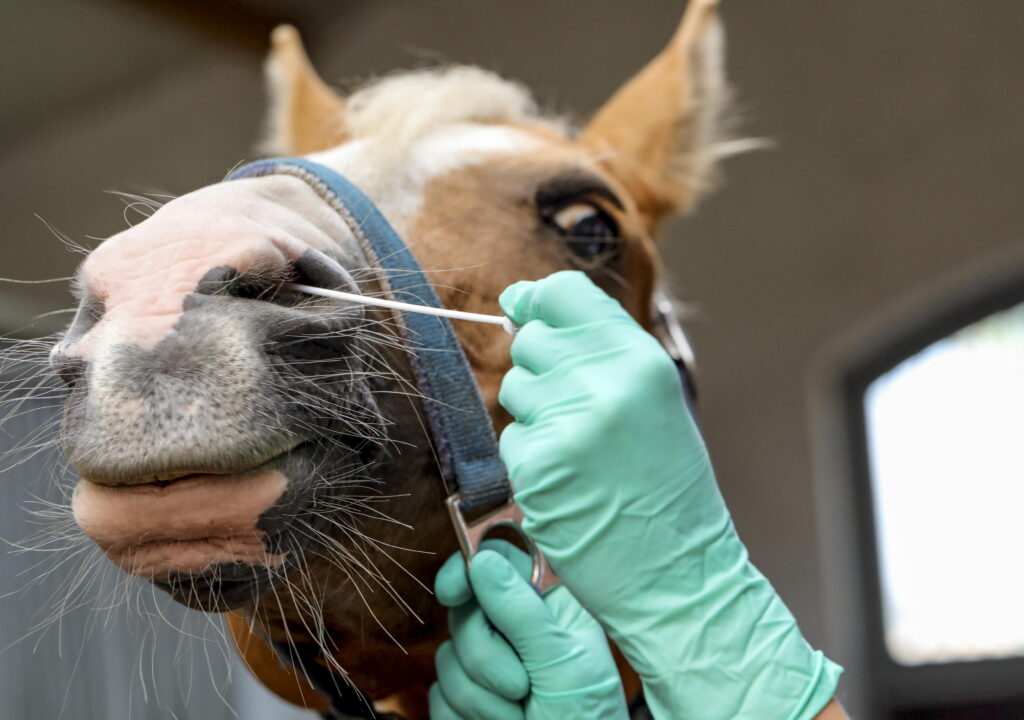
The EHV-1 test Pusterla has been waiting two decades for is finally available. In a 2025 study, he used this commercially available EHV-1 PCR assay (Fluxergy) to test sub- or febrile horses housed at a multiday equestrian event. Nasal swabs were also sent to a commercial laboratory for EHV-1 testing. Results showed 100% agreement between all eight horses tested with the POCT and the laboratory results.
“Being able to rapidly diagnose EHV-1 allowed the affected and in-contact horses to be isolated, an outbreak contained, and a large equestrian event to continue operating without interruption,” says Pusterla.
The POCT also allows for rapid follow-up testing. In Pusterla’s study, horses that tested negative on at least two nasal swabs performed seven days apart were allowed to return to the competition.
“POC testing is also important for sequential testing of in-contact horses that might be in the subacute phase that originally tested negative but may not have begun shedding virus yet,” he notes. “Repeat testing on these horses 24-48 hours later is important for containing disease.”
Commercial tests for EIV are also available, one of which Kawanishi et al. validated in 2023. “The gold standard of diagnosis for EI is made by virus isolation, but it is time-consuming, which limits its application in clinical cases,” they stated.
They validated a microfluidic immunofluorescence assay kit designed for human use that detects SARS-CoV-2, influenza A, and influenza B nucleocapsid viral antigens from a single nasal/nasopharyngeal swab.
“H3N8 is an influenza type A virus,” says Pusterla. “A human assay like this will pick up the equine variant. Sometimes you don’t have to develop an equine-specific test; they can cross-react across species.”
With this test, the practitioner places a whole drop of extraction buffer mixed with nasal/nasopharyngeal swab sample on the test strip application area. Test results indicate positive or negative for SARS-CoV-2 and influenza A/B with a 12-minute turnaround time.
Kawanishi et al. collected nasopharyngeal swabs at 0 to 8, 10, and 13 days postinfection from three horses experimentally infected with A/equine/New York/1/2017. They also performed virus isolation and RT-PCR and examined nasal swabs from 10 healthy horses and 20 pyrexic (i.e., rectal temperature of ≥ 38.5 degrees C, or 101.3 F) horses.
“The microfluidic immunofluorescence assay kit succeeded in detecting 11 EIV strains as well as nasopharyngeal samples from EIV infected horses,” the researchers wrote. “The microfluidic immunofluorescence assay kit did not detect other viruses and bacteria used in this study, and this suggests that the microfluidic immunofluorescence assay kit has a high specificity for EIV antigens.”
Using real-time PCR as a reference standard, the microfluidic immunofluorescence assay kit’s sensitivity was 60.7%. The sensitivity and specificity of virus isolation was 64.3% and 100%, respectively.
“The microfluidic immunofluorescence assay kit could be an effective diagnostic tool in the field,” they concluded.
Endogenous Adrenocorticotropic Hormone (eACTH)
Practitioners also have access to a commercially available POCT for eACTH (TRUFORMA). According to T.J. Barclay, DVM, senior professional services veterinarian for Zomedica, validation data have not yet been published, but the research has been performed and the manuscript is in preparation. Data will be presented at the 2025 AAEP Annual Convention.
“The primary indication for this eACTH test is testing horses for pituitary pars intermedia dysfunction (PPID),” says Barclay. “The device is small and gives results in 18 minutes after sample centrifugation to separate plasma.”
The device uses bulk acoustic wave technology and is an immunoassay that detects eACTH.
“Inter- and intra-assay precision is good, with a coefficient of variation < 15% across the dynamic range,” he adds. “When compared with the industry-standard Siemens Immulite 2000, it demonstrated good correlation and linearity.”
This is a screening test that can be used in horses showing clinical signs consistent with PPID, such as delayed shedding, excessive sweating, recurrent infections, and laminitis.
Barclay says a unique feature of this eACTH assay is its ability to separately measure and quantify full-length ACTH and corticotropin-like intermediate lobe peptide (CLIP), a natural breakdown product of ACTH. The traditional assay for eACTH has a significant amount of cross-reactivity with CLIP.
“Many horses with PPID have large amounts of CLIP in circulation, which is magnified with a thyrotropin-releasing hormone (TRH) test,” he explains. “Quantifying CLIP may lead to a better understanding of PPID, and it may turn out measuring CLIP changes our diagnostic protocol. Perhaps CLIP is a more important molecule to measure in these horses. We don’t know yet; it’s a hot area of investigation right now.”
Future Directions
Point-of-care tests, even those that are not directly stallside using whole blood, show immense value in equine practice, be it for metabolic issues or infectious disease screening. Pusterla and Barclay both indicated the devices they described have room for growth, with future capabilities of detecting additional analytes.
“With this technology, there is no limit to what we can test patientside,” says Pusterla. “This is just the beginning.”
Related Reading
- New Point-of-Care ACTH Assay in Horses
- Practical Uses of Serum Amyloid A in Horses
- Short-Distance Transportation’s Impacts on Equine Endocrine Testing
Stay in the know! Sign up for EquiManagement’s FREE weekly newsletters to get the latest equine research, disease alerts, and vet practice updates delivered straight to your inbox.