Equine herpesvirus 1 (EHV-1) and equine herpesvirus myeloencephalopathy (EHM) have huge impacts on the horse industry, including losses of horses, delays or cancellations of events, and veterinary expenses. When a group of horses is exposed, it is helpful to identify at-risk animals as soon as possible and implement rigorous biosecurity practices. In a recent study, researchers at Cornell University examined whether EHV-1 antibody testing can confirm exposure in nonclinical horses during an outbreak.
Study Population
Two neurologically affected horses with PCR-confirmed EHV-1 had been admitted to the equine hospital for four days prior to quarantine, where they potentially exposed five other horses. Handlers initially did not wear personal protective equipment (PPE) because the positive horses were not displaying clinical signs of EHM. Four of the potentially exposed horses had been immunized against EHV-1 and EHV-4 within the prior seven months. The researchers monitored the exposed horses’ rectal temperatures and collected nasal swab samples for EHV-1 two to six times biweekly over 29 days.
Novel Serological EHV-1 Bead Assay
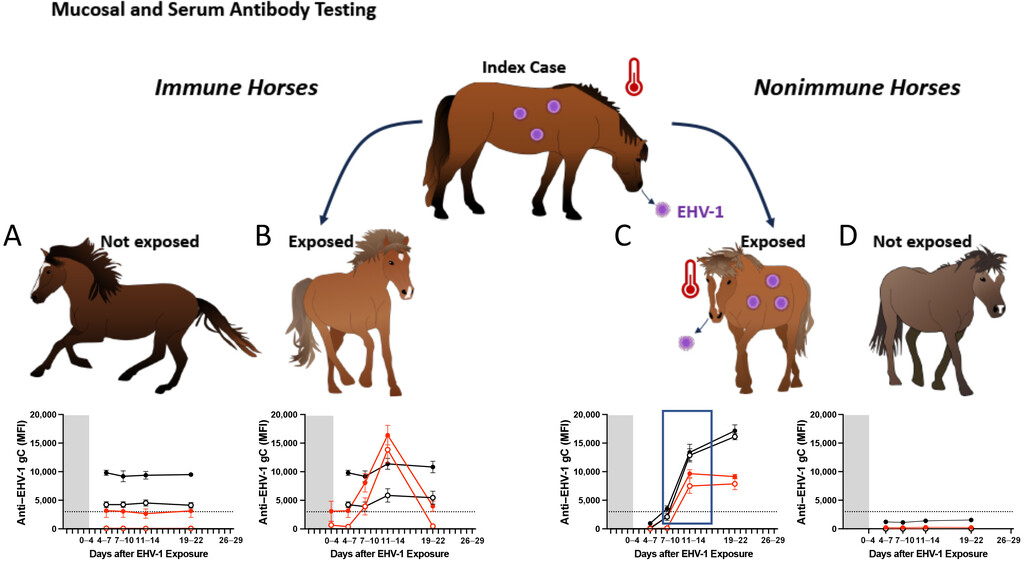
During an EHV-1 outbreak, caretakers typically take exposed horses’ rectal temperatures twice daily and monitor their clinical signs to identify infected animals. With this method, it is only possible to identify immune horses by their absence of fever during the quarantine period. However, some horses without clinical signs might never have been exposed yet are still subject to movement restrictions under an all-encompassing policy. In this study, the clinicians used a novel serological EHV-1 bead assay to measure serum and mucosal antibodies in the potentially exposed horses as soon as the index case was identified.
They categorized the results in four groups:
- Exposed and immune horses: four horses in this study.
- Unexposed and nonimmune horses: one horse that came in for gastroscopy when the index case was in the hospital.
- Unexposed and immune horses: none in this study.
- Exposed and not immune and not yet clinical: none in this study.
The two horses with clinical disease were expected to have high serum and mucosal antibody responses for one to five weeks.
Final Thoughts
The authors proposed that identifying exposed and nonimmune horses early in an outbreak enables rapid supportive treatment and diligent biosecurity practices, especially while they are shedding large amounts of virus. This is particularly helpful for horses that have left the index case’s environment, potentially disseminating virus to other barns. The researchers recommend taking two antibody samples one week apart to confirm or exclude EHV-1 exposure in suspect horses.
It might be possible to manage EHV-1 outbreaks more effectively by identifying immune horses early. The authors recommend performing serum and mucosal antibody testing twice a week for 10 to 14 days to categorize exposure and immunity results. Horses identified as at risk with this method can receive supportive care in a timely manner. Horses identified as immune and not at risk may be released earlier from quarantine based on the antibody test results.
In summary, the authors wrote, “Horses with preexisting immunity are at a low risk for developing clinical signs or shedding virus even if exposed to EHV-1 during an outbreak.”
Reference
Perkins GA, Wagner B, Rollins A, et al. Serum and mucosal antibody testing to detect viral exposure in contact horses during an equine herpesvirus myeloencephalopathy outbreak. American Journal of Veterinary Research Mar 2025; DOI: 10.2460/ajvr.25.03.0106
Related Reading
- Equine Stallside Testing: Elevating Patient Care
- EHV-1: Panic, Preparation, and Poise
- Intranasal vs. Intramuscular EHV-1 Vaccination: Which Is More Effective?
Stay in the know! Sign up for EquiManagement’s FREE weekly newsletters to get the latest equine research, disease alerts, and vet practice updates delivered straight to your inbox.