Erin Contino, DVM, MS, DACVSMR, Associate Professor of Equine Sports Medicine at Colorado State University, brought new information to attendees at the 2025 American Association of Equine Practitioners Convention on the use of 2.5% polyacrylamide hydrogel (iPAAG) in an osteochondral fragment model of osteoarthritis.
She reported on previous clinical trials in horses that have shown an increase in favorable responses over time, with 83% sound at two years post-injection. Yet, the mechanism of action is not fully understood beyond its physical integration into the synovial lining for at least two years.
Study on 2.5% iPAAG
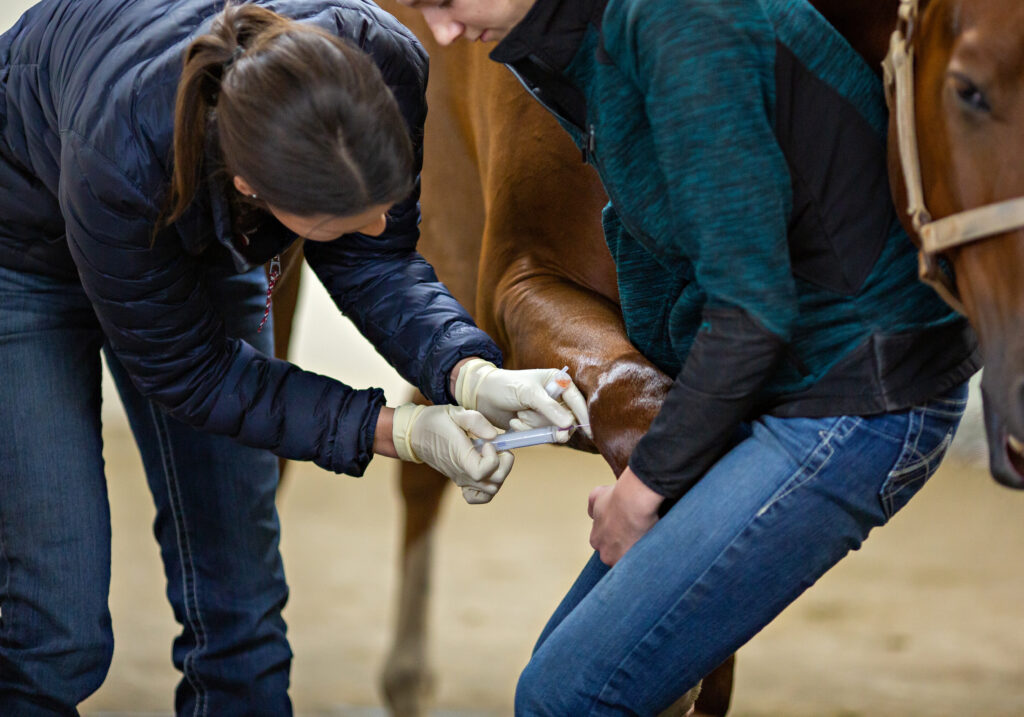
In a recent study, Contino and her colleagues at CSU assessed the efficacy of 2.5% iPAAG in a middle carpal joint osteochondral fragment model of osteoarthritis. It involved eight treated horses and eight controls. They created an osteochondral fragment via arthroscopy on Day 0. At Day 14, they injected the treated horses with osteochondral (OC) fragmentation with 2 ml of 2.5% iPAAG while the controls with OC fragmentation received saline. Saline was also injected into contralateral (sham control) joints on all horses.
On Day 16, the horses started on six minutes of treadmill work five days a week for the remainder of the 70-day study. Lameness was evaluated by subjective and inertial sensor systems as well as AI motion capture and kinetic and kinematic gait assessments.
Every other week, synovial fluid was obtained from both carpi in all horses to measure GAG concentrations, PGE2, cytokines, cytology, and RNA extraction. Serum GAG concentrations were also measured at 0, 2, 4, 6, 8, and 10 weeks. Carpal radiographs were taken on Days 0, 14, and 70. At the study endpoint of 70 days, the articular cartilage and joint capsule with synovial membrane connected were sent for histopathology, GAG quantification, and RNA analysis to determine differentially expressed genes and enriched pathways.
On treatment day (Day 14), the researchers noted a significant difference in lameness grade of the OA limbs between treatment and control groups. The treated OA limbs had significantly decreased mean subjective lameness at Day 49 but not at other timepoints. By the end of the study (Day 70), the 2.5% iPAAG-treated OA limbs had decreased subjective lameness scores, but this was not statistically significant. At no point did the saline-treated OA limbs’ subjective lameness scores decrease significantly, and the researchers noted no change in lameness score from Day 14 to Day 70.
Comparing osteochondral fragmented joints in 2.5% iPAAG-treated versus saline-treated controls at Day 70, the researchers noted that:
- On radiographs, the treated horses had less radiocarpal bone sclerosis than controls.
- The treatment group had less interleukin-8 in synovial fluid than control limbs.
- There was less PGE2 in synovial fluid of treated joints at Day 28 compared to controls.
- Synovial membrane integration of 2.5% iPAAG was visible in all eight joints, yet there was no significant cellular infiltration and no cytology values outside of the normal range.
- No 2.5% iPAAG was seen on cartilage histology.
- The synovial membrane was evaluated histologically for cellular infiltration, intimal hyperplasia, subintimal edema, subintimal fibrosis, and vascularity, and there were no differences between treatment groups.
- Articular cartilage scores in the treatment group were significantly better than controls.
- Treated OA joints retained the same amount of joint elasticity as the horse’s contralateral control limb. Saline-treated OA limbs had significantly stiffer joint capsules, demonstrating that 2.5% iPAAG preserved the elastic modulus of the joint capsule.
They found no evidence that 2.5% iPAAG is neurotoxic, despite anecdotal concerns because it is polymerized from the neurotoxin acrylamide.
Take-Home Message
Contino et al. reported that 2.5% iPAAG showed some evidence of disease-modifying effects—specifically, less joint capsule stiffness, better third carpal bone articular cartilage histopathology scores, and less cartilage degradation than controls. Treated horses were less lame at all time points after treatment, but this result was only statistically significant at Day 49.
The nontreated horses had increased joint capsule stiffness consistent with fibrotic remodeling and loss of normal tissue compliance caused by osteoarthritis.
A difference in gene expression in the direction of suppressing inflammatory pathways and supporting innate joint homeostasis indicates that 2.5% iPAAG might provide beneficial effects earlier than previously recognized. Contino said this might warrant its use earlier in a disease process.
In summary, this study supports earlier theories (Tnibar 2015) that 2.5% iPAAG has a primary biomechanical mechanism of action, integrating into the synovial membrane without an increase in inflammatory cell infiltrates.
Brought to you by Contura Vet.
Related Reading
- Equine Joint Disease Updates: PAAG and APS
- Systemic and Intra-Articular Therapies for Lame Horses
- The Truth Is in the Tissue: Visualizing, Diagnosing, and Treating Synovial Joints with ArthramidVet®
Stay in the know! Sign up for EquiManagement’s FREE weekly newsletters to get the latest equine research, disease alerts, and vet practice updates delivered straight to your inbox.