Equine Asthma Awareness Week is brought to you by Kentucky Performance Products.
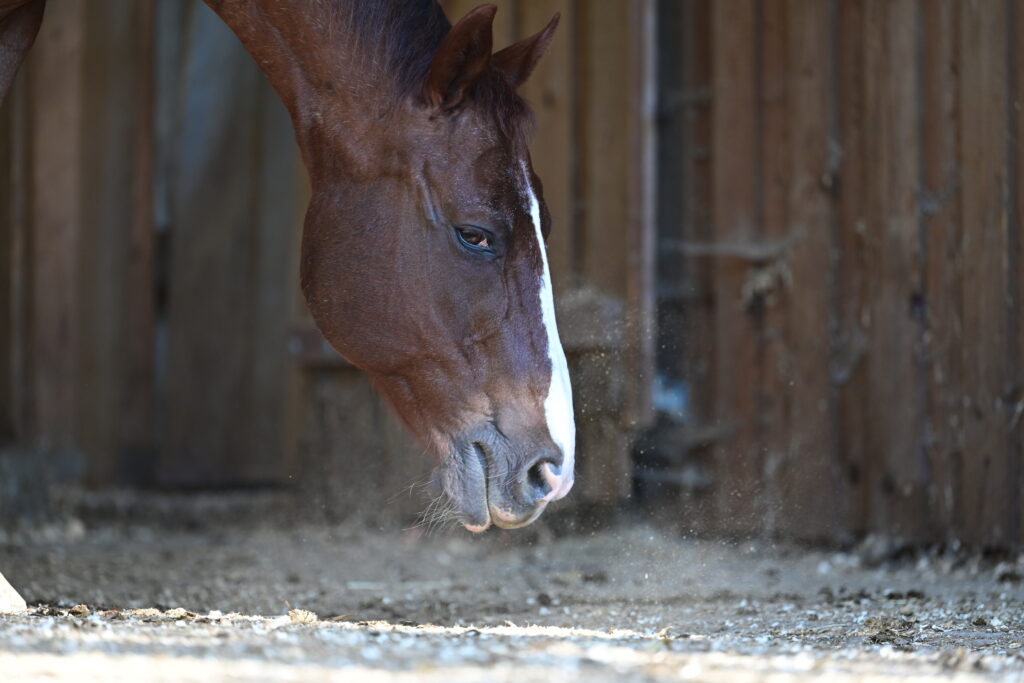
Equine asthma continues to present significant challenges for veterinarians and horse owners alike—it can severely impact a horse’s respiratory function, performance, and overall quality of life. As our understanding of this inflammatory respiratory condition evolves, so too do the strategies for treatment and long-term management. Here we’ll explore the latest findings in equine asthma research and evidence-based approaches to help veterinary professionals optimize care for affected horses.
Nonpharmacological Management of Equine Asthma
Airway inflammation is a known contributor to poor performance, especially in equine athletes. Dust exposure can significantly affect airway inflammation. Laurent Couetil, DVM, PhD, DACVIM (LAIM), of Purdue University, discussed nonpharmacological mitigation strategies at the 2024 American College of Veterinary Internal Medicine Forum.
Particles small enough to penetrate into deep lung tissues elicit mucus production and narrowing of the airways. Culprits that contribute to inhalable particulate matter (PM10) or fine particulate matter (PM2.5) are common in horse environments because of hay and bedding. As horses eat, their breathing zone is rampant with such particles, which they inhale deep into the airways. Endotoxin, mold, and beta-glucan content in dust further exacerbate inflammatory reactions in the airways.
Couetil recommended using feed and bedding with low dust levels as a primary strategy to limit exposure. This might include feeding haylage, avoiding round bales, and bedding with wood shavings. He said studies comparing different feedstuffs showed haylage, steamed hay, and soaked hay effectively reduce dust exposure. Haylage has improved effects over steamed hay in reducing BALF (bronchoalveolar lavage fluid) neutrophilic counts, but both effectively reduce respirable dust exposure.
Barn and stall ventilation help remove airborne particles before they settle. The best housing option, however, is to stable horses outdoors in pastures or paddocks with limited dust. Another strategy for improving airway health is to supplement the diet with essential fatty acids that metabolize into omega-3 PUFAs (polyunsaturated fatty acids) such as EPA and DHA, which actively resolve airway inflammation.
“Feeding horses with severe equine asthma a low-dust diet (e.g., pelleted feed) supplemented with omega-3 PUFA (e.g., DHA) results in rapid improvement in clinical signs and lung function, as well as reduced airway inflammation when compared to only feeding a low-dust diet,” said Couetil.
Horses fed haylage also have higher EPA concentrations compared to hay-fed horses.
In summary, Couetil recommended reducing horses’ exposure to respirable dust and supplementing with omega-3 PUFAs to mitigate airway inflammation from hay feeding. In refractory cases, medical therapy is also important.
Dietary Management of Severe Asthma
Horses with severe equine asthma are at risk of repeated respiratory distress when consuming dry hay due to high numbers of respirable particles, especially in the breathing zone. In a 2024 study out of Canada, researchers compared the effects of feeding steamed hay versus pellets on lung inflammation.
This crossover study included nine horses with severe equine asthma (SEA). All the horses were housed in the same barn and environment, bedded on wood chips, and turned out for several hours each day. The research team first fed dry hay to exacerbate asthmatic symptoms. Then, horses were split into two groups and fed either pellets or steamed hay—the same hay type that exacerbated symptoms when fed dry—at 2% of body weight for four weeks. Following this four-week period, the horses were fed dry hay again to exacerbate lung symptoms, and then each group was fed the other diet for the next four weeks. Veterinarians blinded to diet type evaluated clinical scores and lung functions before and weekly during each diet. After each four-week period, the researchers collected mucus scores and BALF. They recorded each horse’s response to bronchodilation after an intervention at the end of Week 4.
Steaming hay reduced respirable particles by 69% for standard hay and by 87% for dusty hay. Based on clinical scores and BALF neutrophilic inflammation, both steamed hay and pellets led to significant improvements in clinical signs and lung function. Overall, however, pelleted feed vastly improved lung function and tracheal mucus. In addition, after four weeks of pellets, the horses had little residual bronchoconstriction.
The authors noted that four weeks is not a sufficient time frame to expect substantial mitigation of asthmatic symptoms. “Feeding steamed hay as the sole intervention for the management of horses in exacerbation of severe asthma can lead to significant improvement of clinical scores, lung function, and BALF inflammation, but less reliably than feeding pellets,” they wrote. “Some horses can respond well to steaming hay as the sole intervention, but others might need additional dust control intervention.”
They also noted welfare concerns involved with feeding a specialized, low-dust diet. Social companionship is important and achieved by feeding all horses stabled together the same diet rather than separating an asthmatic individual to eat alone. Also, it is known that a pelleted diet does not always satisfy a horse’s need to chew, which can have behavioral consequences.
Symoens A, Westerfeld R, Mozo Vives B, et al. Steamed hay and alfalfa pellets for management of severe equine asthma. Equine Veterinary Journal July 2024; DOI: 10.1111/evj.14209
Targeted Therapies for Asthma Treatment
It is reported that about 15% of horses experience severe asthma and, even with appropriate management, clinical signs persist. In humans, physicians can now take steps to target individual therapy for “distinct immune and inflammatory pathways.” Like humans, horses are affected by multiple phenotypes (physical characteristics resulting from gene expression and the environment) and endotypes (molecular and cellular mechanisms leading to specific phenotypes). A recent study described known phenotypes or endotypes of equine bronchial asthma and the effects of specific therapies.
Equine asthma is categorized into several types:
- Mild with subclinical airway disease.
- Moderate with cough, poor performance, and abnormal thoracic auscultation.
- Severe (SEA) with labored breathing at rest.
Phenotypes and endotypes the researchers examined in their study include those induced by allergies, obesity, pasture-associated asthma, and cellular components (like mast cells or neutrophils) identified with BALF. However, the authors reported that most equine asthma cases are triggered by air pollutants from dust exposure, dry hay, and fungi and mites in bedding
Targeted therapy for SEA relies on environmental management, avoiding antigenic triggers through dietary modification and clean air, and corticosteroids (inhaled or systemic) and bronchodilators.
Targeted therapy for MEA (mild or moderate equine asthma) relies on reducing exposure to airborne dust and using inhaled and systemic corticosteroids.
For both MEA and SEA, dietary supplementation of a pelleted diet with omega-3 polyunsaturated fatty acids improves BALF compared to feeding a pelleted diet alone. Feeding steamed hay or haylage are alternative dietary strategies that improve lung inflammation. Outside living reduces dust exposure; bedding with cardboard or wood shavings is better than using straw; and feeding hay on the ground is better than using raised feeders such as haynets or wall-affixed feeders that assault the breathing zone with particulates. These are just some of the authors’ suggestions for targeted therapy to mitigate environmental triggers for equine asthma.
Leduc L, Leclere M, Lavoie JP. Towards personalized medicine for the treatment of equine asthma. The Veterinary Journal 2024, vol. 305; DOI: 10.1016/j.tvjl.2024.106125
Polyphenol Supplement for Horses With Mild Asthma
In humans, dietary polyphenols have been shown to have anti-inflammatory effects in individuals with asthma. A team of researchers from the University of Georgia’s College of Veterinary Medicine recently set out to determine if these supplements have similar effects on equine asthma.
In Part 1 of the study, they gave 18 study horses (10 with asthma, 8 healthy) a daily top-dressed polyphenol supplement for six to eight weeks. They performed physical examinations on all horses and assessed BAL cytology and cytokine concentrations in BAL fluid and serum before and after the supplementation period. In Part 2 of the study, the researchers randomly split the 10 asthmatic horses into treatment (5) and control (5) groups. They fed them low-dust hay with or without supplementation for four weeks, followed by dusty hay with or without supplementation for four weeks to incite airway inflammation. Then they evaluated horses’ respiratory signs, rebreathing exam findings, and pulmonary inflammation.
The asthmatic horses in Part 1 had significantly improved BAL cytology after 6-8 weeks of supplementation. In Part 2, the supplemented asthmatic horses had lower respiratory rates during dusty hay feeding and better rebreathing exam results than the unsupplemented horses.
“Polyphenol supplementation may modulate pulmonary inflammation and improve clinical signs in mildly asthmatic horses when combined with environmental management,” the study authors concluded.
K.M. Andrews, L.J. Berghaus, K.A. Hart. Effects of mixed polyphenol supplementation on lower airway inflammation in horses with Equine Asthma Syndrome. Journal of Equine Veterinary Science, Volume 154, 2025, 105681; doi.org/10.1016/j.jevs.2025.105681.
Related Reading
- Disease Du Jour: Equine Asthma and EIPH
- Impact of Steamed Hay and Alfalfa Pellets on Severe Equine Asthma
- Disease Du Jour: Effects of Wildfire Smoke on Horses’ Airways
Stay in the know! Sign up for EquiManagement’s FREE weekly newsletters to get the latest equine research, disease alerts, and vet practice updates delivered straight to your inbox.