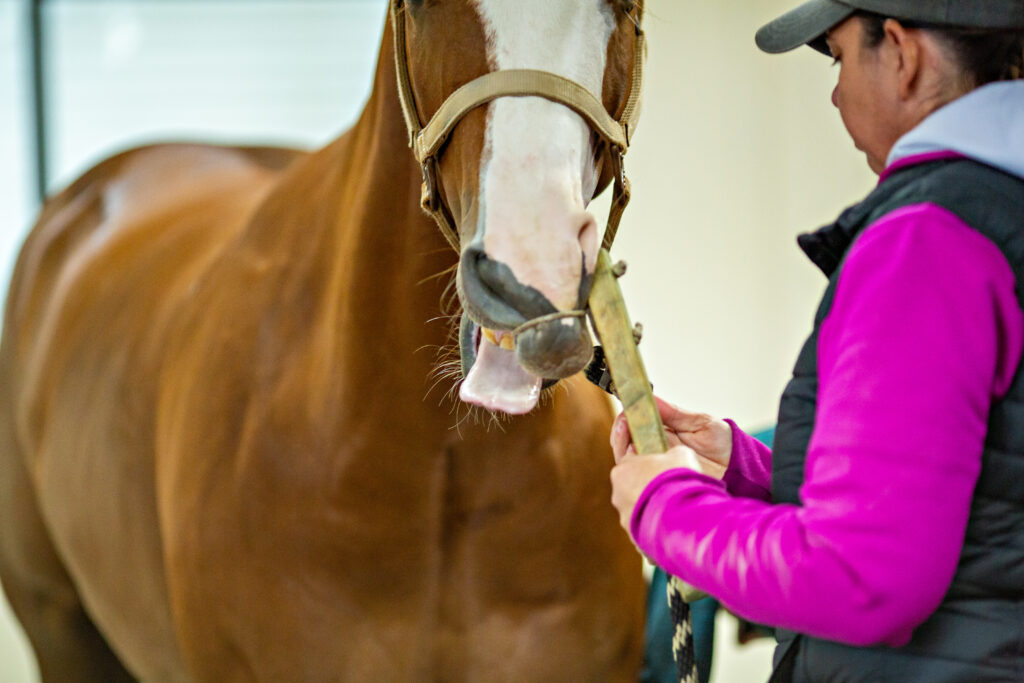
Veterinarians often need to restrain horses during procedures to prevent injuries to both humans and horses. In a recent study, researchers examined 10 horses’ responses to a twisted rope lip twitch and analyzed how the horses’ individual personalities impacted that response.
The Pain Ethogram
One of the main indicators of discomfort or pain in horses is an asymmetric or backward ear position. In this study, the researchers used the Pain Ethogram (developed by Sue McDonnell, PhD, CAAB, and associates) to monitor the horses for signs of stress. These signs could manifest as changes in ears, eyes, head, forelimbs, body, hind limbs, and tail postures. (Horses receive a composite score determined by adding up all the changes in each variable.) The researchers evaluated whether pain and stress indicators are recognizable during lip twitch application and if these observed variables are related to individual personality traits as described by each horse’s caretaker.
Study Population
The study included 12 horses (11 geldings and one mare) ranging in age from 5.5 to 16 years. Ten of the horses fulfilled the study protocol until its end. The researchers randomly assigned two experimental session possibilities to each horse, either electrical stimulation or thermal and mechanical stimulations. They recorded data before test stimuli or twitching started; during assessment of nociceptive thresholds from test stimuli; during twitching for five minutes; and immediately upon twitch removal and up to 15 minutes later.
Horses’ Pain and Stress Responses to Lip Twitching
The authors reported that observable behavioral changes coincided with stress from an applied lip twitch. Ear position changed dramatically; horses spent less time with their ears forward and more time with them backward during twitching. A reduction in forward ear positioning also correlates to withdrawal from attention to the environment and places the horse in a more inward focus and negative emotional state. In addition, horses decreased forelimb resting (equal weight distribution) during and after twitching, indicating “a disruption of relaxed postures typically associated with low arousal states.” Pawing also decreased with twitching, likely due to generalized suppression of active behavior while twitched that allows horses to cope with threats they can’t escape.
Head movements increased, possibly because of frustration at the inability to escape the twitch. This contrasts with previous studies that suggest twitching acts like a sedative through endorphin release and analgesia. Nociceptive stimuli also influenced forelimb weight distribution, with electrical stimuli eliciting longer durations of weight shifting than thermal and mechanical stimuli.
The researchers noted a correlation between horses’ personality traits and behavioral responses to twitching. “Neurotic” horses that were highly sensitive and emotionally unstable were more likely to alter weight distribution during baseline and post-twitch intervals. This sensitivity suggests a low pain threshold coupled with high frustration levels. These horses also tended to move away less during the nociceptive stimulus during twitching, which indicates a “freeze” or immobilization response similar to that seen in many other species during stress situations. Neurotic horses held their ears backward for longer periods, especially during the twitch period. More agreeable and generally cooperative horses coped with the mild stress by moving away from the nociceptive stimuli during the twitch period.
Final Thoughts
The authors advised that different equine personalities will elicit different stress responses, with the potential for a flight reaction that could endanger the horse and/or handlers. It is important to regularly monitor ear and head position, head movement, and limb weight distribution to continually assess how the horse is coping with the twitch application and the noxious stimuli it is experiencing. They suggested that a food reward might temper active responses to prevent unwanted explosive behaviors.
Reference
Kellershohn JJ, Blum S, Montavon S, et al. Are indicators of stress and pain recognizable during lip twitch in horses? A behavioral investigation, Journal of Veterinary Behavior 2025; DOI: 10.1016/j.jveb.2025.08.003
Related Reading
- Injury Risk and Prevalence in Equine Practice
- Disease Du Jour: Fear Free Veterinary Care
- Horse Handling Techniques for Safer Nerve Blocks
Stay in the know! Sign up for EquiManagement’s FREE weekly newsletters to get the latest equine research, disease alerts, and vet practice updates delivered straight to your inbox.
![[Aggregator] Downloaded image for imported item #18374](https://s3.amazonaws.com/wp-s3-equimanagement.com/wp-content/uploads/2025/09/30140012/EDCC-Unbranded-28-scaled-1-768x512.jpeg)