This article originally appeared in the Spring 2026 issue of EquiManagement. Sign up here for a FREE subscription to EquiManagement’s quarterly digital or print magazine and any special issues.
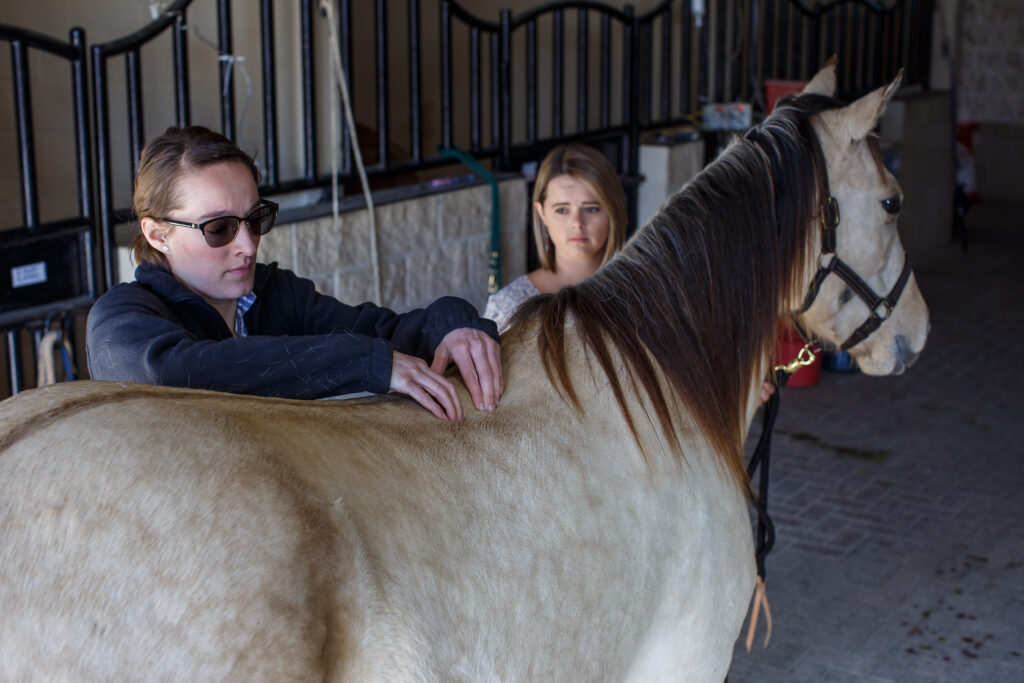
Electroacupuncture is a form of acupuncture that adds electrical stimulation to the acupuncture needles on acupuncture points. It has shown varying efficacious results for managing thoracolumbar back pain in the literature, making it an interesting treatment option. Not all horses will tolerate electroacupuncture needles, however, or stand still for extended periods to receive treatment. As an alternative, veterinarians are beginning to reach for laser acupuncture.
“Laser acupuncture uses nonthermal, low-intensity laser irradiation to stimulate acupuncture points, offering a noncontact therapy with shorter treatment times for needle-shy patients,” explained Kaitlin Sebring, DVM, from the University of Florida Integrative and Mobility Medicine Department, during a presentation at the 2025 American Association of Equine Practitioners Convention.
Study: Is Laser Acupuncture a Viable Alternative to Electroacupuncture?
Sebring and colleagues from the University of Georgia conducted a study to determine if laser acupuncture was a viable alternative to electroacupuncture for treating thoracolumbar pain in horses.
The researchers randomly divided 21 horses with thoracolumbar discomfort into three groups: control, electroacupuncture, and laser acupuncture. Study horses were less than grade 3.5 lame, had no recent treatment for pain (e.g., mesotherapy, biologics, etc.), had no chiropractic or acupuncture treatments in the month prior to the study, and did not receive gabapentin, non-steroidal anti-inflammatory drugs, or methocarbamol in the preceding 30 days.
They used mechanical nociceptive thresholds (MNTs), an objective measure of pain, to determine treatment efficacy. MNTs were measured by applying 5 kg/cm2/second of pressure on the T13, T18, L3, L6, and S2 epaxial muscles until the horse produced an avoidance response (i.e., flinching, vocalizing, moving away).
Sebring’s team performed treatments on Days 1, 4, and 7 of the study. For electroacupuncture, horses were treated for 30 minutes (20 Hz for 15 minutes and 80 to 12 Hz for 15 minutes) at acupuncture points GV-6, -14, and -20 and BL-17, -21, -26, and -54. The same points, with the exception of GV-14, were used for laser acupuncture with a class IV laser ata wavelength of 980 nm at 12 J/cm2 for a total of 120 J and 120 seconds at each site.
MNTs were recorded at baseline (Day 0) and on Days 4, 7, and 14 (7 days after the last treatment). Measurements were performed immediately after acupuncture treatment, and the researchers averaged the three measurements at each site.
Study Findings
“Compared to baseline, we saw a statistically significant increase in MNTs at each pressure point (T13, 18, L3, L6, S2) on Days 7 and 14 in the electroacupuncture and laser acupuncture groups but not in the control group,” said Sebring. “In addition, we averaged all MNTs for all sites over time. In the electroacupuncture group, there were significant increases on Days 1, 4, 7, and 14, so immediately after treatment. In the laser acupuncture group, significantly higher MNTs were noted on Days 4, 7, and 14.”
They then compared each group at each time point, and the only significant difference in MNTs was between the control group and the electroacupuncture groups on Days 7 and 14 at site L3. They noted no significant difference between MNTs between the electro- and laser acupuncture groups at any time point of any site.
In terms of limitations, Sebring said they did not clip the hair coat for laser acupuncture, which might be required for appropriate laser penetration. Further, treatment protocols for both electro- and laser acupuncture might not be optimized, and the researchers only measured MNTs for one week following therapy.
Final Thoughts
In conclusion, Sebring said, “Electroacupuncture and laser acupuncture do provide alternatives for pain relief, and laser acupuncture is a great option for needle-shy horses, as we have seen some evidence that it does improve pain.” Effective protocols need further investigation.
Related Reading
- Conservative Management and Rehabilitation Strategies for Equine Back Pain
- Daily Vet Life: Rehabbing Suspensory and Sacroiliac Injuries
- Disease Du Jour: Muscle Conditions in Horses
Stay in the know! Sign up for EquiManagement’s FREE weekly newsletters to get the latest equine research, disease alerts, and vet practice updates delivered straight to your inbox.