Rehabilitation exercises are important elements in restoring a horse to its former athletic capabilities. At the 2025 American Association of Equine Practitioners Convention in Denver, Colorado, Hilary Clayton, BVMS, PhD, DACVSMR, FRCVS, from Michigan State University, described the process of reintroducing ridden work and building up a horse’s workload to restore fitness.
Keep Musculoskeletal Tissues Active
She began by stressing that when possible, avoid stall rest for a horse in rehabilitation. Because musculoskeletal tissues lose tone rapidly from reductions in loading, it is important to keep them active and moving. Include flexibility, core activation, and strengthening exercises for large mobilizing muscles, she said. Deep stabilizer muscles, which help prevent micromotion of the intervertebral joints during movement, have a lower innervation threshold and are activated before the long mobilizing muscles. A useful means of activating deep stabilizers for core training involves baited (carrot) stretches. Three to five repetitions a day for at least four days a week over six weeks can result in significant hypertrophy of deep stabilizer muscles, said Clayton.
The tail pull exercise—not just lateral pulls but also 45-degrees pulls both cranio- and caudal-laterally—is particularly useful to improve pelvic stability. These different directions activate slightly different branches of the muscles that stabilize the hip and stifle.
As for saddle fit, Clayton noted that if a horse is off work for more than a month, the back shape might change because of rapid muscle atrophy. As the horse is put back in work, those muscles will redevelop, so it might be necessary to use shims or pads initially while the back muscles return to their previous shape.
Load the Back Gradually
In horses that are recovering from back pain, especially after surgery for impinging spinal processes (kissing spines), she recommended increasing the load on the horse’s back gradually by using a weighted girth or saddle cloth before starting ridden exercise with a lightweight rider. Weights should be placed close to the horse’s center of mass and fastened securely to prevent bouncing. She said she likes to use thoracic lifts and walking over poles to activate the core muscles in preparation for ridden exercise.
Slowly Increase the Work Volume
Clayton said three things determine exercise volume: Duration + intensity + workout frequency. She advised asking for slowly progressive increases in work volume on a weekly basis by incrementally increasing distance or duration before amplifying intensity. With any ridden exercise, injury recovery takes precedence over developing a horse’s fitness schedule; injury determines how fast an exercise program can progress.
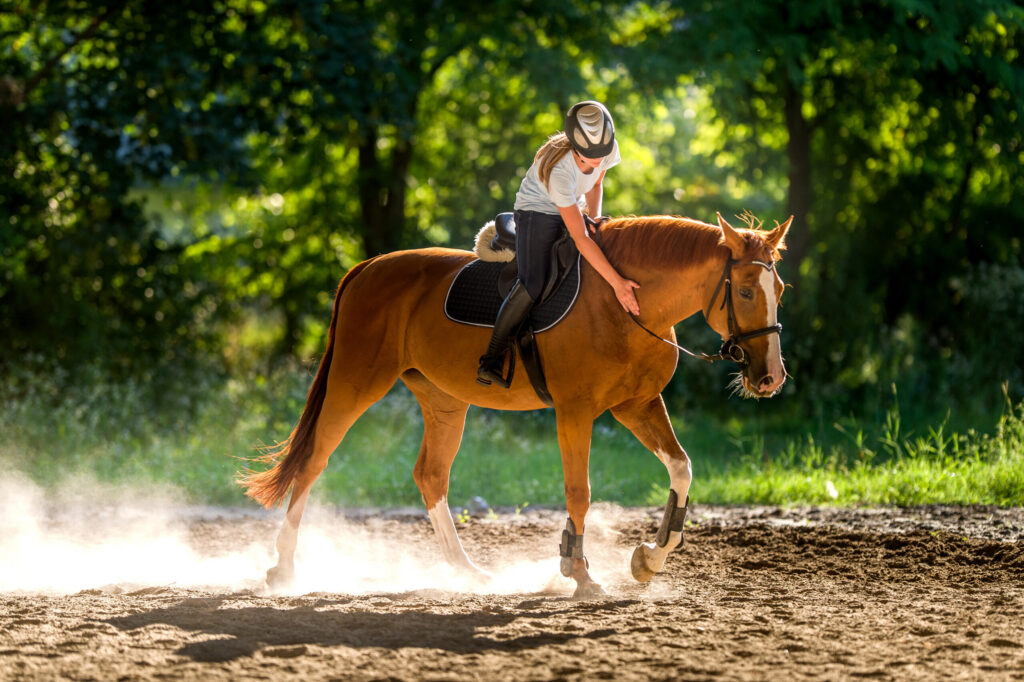
Clayton recommended starting ridden exercise with a low exercise load, such as walking under saddle five to seven days a week for 5-10 minutes at a time. An increase in speed at walk is achieved by moving the limbs through a larger range of protraction and retraction. When appropriate, walking in circles and tighter turns increases bending, suppleness, and agility. Walking over poles activates the core muscles, and backing up correctly flexes the lumbosacral joint as the horse tilts his pelvis. Different surfaces and footing help improve proprioception, especially when changing surfaces frequently (e.g., sand to pavement to grass).
Clayton said gradients are invaluable, as uphill efforts put more weight on the haunches and strengthen the hindquarters. Always take downhill inclines at a walk during rehab, due to increased loading and concussion on the forelimbs. Downhill work helps train thoracic sling muscles. To achieve the best results, the horse must be in self-carriage without leaning on the reins. Transitions between walk, halt, and rein back are helpful.
Once the horse has built up to walking for 30 minutes, Clayton recommended including brief periods—about 30 seconds at a time—of trot and later canter, with weekly increases in duration. She believes two minutes of continuous trot is too much to begin with so advises starting with just 30-second bursts. It is also notable that trot increases loading on both the back and limbs. A sitting trot puts the most rider force on the horse’s back, posting off-loads one diagonal so the rider must be sure to change the posting diagonal frequently, and a standing or two-point position in the saddle with stirrups shortened allows the rider’s hip, knee, and ankle to absorb the vertical motion resulting in lower peak forces on the horse’s back. Trotting over poles increases range of motion of the limb joints in the swing phase.
When it is time to introduce canter, Clayton recommends starting with a light seat or standing position to reduce compressive forces on the horse’s back. The limb forces at canter are similar to trot, and the back only assumes a little higher force than at trot.
Monitor Healing Progress and Return to Function
Throughout a rehab program, it is important for the veterinarian to be included in scheduled rechecks and clinical evaluations at key points to monitor healing progress and return to function. The type of injury and rate of healing dictate how quickly an exercise program may progress.
From a fitness standpoint, if a horse has been out of work for a month or less, exercise starts slowly and increases gradually with the goal of returning to the previous work level in 1-2 weeks. For each additional month a horse is out of work, allow an additional 2-4 weeks to return to preinjury fitness level. However, the rate of progress will be slower during rehabilitation. It is important that owners and riders understand the expectations and limitations during rehabilitation so they can progress at an appropriate rate to accomplish their goals.
Sports medicine coverage from the 2025 AAEP Convention is brought to you by Dechra.
Related Reading
- Therapeutic Exercises for Horses With Topline Dysfunction
- Incorporating Elastic Therapeutic Tape Into Equine Practice
- Improving Equine Rehab Outcomes Through Better Owner Adherence
Stay in the know! Sign up for EquiManagement’s FREE weekly newsletters to get the latest equine research, disease alerts, and vet practice updates delivered straight to your inbox.
![[Aggregator] Downloaded image for imported item #18375](https://s3.amazonaws.com/wp-s3-equimanagement.com/wp-content/uploads/2025/09/30140031/EDCC-Unbranded-26-scaled-1-768x512.jpeg)