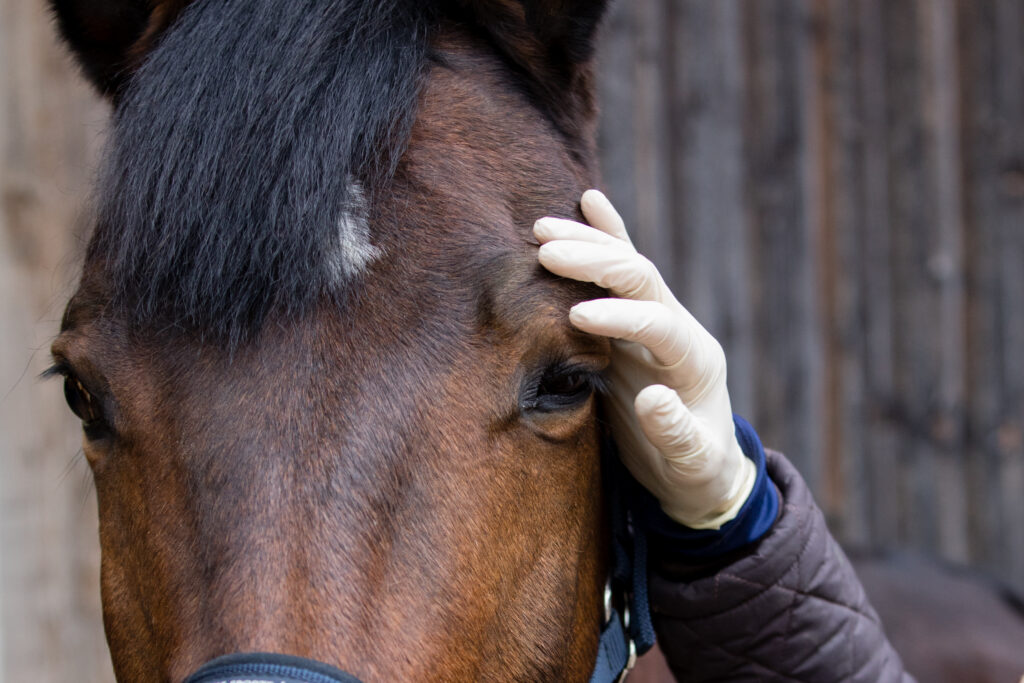
The horse’s eye has numerous defense mechanisms to protect it from pathogens. These include physical barriers, such as tear film and the conjunctival and corneal epithelia, as well as antimicrobial compounds and immune-mediated responses. Resident bacterial communities are critical to maintaining a homeostatic system in the eye. Antibiotics with or without corticosteroids can upset this balance; corticosteroids are known to inhibit healing of the corneal epithelium and impair phagocyte response and neovascularization.
Study: Topical Antibiotics’ Impact on the Horse’s Eye
To better understand topical antibiotics’ impact on the horse’s eye, researchers at the University of Florida looked at changes to the ocular microbiota following topical treatment with antimicrobials with or without corticosteroids.
The prospective, randomized, blinded study included 12 healthy horses split into two treatment groups of six. One group received neomycin, polymyxin B, and bacitracin (BNP) ophthalmic ointment, while the other group received neomycin, polymyxin B, and dexamethasone (NPD) 0.1% ophthalmic ointment. They treated one eye from each horse; the horses’ untreated eyes served as controls. The researchers medicated the treated eyes three times daily for seven days and then discontinued medication.
The researchers collected swabs of the ocular surface within 4-6 hours following treatment. They also collected periocular skin from four horses’ treated eyes. For each time point of collection, they exposed swabs to the environment by holding them in the air for 30 seconds. Sample collections were taken at Days 0, 1, 3, 7, 9, 14, and 30.
Prior to treatment, on Day 0, the ocular surface microbiota was the same for all horses. It is noteworthy that in this study, Gram-negative bacteria were the most represented in the ocular microbiota. The authors noted that this trend occurs not only in horses but also in humans, cats, and dogs. They reported differences in microbiota relative to the timing of sample collection, possibly due to environmental and husbandry conditions such as rounding up the horses for sample collection.
Take-Home Message
In conclusion, the study demonstrates that administering topical antibiotics with or without corticosteroids “induces changes in the ocular surface of equine eyes, yet the microbial communities return to baseline about three weeks following discontinuation of treatment.” By Day 30, all eyes had returned to baseline measurements.
Reference
Martin de Bustamante MG, Plummer CE, Caddey B and Gomez DE. The effect of topical antibiotic or antibiotic-corticosteroid treatment on the ocular surface microbiota of healthy horses. Front. Microbiol 2025, 16:1535095; DOI: 10.3389/fmicb.2025.1535095
Related Reading
- Eye Complications in Horses Following General Anesthesia
- Prepurchase Ophthalmic Examinations: What Do You Need?
- Corneal Cross-Linking to Treat Ulcerative Keratitis in Horses
Stay in the know! Sign up for EquiManagement’s FREE weekly newsletters to get the latest equine research, disease alerts, and vet practice updates delivered straight to your inbox.