In this episode of the Disease Du Jour podcast, Kara Brown, VMD, DACVSMR, discussed equine tendon and ligament injuries. She explained the pathophysiology of soft tissue injuries, diagnostic imaging modalities, injury management strategies, the role of orthobiologics, and more.
This episode of Disease Du Jour is brought to you by Equithrive.
The Pathophysiology of Equine Soft Tissue Injuries
Brown explained that tendon and ligament injuries are usually caused by overstrain, either from a single overload event or, more likely, chronic repetitive strain. In chronic cases, the horse often isn’t overtly lame in the early stages. It might display very subtle lameness or performance issues.
“That inflammation weakens the tendon over time, and then with continued exercise and strain on the tendon, the structural properties of the tendon are overwhelmed, and that’s going to result in damage to the fiber,” Brown explained. “Unfortunately, because tendons and ligaments repair with a large amount of scar tissue, which is strong but not really elastic, horses are very prone to reinjury in these healed areas.”
Common Tendon and Ligament Injuries in Horses
Across the board, Brown said, the soft tissues on the palmar and plantar aspects of the cannon bone are most prone to injury, including the superficial and deep digital flexor tendons, the suspensory ligament, and the check ligament. She noted that certain types of horses are predisposed to certain injuries: Bowed tendons are prevalent in racehorses and eventing horses competing in high-speed events; suspensory desmitis is prevalent in Western performance, hunter/jumper, and dressage horses; and deep digital flexor tendinitis is common in Western performance horses, especially Quarter Horses predisposed to navicular disease.
Diagnostic Imaging Modalities
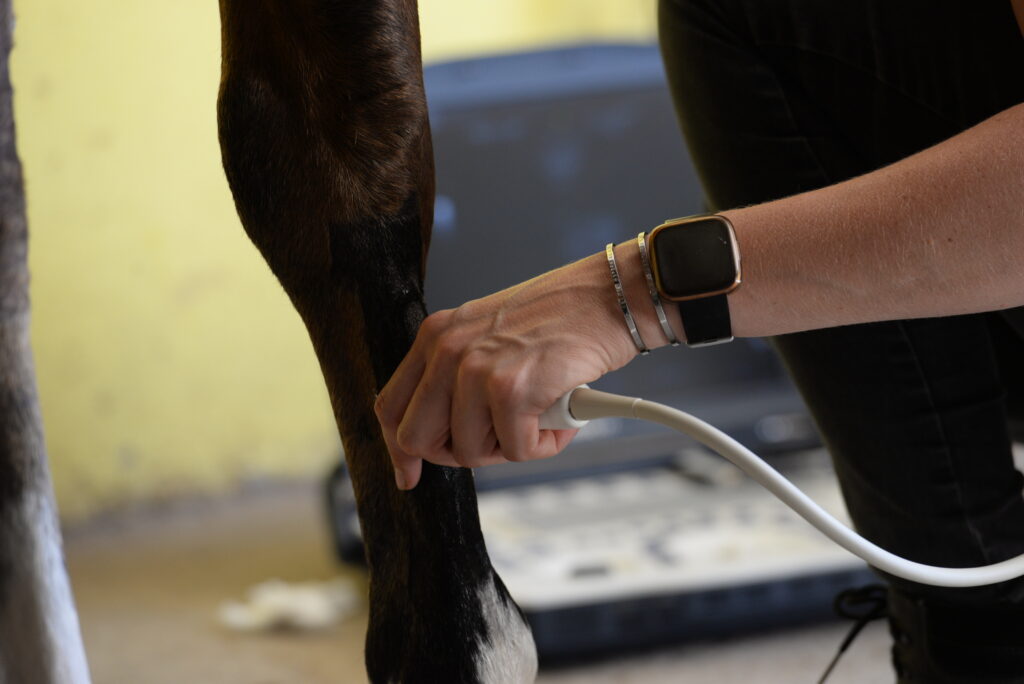
While ultrasound is the “bread and butter” diagnostic imaging modality for identifying soft tissue injuries, especially in the field, Brown noted that it has limitations. “The one area that I think across the board is very difficult to assess [with ultrasound] is the most distal portion of the deep digital flexor tendon within the foot,” she said.
Some ligaments are also difficult to assess on ultrasound, such as the proximal suspensory ligament. “It has muscle and fiber bundles within it, which makes it already pretty heterogeneous in its characteristics, which then makes that really difficult to distinguish from an actual lesion,” she said.
MRI is helpful for assessing areas that aren’t visible on ultrasound. PET (positron emission tomography) is also valuable but is typically used in combination with a cross-sectional imaging modality. “Sometimes we’ll use [PET] to screen the lower limb and say, ‘I think there’s active injury in this area.’ And then we’ll follow up with an MRI,” Brown said. “Or, if we have a question about an MRI and are looking to get another indicator of active injury, then we’ll employ the PET scan as well.”
The Role of Orthobiologics in Managing Equine Soft Tissue Injuries
A large base of literature supports the use of intralesional injections with regenerative therapies, especially autologous mesenchymal stem cells and platelet-rich plasma (PRP), said Brown. These therapies improve the quality of the repair tissue and decrease reinjury rates.
Brown reaches for orthobiologics for most cases she manages but noted that the lesion must be large enough to inject. “I don’t like forcing a substance into a small hole, but it doesn’t have to be very big. As long as you can get a needle into it, then for me, it’s relatively suitable for injection,” she said.
Brown also noted that the decision between platelet-rich plasma and stem cells comes down to the owner’s finances and availability. She often starts with PRP because it is a point-of-care treatment, but many clients also elect to take bone marrow and bring the horse back for treatment with mesenchymal stem cells. “We have pretty good evidence to support the use of stem cells in addition to PRP, but stem cells do seem to have some benefits over a lot of other orthobiologic therapies,” she said.
Listen to the podcast episode to learn more about managing soft tissue injuries. Brown discussed the role of farriery, the current thinking around stall rest versus controlled exercise, follow-up imaging and evaluation intervals, and more.
About Dr. Kara Brown
Kara Brown, VMD, DACVSMR, is an assistant professor of equine sports medicine and rehabilitation at the University of Pennsylvania School of Veterinary Medicine’s New Bolton Center. She is also a graduate of the University of Pennsylvania School of Veterinary Medicine. After graduation, she completed an equine internship at Woodside Equine Clinic, followed by a large animal internship, a clinical fellowship in large animal cardiology and ultrasound, and a residency training program in equine sports medicine and rehabilitation at New Bolton Center. She is a boarded diplomate of the American College of Veterinary Sports Medicine and Rehabilitation and has a strong clinical and research interest in poor performance in the equine athlete, axial skeletal pain, and regenerative medicine.
Related Reading
- Rehabilitating Equine Soft Tissue Injuries
- Disease Du Jour: Equine Rehabilitation Modalities
- Rehabbing Equine Hind Proximal Suspensory Ligaments
Stay in the know! Sign up for EquiManagement’s FREE weekly newsletters to get the latest equine research, disease alerts, and vet practice updates delivered straight to your inbox.