This article originally appeared in the Spring 2026 issue of EquiManagement. Sign up here for a FREE subscription to EquiManagement’s quarterly digital or print magazine and any special issues.
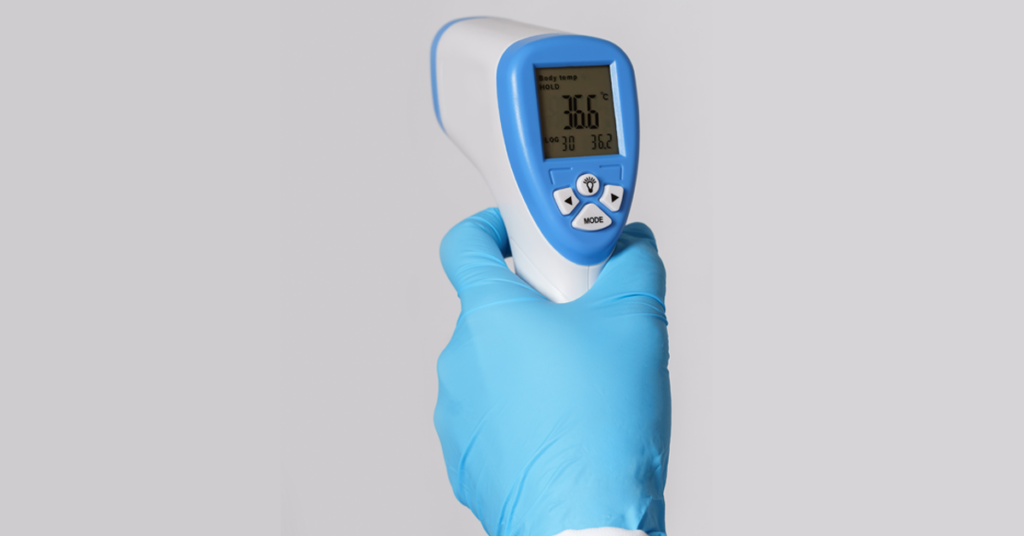
One of the most important ways to identify sick horses at competitions is by taking their temperatures daily. Temperature-taking is also an essential part of a routine physical exam. Noncontact, infrared thermometers might help make this task easier, eliminating the need for rectal temperatures and risk of injury to the temperature-taker.
“Taking a rectal temperature can pose a serious risk to the veterinarian or caretaker,” said Rebecca Bishop, DVM, MS, PhD, DACVS-LA, from the Department of Veterinary Clinical Medicine, University of Illinois, in Urbana, during a presentation at the 2025 American Association of Equine Practitioners Convention. “Those risks shouldn’t be overlooked, and risk mitigation strategies are advisable.”
Noncontact Infrared Thermometers for Equine Temperature Monitoring
One potential strategy involves using noncontact infrared thermometers. Previous work by Bishop and colleagues found the infrared thermometer could successfully take a horse’s body temperature using the cornea or perineum. The values weren’t numerically equivalent to the rectal temperature, but they helped create reference ranges for those two sites (Zobrist et al. 2024).
“However, that study was limited to healthy horses in a controlled environment, which does not reflect the real world,” explained Bishop.
Study: Feasibility of Infrared Thermometers in Ambulatory Settings
During her presentation, Bishop relayed the details of a follow-up prospective, observational study that assessed the feasibility of using infrared thermometers in an ambulatory setting in different environmental temperatures in both healthy and febrile horses.
The study involved 107 healthy and nine febrile horses. Body temperatures were taken in barns, open sheds, and paddocks. Ambient temperature, humidity, and weather conditions were recorded in addition to the horses’ temperatures. Digital rectal temperatures and infrared temperatures were taken in each horse with specific guidelines.
“We found there was significant linear correlation between digital rectal temperatures and infrared perineal temperatures but not between digital rectal temperatures and infrared corneal temperatures,” said Bishop.
The febrile horses had rectal temperatures > 101.5 F. Those horses were younger and had either a fever of unknown origin, pneumonia, cellulitis, or colitis.
According to Bishop, the corneal infrared temperature had a specificity of 87% and a sensitivity of only 50% for detecting a fever. In contrast, the perineal infrared temperature had a lower specificity (87%) but was more sensitive (67%). When combined, the cornea and perineal infrared temperatures had a specificity of 85% and sensitivity of 77%.
“In general, a test with higher sensitivity is better able to correctly identify those individuals with a condition (in this case a fever), while a more specific test is better for identifying those without the condition,” said Bishop. “These findings suggest that the perineal temperature is less likely to classify a febrile horse as normal but may misclassify some horses with normal rectal temperature as having a fever. By combining the two readings, we can be more confident in the overall accuracy.”
This study also found that perineal temperature was less affected by ambient temperature, was more sensitive for fever, but had more false positives than the corneal temperature.
“Thick tails and heavy blankets might have affected the readings, but overall, perineal temperature was better tolerated than rectal temperature. And even though a person still has to stand near the horse’s rear, it takes less than two seconds and is far less noxious,” relayed Bishop.
Final Recommendations
Her recommendation was therefore to identify febrile horses using either corneal or perineal noncontact infrared temperature then verify a suspected fever by digital rectal temperature.
“These data should be confirmed in larger populations of febrile horses and, moving forward, we could also compare these findings to the temperature read by microchips,” Bishop concluded.
Related Reading
- What Did We Learn From Last Year’s EHV-1 Outbreak?
- Equine Stallside Testing: Elevating Patient Care
- EHV-1: Panic, Preparation, and Poise
Stay in the know! Sign up for EquiManagement’s FREE weekly newsletters to get the latest equine research, disease alerts, and vet practice updates delivered straight to your inbox.