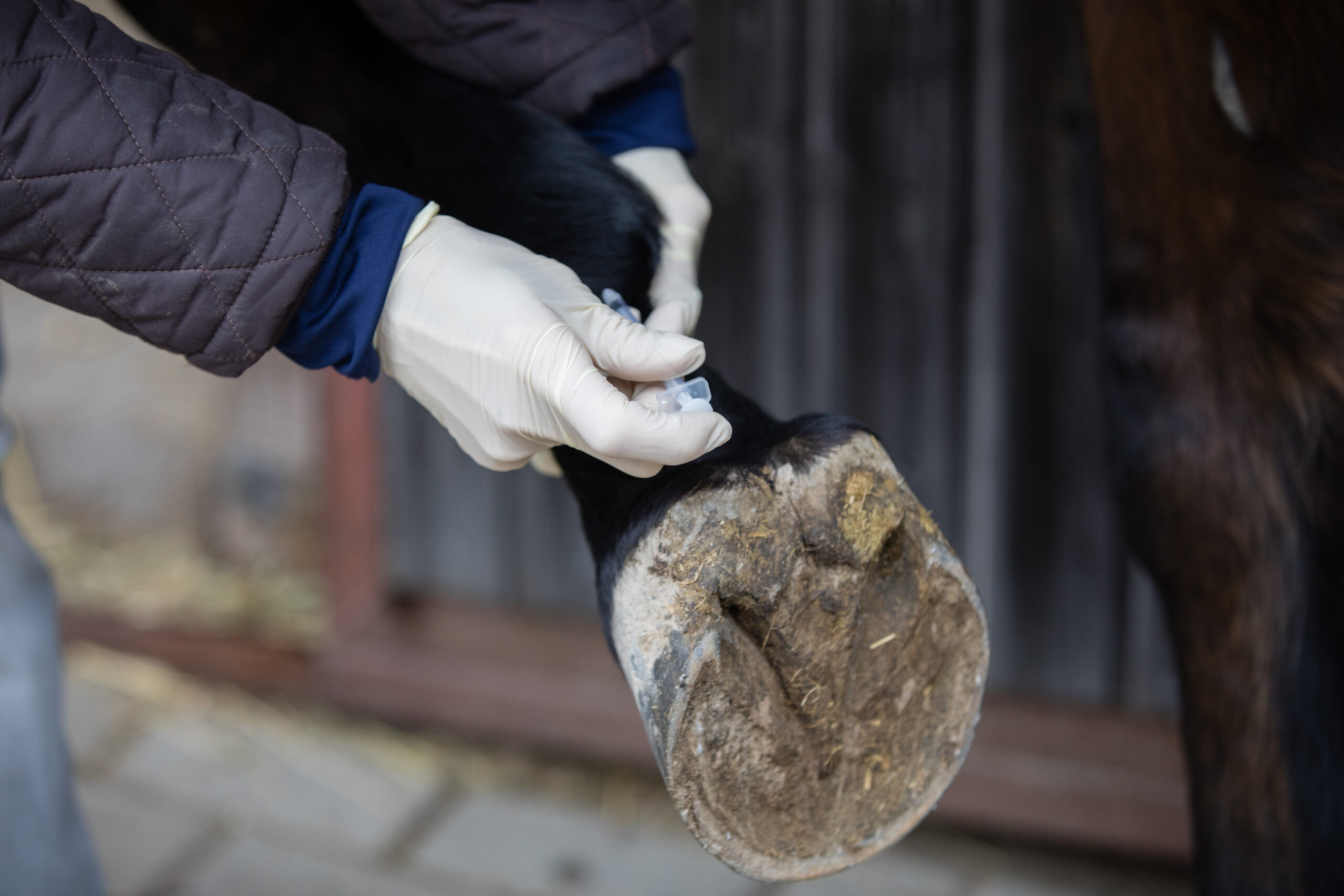
In this episode of the Disease Du Jour podcast, Alicia Bertone, DVM, PhD, DACVS, DACVSMR, joined us to discuss her new research on using umbilical tissue-derived allografts to treat equine musculoskeletal conditions
This episode of Disease Du Jour is brought to you by Equithrive.
What Prompted the Development of Umbilical Tissue-Derived Allografts?
Most orthobiologics currently used in equine practice are autologous blood products, Bertone explained. “Those will always be limited by the fact that they are coming from usually an adult horse, but also one that already is not of perfect health,” she said.
Umbilical tissue products are developed in the fetus and are free from disease, degradation, and inflammation. The specific umbilical tissue allograft Bertone studied contains more than 2,600 growth, development, and anti-catabolic proteins.
“In addition, it helps supply a scaffold, because it is a connective tissue. You can kind of think of it like a lattice work,” she said. “Essentially, the product has the opportunity to be an allograft. Due to decades and decades and decades of putting allografts in joints and tendons and ligaments in humans and elsewhere without adverse reactions, it is considered a safe source of tissue.”
The umbilical product is available directly off the shelf, eliminating the collection and processing time required with other biologics.
Umbilical Tissue Suspension Superiority Study
Bertone recently conducted an FDA superiority study on equine umbilical tissue suspension. “The clinical study was designed to test the hypothesis that this umbilical tissue allograft would be better than the control,” she said. “The goal was to show greater improvement in lameness, pain, or swelling in real-world cases of joint, ligament, or tendon conditions in client-owned performance horses with a follow-up out to 12 weeks.” The study also followed performance and soft measures of health and wellness for 26 weeks.
Bertone noted that this was one of the most rigorous adverse event studies conducted in equine medicine, with any reactions or findings at the injection site confirmed by the veterinarian and recorded.
“This treatment was superior in pretty much all of the analyses that were looked at,” Bertone said. “It was sort of a convergence of effects. By two weeks and four weeks, there was a significant improvement, meaning significantly greater than the standard-of-care control.” Improvements over the control were sustained in lameness, pain, and swelling to 12 weeks. Performance to 26 weeks was also dramatically improved over the standard of care. In addition to the greater improvement in clinical parameters, horses treated with the umbilical product were three times more likely to be pain-free, 2.72 times more likely to return to performance levels equal to or better than before, and 4.8 times less likely to have an adverse reaction, Bertone said.
Which Anatomic Locations Are Umbilical Products Most Effective in Treating?
Bertone explained that use in painful, dysfunctional joints had the strongest evidence, but performance improvements were greatest for ligaments at 12 and 26 weeks, with a Cohens d effect score of 2.26. The most treated joints, in order, were the stifles, fetlocks, coffin joints, carpi, and hocks. The most treated ligaments were the suspensory ligaments, both proximal and branches. The most treated tendons were the superficial digital flexor followed by the deep digital flexor.
Bertone said umbilical-derived products should be agnostic to tissue type. “All tissues want to have IGF (insulin-like growth factor), FGF (fibroblast growth factors), want to have tissue inhibitor metalloprotease, want to have these proteins that are really valuable for turnover no matter where it is,” she said. “Regardless of the joint, regardless of the tissue type, these effects would be expected to occur.”
Listen to the podcast to learn more about umbilical-derived tissue allografts, including collection and processing procedures, quality control measures, future research directions, and more.
Read Bertone’s full study here.
About Dr. Alicia Bertone
Alicia Bertone, DVM, PhD, DACVS, DACVSMR, received her Bachelor of Science and DVM from Cornell University, where she also completed an internship. She subsequently completed a combined surgery residency/PhD program at Colorado State University. She joined the surgery faculty at Louisiana State University that same year.
Bertone became board-certified as a Diplomate in the American College of Veterinary Surgeons in 1988 and joined the surgery faculty at The Ohio State University as an equine orthopedic surgeon in 1989. She focused her clinical and research efforts in the field of orthopedics and became a full professor in 1997.
Bertone has served as an equine orthopedic surgeon at The Ohio State University Galbreath Equine Center for more than 25 years, managing cases and training veterinary students and equine surgery residents.
Bertone has been recognized as one of the top extramurally funded researchers in the College of Veterinary Medicine and has more than 180 peer-reviewed scientific publications. After completing a one-year sabbatical at the Center for Molecular Orthopedics at Harvard University, Bertone served two terms as the Trueman Family Endowed Chair and established the Comparative Orthopedic Molecular Medicine Suite and Applied Laboratories, which specialize in regenerative medicine, including stem cell and growth factor therapies.
Bertone became board-certified in Equine Sports Medicine and Rehabilitation in 2013. Her clinical focus is orthopedic surgery, and her research focus is in the study of comparative orthopedic medicine, regenerative medicine, and gene therapy for the treatment of cartilage injury and bone repair.
Related Reading
- Orthobiologics in Equine Practice: What’s Available and What Do We Know?
- Translational Medicine in Human & Equine Sport
- Platelet-Rich Plasma for Equine Joint Therapy: Where Are We At?
Stay in the know! Sign up for EquiManagement’s FREE weekly newsletters to get the latest equine research, disease alerts, and vet practice updates delivered straight to your inbox.