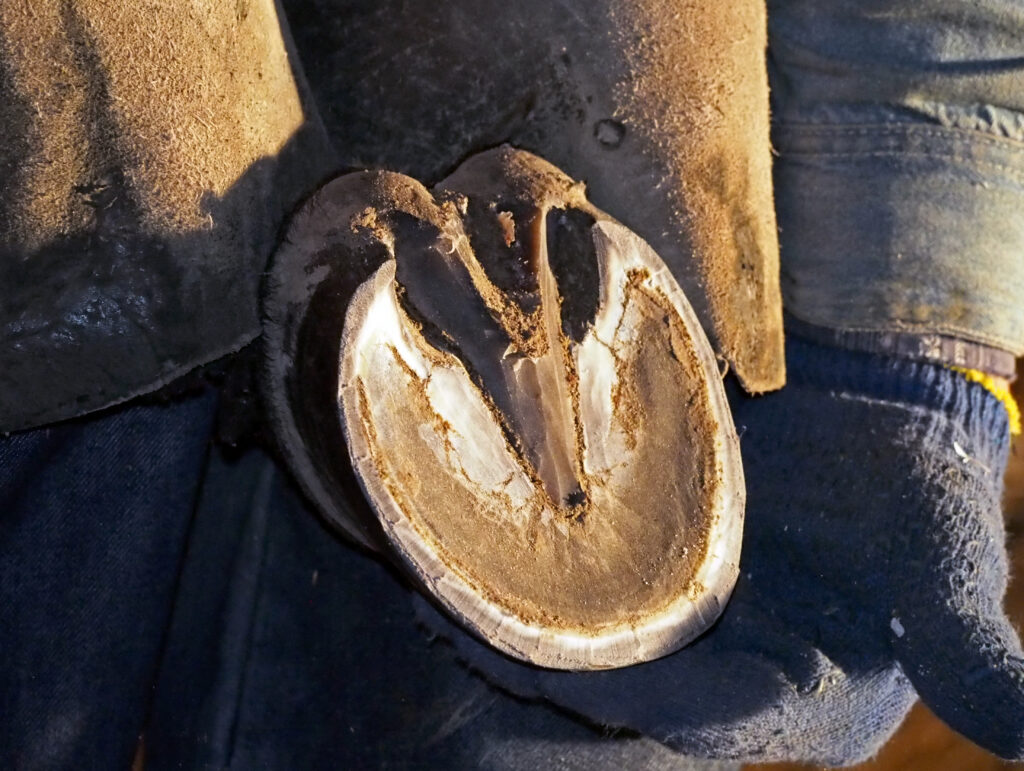
Thin soles are a relatively common yet simple problem in horses. “It’s basically a balance between hoof wear and growth,” said Jaret Pullen, DVM, APF-I, of JP Hoofworks, during a Burst session at the 2025 American Association of Equine Practitioners Convention. “When we have a horse that wears more than it grows, we’re going to have thin soles.”
Left untreated, horses with thin soles can suffer from abscesses, bruising, coffin bone remodeling, chronic pain, and lameness.
“There are two levers to pull in order to change this,” said Pullen. “Have the horse grow more sole or wear less. To achieve this, we have to do both.”
Mechanical Measures
Mechanical means of increasing hoof growth involve decompressing the vascular centers to get more blood flow to the growth centers. You can achieve this by raising the palmar angle (e.g., using a rocker shoe or wedge) and easing breakover, he said, which will reduce the tension on the deep flexor tendon as well as the compression on the solar corium.
Nutritional Support
“Once we get the blood flowing to those growth centers, what can we do to bring the nutrients to it? We have to provide the nutrients in the blood,” said Pullen, who likes to supplement these horses’ diets with really high doses (100-200 milligrams/day) of biotin as well as DL methionine.
Reducing Wear
Any level of external protection (e.g., shoes, boots, leather pads, urethane pour pads, clogs) can help reduce solar abrasion and hoof wear.
“Sometimes my clients like to leave their horses barefoot, and I have to explain that that’s going to be more difficult to reduce the wear,” he noted. “But if they want to go down that road, we can provide some sort of solar keratin support (e.g., sole tougheners, topical hardeners).”
Management practices can also help reduce wear. This includes turning horses out on softer, less abrasive surfaces, avoiding moisture as much as possible, and bedding stalls with shavings vs. courser sawdust. Pullen reminded attendees that management changes can be regionally specific: You’re going to be dealing with much more moisture in New England and Florida but more abrasive substrates in states such as Arizona, Colorado, and Texas.
“In the end,” he said, “there are simply two levers to pull: Increase growth and decrease wear.”
Related Reading
- Radiographs vs. MRI Show Limited Hoof Measurement Agreement
- Horses With Uneven Feet: Causes, Assessment, and Management
- Where We Stand With Podotrochlosis
Stay in the know! Sign up for EquiManagement’s FREE weekly newsletters to get the latest equine research, disease alerts, and vet practice updates delivered straight to your inbox.