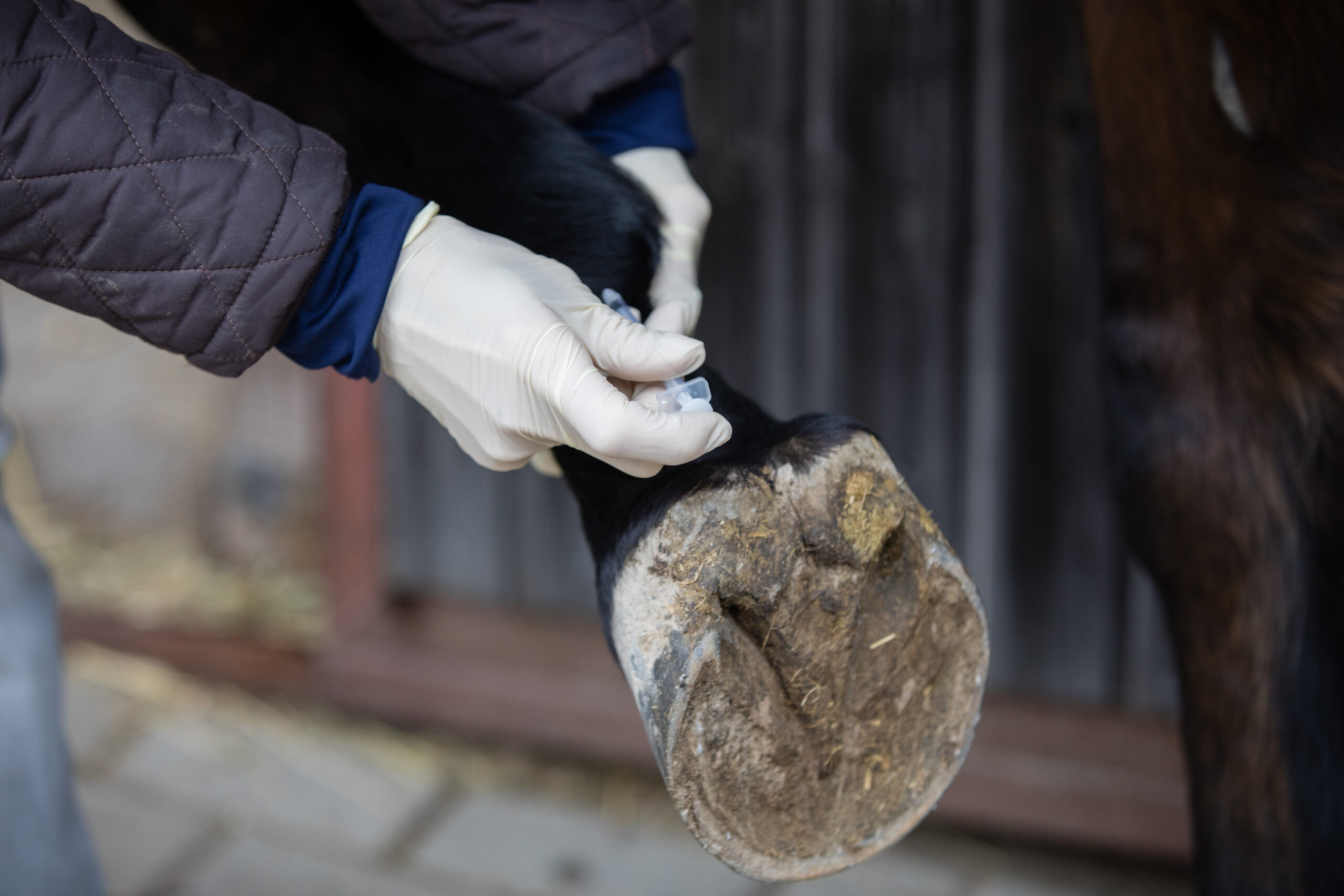
Traumatic injuries in horses are often accompanied by hemorrhage that can alarm owners and be challenging for equine practitioners to control. In a recent study, researchers at Cornell University evaluated the use of a hemostatic agent to control high-pressure, high-flow external hemorrhage.
Hemostatic Agents
TRAUMAGEL and VETIGEL are two hemostatic agents that come as prefilled syringes and have the same composition—naturally derived polysaccharides, sodium alginate, and poly (n-acetyl-D glucosamine, D glucosamine)—but are packaged at different volumes. These products adhere within the wound, activate platelets and coagulation factors, and create a scaffold for platelet aggregation and clotting. They also form a mechanical barrier to staunch the flow of bleeding. Hydrogels are biocompatible due to their high water content and polymeric backbone structure similar to extracellular matrix.
The researchers chose to evaluate TRAUMAGEL for hemorrhage control in large animals because of the larger syringe size (30 ml) compared to VETIGEL (5 ml). TRAUMAGEL is FDA-approved for use in people but should be removed from the wound within 24 hours. In contrast, VETIGEL is marketed for small animal use with no removal time restrictions.
Study in Holstein Calves
The study involved 18 Holstein calves aged 2-4 weeks. They all underwent a carotid arteriotomy under general anesthesia without clamping of the artery following the incision. The control group (n = 9) received compression with gauze pads stacked under hand pressure. The treatment group (n = 9) had 30 ml of TRAUMAGEL injected directly into the wound, followed by compression with gauze pads and manual pressure.
The researchers evaluated hemorrhage at 3, 9, and 19 minutes and assigned ratings of none (0), mild (1), moderate (2), or severe (3). They also recorded heart and respiratory rates and blood pressure at minute intervals throughout the trial. Monitoring stopped if hemostasis was achieved for at least five minutes.
All calves had significant hemorrhage in the initial two minutes after the arteriotomy. Manual compression mitigated severe bleeding in most of the treatment and a few control calves. All nine treated calves had hemostasis by the end of the trial as did five of nine in the control group. Most importantly, the median time for hemorrhage control in the treated group was 2 minutes and 50 seconds (range of 78-570 seconds) compared to 18 minutes and 54 seconds (range of 165-1,140 seconds) for the control calves.
Take-Home Message
The calves in the control group had nearly 24 times greater odds of uncontrolled hemorrhage. All animals experienced hypotension with low mean arterial pressures similar between the groups.
“TRAUMAGEL together with direct wound pressure was an effective method to decrease the severity of hemorrhage and time to hemostasis compared to control animals receiving only direct wound pressure,” the authors stated.
Reference
Radcliffe RM, Eggert HE, Hayes GM, et al. A hemostatic hydrogel has high efficacy for the treatment of hemorrhage in a large animal randomized controlled trial. JAVMA Deb 2025; DOI: 10.2460/javma 25.06.0424
Related Reading
- Researchers Assess Efficacy of Polyamide Surgical Mesh Implants in Horses
- Silicate Dressing Improves Healing of Equine Distal Limb Wounds
- Managing Post-Castration Complications in Horses
Stay in the know! Sign up for EquiManagement’s FREE weekly newsletters to get the latest equine research, disease alerts, and vet practice updates delivered straight to your inbox.