Hilary M. Clayton, BVMS, PhD, DACVSMR, FRCVS, professor and McPhail Dressage Chair emerita at Michigan State University, has dedicated her career to improving the equine veterinary industry’s understanding of biomechanics, performance, and rehabilitation. Clayton shared some of her key career findings during the Frank J. Milne State-of-the-Art Lecture at the 2025 American Association of Equine Practitioners convention, held Dec. 6-10 in Denver, Colorado.
To begin, Clayton highlighted the importance of locomotion as a necessity for finding food, water, and mates.
“Animals move in different ways, swimming, flying, or running, but each of these motions requires generating a force by pushing against the environment using, for example, fins in water, wings in the air, or feet on the ground. The environment then pushes back, prompting locomotion,” explained Clayton.
Locomotion is controlled by three-dimensional ground reaction forces (GRFs) acting in vertical, longitudinal, and transverse directions.
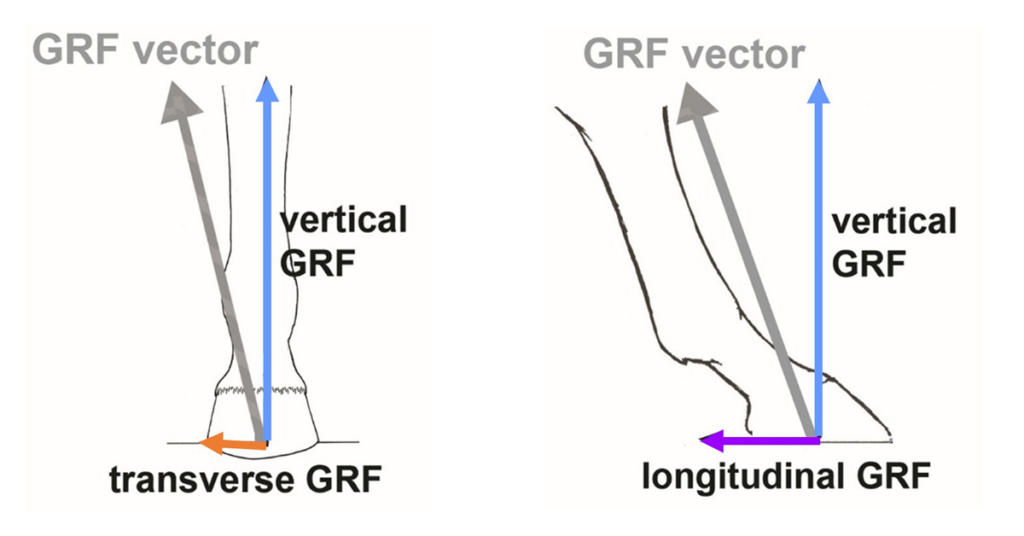
“The vertical component always acts in an upward direction combating gravity that is continually pulling the horse’s body downward,” she explained. “The longitudinal forces align along the long axis of the body and are involved in accelerating, decelerating, or maintaining speed. And the transverse forces act side to side across horse’s body to provide turning or lateral movements. GRFs are represented diagrammatically by arrows that are scaled to the magnitude of the force and are aligned with the direction in which the force acts.”
During locomotion, the GRF vector—the combination of each limb’s vertical, longitudinal, and transverse GRF components—passes either through or close to the center of rotation of that limb. Specifically, the tuber spinae scapulae in the forelimb and the hip joint in the hind limb.
When the horse moves in a straight line, said Clayton, the vertical GRF is by far the largest.
“Knowledge of how the GRF vector changes through the stride in each gait not only provides an insight into balance and athleticism but also influences many other cyclic biomechanical signals, including saddle forces and rein tension,” she explained.
Finding the Balance
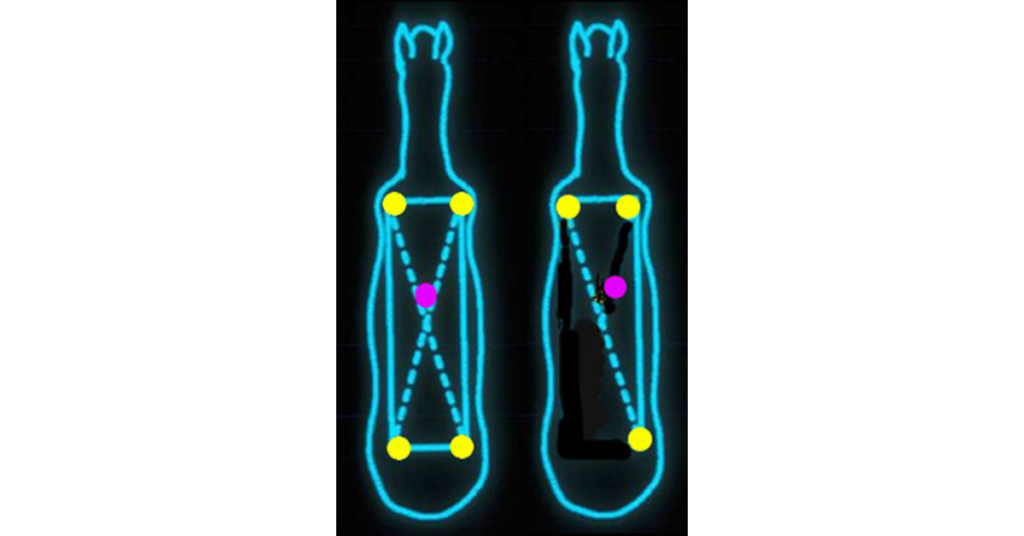
Understanding balance stems from appreciating where the horse’s center of mass (CoM) is located and how it is influenced by the forces acting on it. CoM is defined as the point where the horse’s entire mass is considered to be concentrated.
“The horse is in static balance when its CoM is vertically above (within) the base of support provided by the grounded hooves,” Clayton explained. “If the horse’s balance is disturbed so the CoM is no longer within the base of support, the horse will take a step to establish a new base of support that includes the CoM. That’s exactly what happens during locomotion when the horse is in dynamic balance. In this case, there are many times during the stride when the CoM is outside the base of support, but then the next limb to contact the ground ‘catches’ the horse’s body. Each limb in turn supports the body and propels it forward.”
How Do Horses Manage Their Balance?
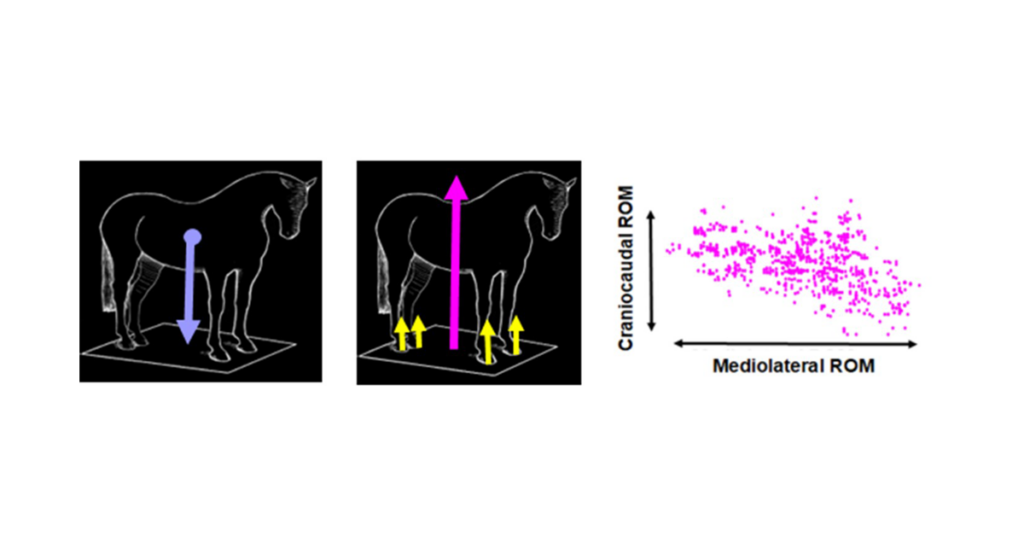
Even when a horse appears to be standing completely still, the CoM is continually moving. Proprioceptors track these movements and, when necessary, change the GRFs to preserve stability. The total GRF summed over all four limbs circles around the CoM and, if it drifts too far, muscular contractions change the GRFs to restore the CoM to its neutral position.
Stabilography is a technique that tracks the successive positions of the point at which the total GRF vector originates. A stabilogram consists of a cloud of data points representing movements of the total force vector over a period of time. Analysis of these movements is a simple and sensitive technique for assessing a horse’s balance and detecting balance deficits.
“Stabilography has clinical applications in detecting neurologic diseases and in distinguishing neurologic cases from subtle lameness,” said Clayton. She showed examples of stabilograms illustrating the huge balance deficits in a wobbler and a horse with vestibular disease. Stabilography also offers a technique to evaluate improvements in stability or balance as a horse progresses through a rehabilitation program.
Effects of the GRFs
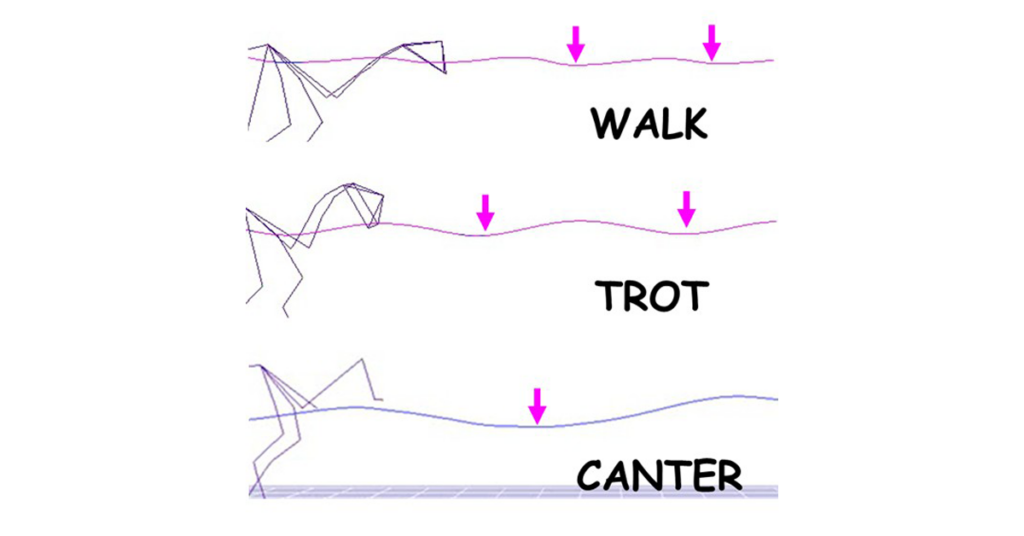
“If the total GRF vector passes through the CoM, it causes linear motion of the body. If it does not pass through the horse’s CoM, then both linear and rotational movement will ensue,” said Clayton. “Rotation around the CoM as seen in the sagittal plane is called pitching. It results in the horse rotating more onto the forehand (downhill) or onto the haunches (uphill).”
Knowledge of these principles is useful in understanding how horses respond to different training techniques. “For example, the forehand may be lightened or elevated by driving the horse forward using propulsion from the hind limbs or by using the forelimbs to push upward,” she relayed.
Future Directions
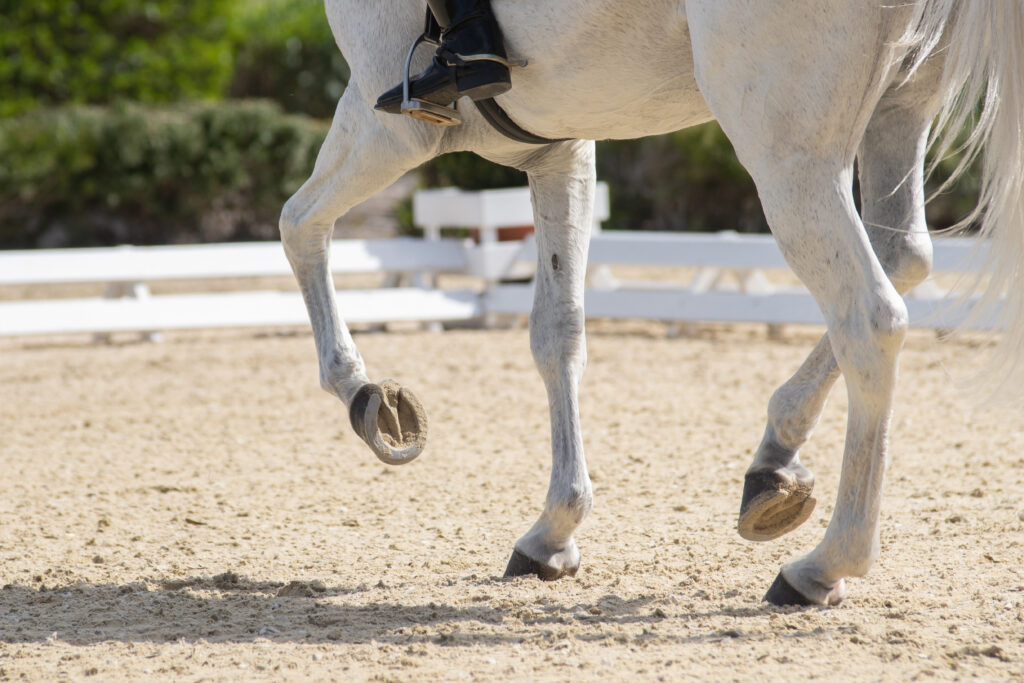
Despite having a fulfilling career and making incredible advances to our understanding of the science of equine movement, lameness, and rehabilitation strategies, Clayton continues to conduct research.
“I am currently working on understanding how dressage horses control their limb compliance in the highly collected gaits and movements,” she said. “I am curious about the mechanisms used to change the elasticity of the soft tissues independently and differently in the forelimbs and the hind limbs to achieve the uphill posture needed for high collection.”
Take, for example, the piaffe. The croup sinks progressively lower from collected trot through passage to the piaffe but, at the same time, the withers are being lifted higher from collected trot to piaffe. The mechanics involve changing the compliance within the limbs and, when we understand how this is achieved, it will offer an opportunity to develop more effective training methods.
Conclusion
Understanding GRFs, and how they affect CoM movements, is key to understanding equine athleticism. For veterinarians, recognition of normal gait patterns and their variations is a prerequisite to evaluating gait deficits due to lameness or neurologic disease. Furthermore, rehabilitation programs should be founded on knowledge of biomechanical principles and their effects.
Sports medicine coverage from the 2025 AAEP Convention is brought to you by Dechra.
Related Reading
- Understanding the Biomechanics of the Horse’s Fetlock Joint
- How to Plan a Ridden Rehabilitation Program for Horses
- Therapeutic Exercises for Horses With Topline Dysfunction
Stay in the know! Sign up for EquiManagement’s FREE weekly newsletters to get the latest equine research, disease alerts, and vet practice updates delivered straight to your inbox.